The story of Burton snowboards is inextricably linked to the evolution of snowboarding itself. Jake Burton Carpenter, the visionary who shaped snowboarding more than any other, started Burton out of his Vermont barn in 1977.
While there are numerous arguments as to who actually created the first snowboard, not many disagree that it was Jake Burton Carpenter who truly developed and pioneered the sport on a national and global level. Starting manufacturing in 1977, Jake and his company merely capitalized on the idea of sliding on snow for entertainment.
We have collected and sold dozens of vintage Burton snowboards over the years. From the vintage Burton Backhill's and Backyards to the vintage Burton Performer's in the mid 1980's we've seen them all. Currently we loan out our collection to educational institutions and museums free of charge. We also have a program for private parties to rent our exhibits. If you are looking to sell you board we are here to help. If you are looking to buy click here.
The Early Days
Many inventors throughout the years have developed versions of the modern day snowboard. In 1926 Howard J. Ferris patented a stand up sled named the Skeeboggan. Others followed in his footsteps and most notably Sherman Poppen patented the Snurfer in 1965. He later partnered with Brunswick (yes the bowling company) to market his product.
They decided to distribute the Snurfers to thousands of hardware stores throughout the country. While Sherm sold over half a million Snurfers, he never fully realized the Snurfer's true potential. Had Brunswick distributed Snurfers to sporting goods stores, who knows how snowboarding history would be written.
Read also: Stretch Slim Jacket Performance
Believe it or not the Harvard business school used Sherm's Snurfer misfortune to teach what not to do. It is said Jake Burton Carpenter was inspired by the Snurfers he rode as a teenager. Like many innovators Jake never seemed satisfied; always trying to improve on his designs.
All through high school and college he tinkered with his inventions and finally after quitting his job at a Manhattan investment bank in 1977, he got a break that ultimately founded Burton Snowboards; an inheritance from his grandmother of $20,000. As for the reasons he quit..."I wasn't loving it," he recalled "But I got to talk to the entrepreneurs whose businesses we were selling. I was amazed that they didn't intimidate me.
Jake, now 23 years old, with his degree in economics and his newly acquired bank roll, moved to Stratton Mountain, Vermont to work nights as a bartender and days on his snowboards. 100+ designs were created from wood and various laminated materials before he settled on a marketable product. Only problem, it was now summer and no one wanted to buy. Jake's perseverance is what saved his dream of not only creating a truly superior product, but also inventing the sport in the first place.
To grow the sport, Carpenter began knocking on Vermont ski resorts’ doors and eventually convinced them to let in his ragtag crew of snowboarders. (Stratton Mountain would host the U.S. Open of Snowboarding at Stratton for 27 years.) He noted that snowboarders were “always held to a higher standard.
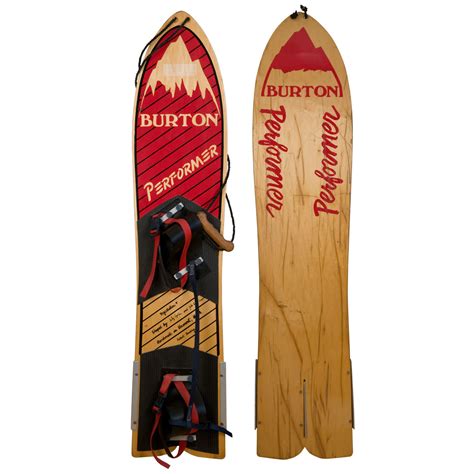
A selection of vintage Burton snowboards.
Read also: Choosing the Right Snowboard
Vintage Burton Snowboard Catalog c. 1980's and Beyond
Jake limped along throughout the 1979-80 winter season with just over 700 boards sold. Although this was double his previous years sales, he was still operating in the red in 1981 with financial losses adding up to $130,000. Jake was not alone in his struggles to grow the sport and he along with others finally pushed the envelope with advances in technology that spurred the soon to be, fastest growing sport in the country.
By 1984 Jake with his newly developed metal edge snowboards broke $1,000,000 in sales finally realizing the profit he deserved. It is noted to vintage Burton snowboard collectors that Jake changed his name in 1984 from Jake Burton Carpenter to simply Jake Burton to avoid confusion.
Jake's momentum increased yet again with the opening of a manufacturing plant in Innsbruck Austria in 1985. From there on out sales rose on an exponential level realizing over 100,000 snowboarders by 1987.
Burton raced competitors like Sims-as well as hungry ski brands eyeing the snowboarding market-to produce the best gear possible. Technical innovations followed over the years-wooden boards were replaced by P-Tex and metal, straight edges became curved, water-ski straps turned into real bindings with the first highbacks. Simultaneously, Burton softgoods exploded.
Read also: Staying Warm & Dry with Burton Gore-Tex
While splitboarding never represented more than a niche market for a mega-brand like Burton, products like the Editor’s Choice-winning Flight Attendant X split, the Hitchhiker binding and Tourist boot have been consequential in on our backcountry world.
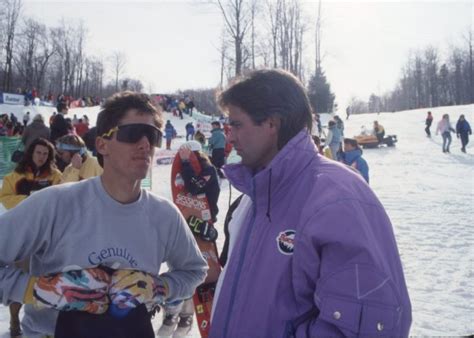
Jake Burton and Craig Kelly in the 80s.
Burton certainly grew into a behemoth of a brand, one that many snowboarders love to hate-complaining that it’s too big, it’s too corporate and without soul. In that Snowboarder interview, however, Pat Bridges asks us to imagine the sport’s development without Burton, wondering, “Where would snowboarding be today?” What if Burton hadn’t been the brand to seize the market? What if it had been a ski brand, or, worse, a stockholder-beholden corporation like Nike?
Burton may have blown up and become a massive, profitable business, but at the end of the day, Carpenter was there, involved, guiding the direction, whether it was from his office or hospital bed. He did his best to sell out boards without selling out the sport he loved.
Most impressive, at least to me, are not Carpenter’s business accomplishments, but the personal battles he fought. Not only did he fight cancer, but he dealt with heart surgery, a knee replacement and was paralyzed by a rare nerve disease. Both Carpenter and Donna marveled at the support they received from the Burton family and the snowboard community at large. Both of which, of course, Carpenter was integral in building.
Jake Burton slashes a turn through the corn in the late 1970s. board was a Burton. that I got from my older brother in fifth grade. and beautiful. remember I found amusing and a little bit creepy. and trips to Tahoe were fewer than I’d like. that so many of us share, passed away on Wednesday night. cancer. their three sons, Timi, George and Taylor.
Simultaneously, Burton softgoods exploded. by the people that pushed the sport. partnered up with legendary freerider Craig Kelly. White, Kelly Clark, Anna Gasser, Mark McMorris, Danny Davis and Kevin Pearce. there are the OGs, like Jeff Brushie, Mikey Rencz and Nicolas Muller. Jake Burton digs in to the ’80s . Now, many of these riders have taken to social media to pay their respects to the late maverick.
On Instagram, Shaun White called Carpenter “the father of snowboarding,” and went on to say “Jake helped pave the way for snowboarders across the world to pursue their dreams, and his impact on snowboarding will live on in all of us.” Kevin Pearce penned, “Jake, you were an inspiration to all, and made a large impact on me. You helped to carve a path through this crazy life that has allowed me to be where I am today.
His contributions to our sport will continue to reverberate. Olympic broadcasts and trade-show floors. from under their beds, stare at them and dream.
A Day For Jake - A Tribute to Jake Burton Carpenter | Minnesota
| Year | Event | Significance |
|---|---|---|
| 1977 | Jake Burton starts Burton Snowboards | Marks the beginning of Burton's journey in snowboarding. |
| 1984 | Burton's sales exceed $1,000,000 | A major financial milestone for the company. |
| 1985 | Opening of manufacturing plant in Austria | Expands Burton's production and reach in Europe. |
| 1987 | Over 100,000 snowboarders | Reflects the growing popularity of snowboarding and Burton's influence. |