In the early 2000s, snowboards all featured a traditional cambered design. But then a technology called rocker came along and it forever changed snowboard construction. Its popularity has generated lots and lots of rocker variations aimed at improving riding performance on just about any terrain or type of snow.
What exactly are camber and rocker? Camber and rocker describe the curve of a snowboard when you look at them from the side. Snowboards with camber have midsections that arch off the snow slightly when unweighted, while snowboards with rocker have midsections that rest on the snow and tips and tails that curve up.
For years, snowboards used cambered designs exclusively, and camber is still a popular choice. When placed on a flat surface, a cambered board has an uplifted waist (midsection) while the contact points rest on the ground near the tail and tip/nose. The area where the board arcs upward by a few millimeters is known as camber.
When a rider applies body weight and presses into the board, the camber flattens, creating continuous edge contact with the snow. Camber puts springiness (or pop) into snowboards and gives boarders good edge control while carving turns.
Benefits of camber:
Read also: Protect Your Face: The Ultimate Snowboard Helmet Guide
- Control at high speeds: Racers use cambered boards for the precision and security they provide at high speeds.
- Grip on hard snow: The continuous edge contact provided by camber creates good edge hold on hard snow, such as the groomed slopes of a resort.
- Stability while turning: The good edge hold that camber provides creates a stable feel while turning.
What is Rocker? Rocker is essentially the opposite of camber: It's a balanced, continuous arc that curves up from the center of the board, a shape that resembles the floor rails of a vintage rocking chair (hence the term "rocker"). A board's contact space is directly below the rider, located close to the feet. In some circles you'll hear rocker referred to as reverse camber, negative camber or alternate camber.
Rocker offers snowboarders several advantages:
- Improved flotation in powder: The early-rising nose and tail on a snowboard help riders stay on top of soft snow.
- Greater maneuverability: Fully rockered boards that are made to stay afloat have a shorter effective edge. Less edge contact with the snow permits easier, more nimble turning.
- Enhanced park experience: Without all the spring that comes with camber, it is often easier to slide rails on a rockered snowboard. The risk of catching edges is reduced as well. Rockered boards are nice for riding switch, too.
Benefits of rocker: Rocker provides superb flotation in soft snow and easy turn initiation.
Shape and profile: The most obvious difference between rocker and camber snowboards is their shape. Camber features an upward arc underfoot, with contact points near the tip and tail. In contrast, rocker has an upward arc between the bindings with contact points closer to the center.
Flex: Camber snowboards typically have a stiffer and more responsive flex pattern. Rocker boards tend to have a softer and more forgiving flex.
Read also: Using Full Face Goggles
Performance: Camber offers precise edge control, stability at high speeds and pop for jumps.
Recent advancements in camber technology have revolutionized the design and performance of snowboards, catering to a wider range of riding styles and preferences.
The camber profile of a snowboard determines the contact points with the snow, significantly influencing how the board handles various conditions.
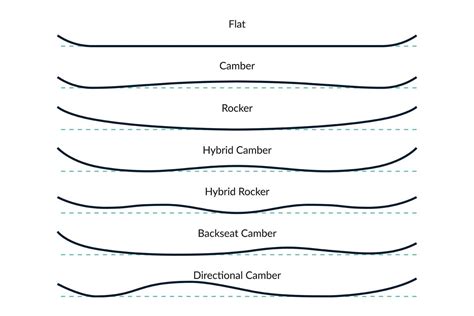
Snowboard Camber Profiles
The main types of snowboard camber profiles include Traditional Camber, Reverse Camber (Rocker), Flat Camber, and Hybrid Camber. Understanding these profiles aids in selecting a snowboard that matches your ability and style.
Read also: Benefits of Positive Camber Boards
Traditional camber is the original design in snowboarding, characterized by an upward curve in the board’s center. The process of de-cambering the board (flattening out the profile arc (camber) with the rider’s weight during a turn) loads the board with energy the rider can then “release” to initiate and “snap” into the next turn. However, this profile can be challenging for novice riders as it makes it easier to catch an edge.
Reverse camber, also known as rocker, features contact points that are positioned inward, facilitating easy turn initiation. However, one downside of rocker snowboards is that they can become squirrely at higher speeds due to reduced effective edge. It can also be a challenge when conditions are icy to initiate edge control.
Flat camber, characterized by being flat between contact points, offers a balance between stability and playfulness. However, flat camber designs can be prone to catching an edge and may be slower than other profiles.
Hybrid camber profiles are blended designs that combine elements of traditional camber, reverse camber, and flat camber, allowing for versatile performance across different riding styles. These profiles enhance stability, pop, speed, and edge-hold, suitable for various conditions.
Hybrid Camber Snowboards Beyond pure traditional camber, there are hybrid camber profiles. While the dominant profile between the rider’s feet remains cambered, these blended profiles try to incorporate some of the advantages of rocker and flat profiles towards the nose and tail of the board. Camber with rocker produces a more forgiving ride by lifting the board’s contact points off the snow. The rocker also offers better float in powder. Camber mixed with a flat profile will also be less “catchy” than traditional camber. They may not float quite as well in powder as a camber/rocker hybrid, but they retain more of the lively “pop” of camber for a playful ride that’s popular with freestyle-minded riders.
Rocker hybrid profiles offer the quick, easy turn initiation of rocker but, like camber hybrids seek to also incorporate some of the benefits of camber and flat profiles into the same board. A rocker/camber hybrid typically incorporates rocker between the feet with cambered sections extending from under the rider’s feet towards the board’s contact points to bring back some of the energy and stability that’s lost in pure rocker boards. Likewise, instead of camber, some rockered hybrids incorporate flatter profiles extending out from the centered rocker section toward the nose and tail. While lacking some of the energy and stability of the rocker/camber hybrids, a rocker/flat hybrid will retain more of the catch-free playfulness of a rocker board.
Flat with cambered sections toward the nose and tail gives a more camber-like, stable ride at speed but the flatter, typically softer section between the feet makes edge to edge transitions easier. Flat with Rocker on the other hand provides a bit more effective edge than pure Rocker so you get a little more stability at speed while retaining the catch-free, super-float ride quality that Rocker fans love.
The camber profile of a snowboard significantly influences its performance characteristics, including stability, edge hold, playfulness, and powder performance.
Camber profiles influence performance aspects like stability and edge control. A camber snowboard is designed for continuous edge contact, enhancing speed control and grip on hard surfaces. Profiles like the Flat Out Camber offer stability and pop, making them ideal for diverse terrain.
Playfulness in snowboards refers to the ability to maneuver easily and perform tricks with greater ease. Flat camber profiles balance stability and playfulness, suiting various terrains. Reverse camber provides a more playful ride, enhancing turn initiation and floatation in powder.
Snowboards with hybrid camber profiles can also improve powder performance by providing a balance of stability and flotation.
Choosing the right camber profile can significantly enhance your riding experience by aligning it with your personal style and preferences.
Personalizing your snowboard setup can enhance comfort and performance by aligning it with your unique riding preferences.
Flat camber profiles are particularly beneficial for newbies and freestyle riders, offering a stable ride and forgiving nature. The Hybrid Rocker profile provides a looser feel that can help beginner riders.
Riders favor traditional camber profiles for their ability to provide powerful pop and smooth landings during jumps. Profiles like the Rock Out Camber help freestyle riders achieve better stability and response while allowing for easy presses.
All-mountain riders may prefer camber + rocker profiles, which offer a combination of grip and float, allowing for performance in diverse conditions.
Camber profiles can affect a snowboard’s ability to float in deep snow conditions. Snowboards with a reverse camber design typically offer enhanced buoyancy and smoother transitions in powder conditions.
Snowboard camber types have gained popularity recently as riders recognize their impact on performance. The earliest snowboards featured a simple camber design, primarily influenced by surfboard shapes.
This early camber played a significant role in shaping the performance and feel of snowboards, greatly impacting the sport.
Personalizing your snowboard experience is essential to enhance performance and enjoyment on the slopes. Experimenting with different camber profiles and customizing your setup helps find the perfect fit for your style and preferences.
Snowboard camber profiles are essential in determining how a board performs and feels during a ride. Traditional camber offers stability, pop, and edge control, while reverse camber provides easy turn initiation and a playful ride.
Flat camber profiles balance stability and playfulness, making them versatile for different riding styles. Customizing board setup can significantly enhance performance and comfort by tailoring elements like flex and binding placement to the selected camber profile.
The placement and angles of your bindings are crucial for optimizing your snowboard’s performance in relation to your camber profile.
Rocker excels in deep snow and trees, enhancing float and maneuverability. The upward arc between the bindings allows the board to plane on top of the snow, reducing leg fatigue and providing a surfy feel. In tight tree lines and technical terrain, rocker's quick turning capabilities and forgiving nature come in handy.
Hybrid profiles adapt to a range of conditions, providing a balance for performance across deep snow, groomers or parks.
For beginners, rocker snowboards are more forgiving and easier to learn due to their catch-free nature and seamless turn initiation. The upward arc between the bindings reduces the likelihood of catching an edge, making the learning process less daunting.
If you're an intermediate rider, you can progress with either camber or rocker, depending on your preferred riding style. Advanced riders often appreciate the power and precision of camber for aggressive riding and technical maneuvers. They may also enjoy the challenge and responsiveness of camber boards in demanding terrain.
Consider what feels best underfoot and aligns with your riding aspirations. Some riders prefer the lively and responsive feel of camber, while others enjoy rocker's loose and surfy sensation. If you have specific goals, such as improving your freestyle skills or tackling steep terrain, let those objectives guide your decision.
Trying different profiles is the best way to determine which suits you best. Many ski shops offer demo days or rental programs, allowing you to try various boards and profiles. Take advantage of these opportunities to see how each profile performs and responds to your riding style.
Understanding the differences between camber and rocker snowboards is essential to finding your perfect board.
Picking the right camber profile can seem like a daunting task, but when it comes to choosing your board there is no "good" or "bad" profile. The most important thing to keep in mind is that each type will relate to different riding styles and snow conditions.
With a variety of camber profiles on the market today, we think it is important to recognize and keep in mind the three basic profile classes: camber, rocker, and flat when making your decision.
A snowboards flex and how it will handle and perform is directly related to the camber profile it features.
Outlined below are the three basic snowboard camber profile classes, along with hybrid variations that blend multiple camber profiles together for versatility in a variety of snow conditions.
Snowboard flex refers to the board’s torsional and lateral bend under pressure. A “softer” flex requires less pressure to initiate and hold the bend while a “stiff” board requires greater force. Unfortunately, there is no standardized flex rating system for snowboards.
The majority of snowboard manufacturers use a 1-10 flex rating system (1=super soft, 10=very stiff) while others will use a proprietary system to convey the same message. We think it’s most helpful to break flex down into three classes: soft, medium, and stiff.