The sport of ice hockey is believed to have evolved from simple stick and ball games played in Britain, Ireland, and elsewhere in the 18th and 19th centuries. Games such as polo are known to have taken place in the pre-Christian era in Persia. In Europe, these games included the Irish game of hurling, the closely related Scottish game of shinty and versions of field hockey (including bandy ball, played in England).
The origin of ice hockey was bandy, a game that has its roots in the Middle Ages. Just as for practically all other sports, the game of bandy achieved its modern form during the 19th century in England, more exactly in the Fen district on the East coast.
Early 19th-century paintings depict shinny, an early form of hockey with no standard rules which was played in Nova Scotia. Many of these early games absorbed the physical aggression of what the Onondaga called dehuntshigwa'es (lacrosse). Shinny was played on the St. Lawrence River at Montreal and Quebec City, and in Kingston and Ottawa. The number of players was often large.
The city of Montreal, Quebec, Canada, became the center of the development of contemporary ice hockey, and is recognized as the birthplace of organized ice hockey. On March 3, 1875, the first organized indoor game was played at Montreal's Victoria Skating Rink between two nine-player teams, including James Creighton and several McGill University students.
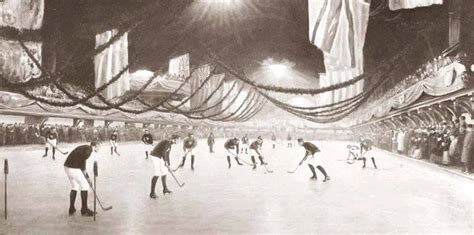
First organized indoor hockey game at Montreal's Victoria Skating Rink, March 3, 1875.
Read also: Remembering Team North America
In 1876, games played in Montreal were "conducted under the 'Hockey Association' rules"; the Hockey Association was England's field hockey organization. The number of teams grew, enough to hold the first "world championship" of ice hockey at Montreal's annual Winter Carnival in 1883. The McGill team won the tournament and was awarded the Carnival Cup.
In 1888, the Governor General of Canada, The Lord Stanley of Preston, first attended the Montreal Winter Carnival tournament and was impressed with the game. His sons and his daughter, Isobel Stanley, were hockey enthusiasts. In 1892, realizing that there was no recognition for the best team in Canada, he purchased a silver bowl for use as a trophy. The three-foot-high silver cup became known as the Stanley Cup and was first awarded in 1892-93.
By 1893, there were almost a hundred teams in Montreal alone; in addition, there were leagues throughout Canada. Winnipeg hockey players used cricket pads to better protect the goaltender's legs; they also introduced the "scoop" shot, or what is now known as the wrist shot. William Fairbrother, from Ontario, Canada, is credited with inventing the ice hockey net in the 1890s. Goal nets became a standard feature of the Canadian Amateur Hockey League in 1900.
The Spread to the United States
The sport migrated south to the United States during the 1890s, and games are known to have taken place there between Johns Hopkins and Yale Universities in 1895. American financier Malcolm Greene Chace is credited with being the father of hockey in the United States. In 1892, Chace put together a team of men from Yale, Brown, and Harvard, and toured across Canada as captain of this team.
In 1896, the first ice hockey league in the US was formed. The US Amateur Hockey League was founded in New York City, shortly after the opening of the artificial-ice St. By 1898 the following leagues had already formed: the Amateur Hockey League of New York, the Amateur Hockey Association of Canada, and the Ontario Hockey Association.
Read also: Features of Custom Hockey Gloves
Early Professional Leagues
The first acknowledged professional hockey team in the world was formed in the United States, in 1903, in Houghton, Michigan. The team, the Portage Lakers, was owned by a dentist named J.L. Gibson, who imported Canadian players. In 1904 Gibson formed the first acknowledged professional league, the International Pro Hockey League.
Logos of National Hockey League teams.
The Ligue Internationale de Hockey sur Glace was founded in 1908 to govern international competition, and the first European championship was won by Great Britain in 1910. The sport grew further in Europe in the 1920s, after ice hockey became an Olympic sport.
Formation of the National Hockey League (NHL)
The National Hockey League was organized on November 26, 1917, in Montréal following the suspension of operations by the National Hockey Association of Canada Limited (NHA). The Montréal Canadiens, Montreal Wanderers, Ottawa Senators and Quebec Bulldogs attended the founding meeting. The Toronto Arenas later were admitted as a fifth team; Quebec decided not to operate during the first season and its players were allocated to the remaining four teams.
The NHL expanded to the United States for the first time, with the Boston Bruins making their League debut in 1925-26. The NHL doubled in size in 1967-68 with six new teams: the California Seals, Los Angeles Kings, Minnesota North Stars, Philadelphia Flyers, Pittsburgh Penguins and St. Louis Blues. Having started the decade with 12 teams, the NHL concluded the 1970s with 21.
Read also: The story of Craig Needham
The NHL again dramatically expanded its footprint across North America. The San Jose Sharks became the NHL's 22nd team in 1991-92 and the decade ended with a four-team expansion over three seasons that increased League membership to 30 teams in 2000-01.
The NHL's first regular-season outdoor game, on November 22, 2003, attracted a sellout of 57,167 to Edmonton's Commonwealth Stadium. Four years later, 71,217 fans filled Buffalo's Ralph Wilson Stadium on January 1, 2008, for the inaugural Winter Classic, the League's first outdoor game in the United States.
The American Hockey League (AHL)
International League teams in Cleveland, Syracuse, Pittsburgh and Buffalo play in the Western Division, and Can-Am League teams in Springfield, Providence, New Haven and Philadelphia play in the Eastern Division. On June 28, 1938, the two founding leagues officially dissolve and the merger is completed, with Podoloff being elected the first President of the IAHL and Chick being named vice president.
The Cleveland Barons win the Calder Cup in 1938-39, and the league adds a ninth team the following year when the Indianapolis Capitals are granted membership. The IAHL drops the word “International” from its name before the 1940-41 season, officially becoming the American Hockey League.
The Buffalo Bisons return to play when the Buffalo Memorial Auditorium (“The Aud”) opens. In February 1942, the AHL holds an All-Star Game to raise funds for the war efforts in the United States and Canada. The St. Louis Flyers join the AHL in 1944 and draw 13,384 fans for their inaugural game, setting a league record. Cleveland and Pittsburgh play what is still the highest-scoring game in AHL history, a 12-10 Barons win on March 17, 1945.
Cleveland and Buffalo dominate the 1940’s with each winning three Calder Cup championships. A young Johnny Bower leads the Cleveland Barons to the 1951 Calder Cup. Head coach King Clancy, 30-goal scorer George Armstrong and star defensemen Tim Horton and Frank Mathers help the Pittsburgh Hornets to the Calder Cup in 1952.
The Rochester Americans join the league in 1956-57 and promptly go to the Calder Cup Finals before losing to Cleveland. The Springfield Indians open the 60’s by winning three straight Calder Cups and star center Bill Sweeney wins three straight AHL scoring titles, two feats that have yet to be duplicated.
The AHL and the Western Hockey League play an interlocking schedule in 1965-66, with each AHL club playing a home-and-home set against the WHL’s six teams (Los Angeles, Portland, San Francisco, Seattle, Vancouver, Victoria). The AHL and WHL face each other again in regular-season play, but the two leagues do not merge and continue to operate independently.
AHL teams begin a tradition of hosting exhibitions against clubs from the Soviet Union in 1977-78, as Dynamo Moscow visits six league arenas. With the Winter Olympics about to take place up the road in Lake Placid during the 1979-80 season, the Adirondack Red Wings host exhibitions against the national teams from the United States, West Germany, Sweden and Finland.
The AHL institutes a shootout to break ties in 1986-87. On December 5, 1987, Rochester’s Darcy Wakaluk becomes the first AHL goalie ever to score a goal. The AHL drops the shootout in favor of awarding a point for an overtime loss in 1987-88. The 1988-89 Sherbrooke Canadiens help rewrite the league’s scoring records, thanks to rookie Stephan Lebeau - who posts 134 points and 70 goals - and Benoit Brunet, who sets a rookie record with 76 assists.
The AHL adopts roster rules prior to the 1994-95 season that put a sharper focus on its role as the top development league for the NHL. The AHL All-Star Game - the first such event in 35 years - is played in front of a sell-out crowd at the Providence Civic Center and is broadcast across North America on ESPN2, TSN and RDS.
For the league’s 60th anniversary in 1995-96, the AHL adds teams in Baltimore and Greensboro, N.C., and is realigned into four divisions and two conferences for the first time. Teams receive a point for an overtime loss, a policy later adopted by the NHL. The All-Star Classic is held in Hershey as the league adds a Skills Competition to the All-Star Game.
Under rookie head coach Peter Laviolette, the Providence Bruins master an incredible 70-point turnaround, winning 56 games in the regular season and capturing the Calder Cup just one season removed from a 19-54-7 outing.
The 2001-02 season is one of the most memorable in league history for a wide range of reasons. The year begins on a tragic note, as AHL alumni Ace Bailey and Mark Bavis are among the victims of the 9/11 terrorist attacks in New York City.
The NHL’s lockout of 2004-05 provides the AHL with some of its brightest young talent ever. Jason Spezza rolls to the scoring championship racking up 117 points for Binghamton, while Rochester’s Ryan Miller becomes the AHL’s first 40-game winner in four decades. The shootout is re-introduced to decide a winner of games tied after overtime. And the league experiences its largest numbers ever at the gate, with more than 7.1 million fans attending games throughout North America, including several contests in NHL arenas.
The AHL Hall of Fame is created, with Johnny Bower, Jack Butterfield, Jody Gage, Fred Glover, Willie Marshall, Frank Mathers and Eddie Shore inducted as the inaugural class.
The first-ever outdoor game in AHL history highlights the 2009-10 season, as the Syracuse Crunch draw a league-record 21,508 fans to the New York State Fairgrounds for a meeting with the Binghamton Senators. The AHL reaches 30 active teams for the first time in 2010-11.
North American Hockey League (NAHL)
Celebrating its 51st season in 2025-26, the North American Hockey League (NAHL) is the oldest and one of the largest USA Hockey-sanctioned junior circuits with 34 teams representing some of the nation's emerging hockey markets, as well as, traditional hot beds in 19 states. It is one of the only two leagues in the United States that implements the free-to-play model.
In its halcyon days of the mid to late 1970s, the then Great Lakes Junior Hockey League survived as a rugged five-team Michigan-Ohio circuit with the Paddock Pools Saints and Detroit Jr. The Paddock Pools Saint, formerly owned by Chuck Robertson, set the tone for excellence, capturing seven consecutive titles from 1977 to 1984 while sending a flurry of players to the collegiate and pro ranks. The NAHL recognized the league patriarch by naming the playoff championship trophy, the Robertson Cup, in his honor.
By the mid-1990s, the NAHL blossomed into two divisions with 10 clubs across the Upper Midwest. During this time, the Compuware Ambassadors emerged as a junior powerhouse, winning eight of 10 NAHL titles from 1986 to 1995. Compuware's decade-long dominance was only interrupted by the Kalamazoo K-Wings, who won NAHL titles in 1991 and 1993, and the Springfield Jr. Blues, who won back-to-back championships in 1996 and 1997.
The league's long-held reputation as a fertile ground for collegiate prospects was confirmed when league luminaries Kip Miller (Compuware Ambassadors) of Michigan State and Brian Holzinger (Detroit Jr. Wings) of Bowling Green captured the Hobey Baker Memorial Award in 1990 and 1995 respectively. Michigan State's Ryan Miller (Soo Indians) received NCAA Ice Hockey's highest honor in 2001.
By the mid-1990s, several NAHL alums were making a profound impact in the National Hockey League (NHL) as Philadelphia Flyer Eric Lindros (Compuware Ambassadors) and Edmonton Oilers duo Doug Weight (Bloomfield Jets) and Todd Marchant (Niagara Scenics) were stars for their respective teams. While Brian Rolston (Compuware Ambassadors), Danton Cole (Detroit Jr. The ranks of NAHL-pedigreed players in the NHL continued to swell.
Geographically, the NAHL's footprint reached beyond the Upper Midwest for the first time with the addition of the Texas Tornado in 1999. The 2003 merger with the Rocky Mountain-based American West Hockey League (AWHL) turned into a watershed moment as the NAHL grew from 11 teams to 21 while becoming the largest junior circuit in the country. The addition of the Fairbanks Ice Dogs extended the NAHL's reach into the nation's 49th state.
In the 2010-2011 season, the league grew to 28 teams with the addition of the Wenatchee Wild in Washington state, as well as into California with the Fresno Monsters. In the last 15 years, the league has continued its growth, while also maintaining a focus on sustainability.
The NAHL has also strengthened its presence in the Eastern portion of the United States. The Johnstown Tomahawks revitalized a historic hockey community in Johnstown, Pennsylvania, and kicked off the NAHL movement eastward. Additional expansion and growth in the East emerged with nine new teams in the past decade and now becoming the largest division with ten teams.
Players receive further exposure through live Webcasts of NAHL games presented by NAHLTV. Also, through comprehensive statistics and timely game reports, NAHL.com promotes the teams' and players' on-ice achievements. Off the ice, the league's emphasis on scholarship and personal growth is seen through academic support and warm experiences gained by billet programs in which players stay with host families.