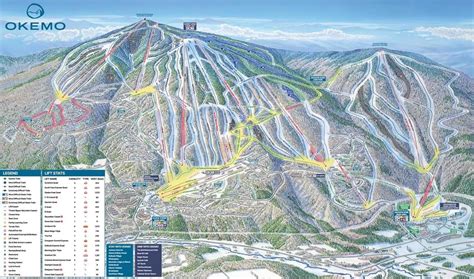
The town of Ludlow, Vermont, and its surrounding area boast a rich history dating back to its charter in 1792. Ludlow was named after Ludlow, Massachusetts, and chartered in 1792. Since the transformation of a community-run ski hill to the launch of Okemo Mountain Resort and a small ski area empire, here are some of the high points in Ludlow’s ever-evolving history.
According to the History of Windsor County, the first grand list of the town taken in 1792 aggregated £540. In 1789, there were 66 poll taxes paid. There were under cultivation 290 acres of land. There were 42 horses and 17 colts, 29 pairs of oxen, 142 cows over three years of age, and 49 young cattle.
In the early 1800s, Consul to Portugal, introduced a Spanish “Merino” breed of sheep to Vermont. Spain, which had been refusing to export the sheep, relented as Napoleon Bonaparte invaded the country. Jarvis, who settled in Weathersfield, VT. In the 1830s, there were, by many estimates close to 1.5 million Merino sheep in Vermont, outnumbering humans nearly 6 to 1. Much of the land had been clearcut and sheep grazed on the rocky soil, penned in by “stone fences” - stone walls that were formed as farmers cleared the landscape.
In the 1940s Ludlow’s woolen mill shipped 10,000 wool blankets to the Queen Mary, which had been converted to carry troops during World War II.
Calvin Coolidge, the 30th president of the United States, was born just 10 miles north of Ludlow in Plymouth Notch, in 1872. A fifth-generation Vermonter, Coolidge grew up on land his family had cleared in the area during the American Revolution. His grandfather owned a general store and his father served in the Vermont House and Senate. Coolidge went to Black River High School in Ludlow and then on to St. Johnsbury Academy and then Amherst College. He became governor of Massachusetts in 1918.
Read also: Is the Ride Jackson Boot Right for You?
Vice-President Coolidge was at the family farmhouse in Plymouth when he learned of President William Harding’s death in 1923. The house didn’t have a working phone, so news was relayed from the store across the street. Coolidge was later elected president in 1924 and his “summer White House” was in the dance hall above his family’s store in Plymouth. You can visit the Coolidge homestead, state park and historical site in Plymouth Notch, which is managed by Vermont State Parks.
The first ski lift in America went in just north of Okemo, in Woodstock, VT, in January 1934. Wallace “Bunny” Bertram, a former captain of the Dartmouth Ski Team put a rope tow up a hill on a Clinton Gilbert’s farm off Route 12. Bertram later moved his operation to the other side of the ridgeline, to Hill #6, later known as Suicide. Bertram sold the ski area to Laurance Rockefeller in 1961. The ski area is still owned by the Woodstock Foundation which was established by Mary Rockefeller in 1968.
In 1935, the state of Vermont bought 4,000 acres of timber land for $9,250 and created the Okemo State Forest. The Civilian Conservation Corps went to work building trails, including a 1.75-mile trail on the Healdsville side of Ludlow Mountain.
It wasn’t until 1955 that plans took hold to build a ski area on Ludlow Mountain. The Okemo Ski Area opened in January 1956 after an 11-inch snowstorm.
The Mueller Era Begins
In 1982, a young couple named Tim and Diane Mueller bought Okemo Mountain Resort after seeing a master plan for development. Over the next 20 years, they invested more than $100 million and added more than 70 new trails, one of the most extensive snowmaking systems in the East, three base villages and a championship 18-hole golf course.
Read also: Staying Warm & Dry with Burton Gore-Tex
Community-run ski hill Okemo was created as a community-run ski hill by a small group of local businessmen who envisioned great alpine ski area potential. The area grew with the introduction of surface lifts and new trails. The mid-1960s saw the arrival of the area’s first overhead lift, the Sachem Double and snowmaking was installed on 12 acres of lower-mountain slopes. With the growing popularity of the sport, a five-year plan for Okemo included a new base lodge, expanded parking, a summit chairlift and added snowmaking.
The early 1970s delivered challenges with a national economic recession that included gasoline shortages, compelling Okemo to install a 10,000-gallon tank which allowed the mountain to guarantee enough gas for skiing guests to return home. Capital improvement projects waned and Okemo investors grew anxious.
A small group of stockholders calling themselves Friends of Okemo, garnered support to replace the board and prepared for a $600,000 snowmaking upgrade, the largest in the country at the time. Sno-Engineering co-founder and ski authority Sel Hannah helped draw up a new master plan. The years of 1977 and 1978 saw a record season for Okemo with 176,000 skier visits. Summer maintenance work on lifts, trails, snowmaking and other improvements totaled over $100,000. Eight new townhouses were built.
Improvements continued and in 1979, the board approved a new chairlift for the next season, replacing the Red Poma, the longest surface lift in North America.
An unprecedented snow drought in 1980 witnessed a statewide drop in skier visits. With limited snowmaking, the upper mountain was skiable only five days during that season. The mountain suffered a net loss of $340,000 and the planned chairlift was shelved. Warm weather and rain resulted in another snow drought the following year and the mountain reported its third greatest loss - $271,000.
Read also: Top-Rated Ski Gloves & Mittens
As the 1981-82 season approached, Okemo was $1.4 million in debt and the bank pulled Okemo’s line of credit. The board agreed, for the sake of the ski area, to find a buyer. A local attorney knew of a young couple looking for a business opportunity in southern Vermont. Tim and Diane Mueller were searching for an investment in the tourism and recreation industry - possibly an inn. When they realized its potential, the Muellers purchased the ski resort that they viewed as a diamond in the rough.
“In 1982 we were new to the ski business, but not the sport,” said Okemo Co-owner and Vice President Diane Mueller. “We realized our focus had to be on providing a high quality ski experience for our guests, so we began to invest heavily in snowmaking - and do to this day. As a result of what our skilled team does out on the mountain, skier visits have gone from less than 100,000 to over 600,000 per year.”
With the Muellers at the helm, plans to expand took shape. The word spread throughout New England and brought an additional 55,000 skier visits to the mountain during the 1983-84 season. Skier visits totaling 224,000 set a new record in 1986.
The remainder of the decade witnessed more trails, lifts, snowmaking and real estate development. Okemo’s first “from scratch” mountain expansion took form in the development of Solitude Peak. A 5,000-foot quad chairlift serving eight new trails on 225 acres brought the resort’s trail count to 68. Snowboarders were welcomed to the resort, initially on limited terrain with certification from Stratton or Magic Mountain.
A $1.5 million investment in snowmaking improved the compressed air system and utilized the Black River as a new water source, increasing Okemo’s snowmaking capabilities significantly. Some 25,000 feet of new snowmaking pipeline was installed and raised the overall coverage to 90 percent of Okemo’s skiable terrain.
Improvements continued through the 1990s and into the new millennium. Vermont’s first halfpipe, the longest in the East, debuted along with several terrain parks. The Summit Lodge and cafeteria opened. Seven new trails made up South Face, an expansion offering southern exposure on challenging terrain. Okemo constructed a 70-million gallon pond for snowmaking water storage.
In 1995, when only 100 inches of natural snowfall was recorded and areas across Vermont reported declines of 10 to 20 percent, Okemo experienced another record year with 480,000 skier visits - a testament to its commitment to snowmaking and grooming.
The Birth of Jackson Gore
With a fairly cramped main base area, Okemo looked to build a second access point. As such, plans were made to expand northward into an area to be known as Jackson Gore. After nearly half a decade of planning, permit, and appeals processes, Okemo broke ground on Jackson Gore in 2001, and opened the first portion of the area for the 2002-2003 season.
The 2000s saw an entirely new base area with the Jackson Gore Inn, resort amenities, two additional buildings of slopeside accommodations, two high-speed lifts and 19 new trails. Okemo’s snowmaking reservoir was increased to 155-million gallons.
7 new trails over 1,260 vertical feet were opened, serviced by a new 4,381 foot long Leitner-Poma high speed detachable quad named Jackson Gore Express. The new base area opened for the 2003-2004 season with some new beginner trails, two surface lifts, and a 2,530 foot long by 390 vertical foot Leitner-Poma high speed quad (Coleman Brook Express).
In a much-anticipated decision, on November 4, 2002, the Vermont Supreme Court has ruled in favor of Okemo’s Jackson Goreproject and has denied an appeal opposing the first phase of the planned unit development. The decision resolves any remaining legal issuesregarding Phase I of the Jackson Gore project. Since commencing the permit process for the Jackson Gore expansion four years ago, Okemo Mountain officials have sought the proper stateand local approvals to embark on the most exciting expansion plan in Okemo’s history.
In April of 2002, the Vermont State Environmental Boardgave Okemo “the green light to begin the $100 million project that would include new lifts and trails, the Jackson Gore Inn, a base lodge facility and skier services and amenities.
“Receiving the Supreme Court’s decision is wonderful news, commented Tim Mueller, owner of Okemo. “It’s been a long time coming and marksthe end of any remaining legal issues regarding Phase 1 of the project. Okemo will unveil seven new trails and a highspeed detachable quad chairlift in the new Jackson Gore area this season. The Jackson GoreExpress will run at a speed of 1,100 feet per minute and has a carrying capacity of 2,400 pph. Many of the trails in the new mountain area havesweeping turns and undulations reminiscent of classic New England trails. With the addition of Jackson Gore, Okemo now has 5-mountain areascomprised of Jackson Gore, Solitude, Northeast Summit/Glades, South Face and South Ridge. The “grand opening of the new area is expected totake place in December.
Following the 2010 introduction of a four-season mountain coaster, Okemo constructed a summertime Adventure Zone that has grown to include miniature golf, disc golf, bungee jumping, zipline tours, a treetop challenge course, Segway PT tours, a climbing wall, and more. Lift-served mountain biking made its debut at the Clock Tower base area last summer. Okemo also offers two 18-hole championship golf courses and serves as an ideal hub from which to explore Vermont’s Green Mountains.
In 2014 Okemo made history again with Sunburst Six, the first six-passenger bubble chairlift with heated seats in North America. This year, Quantum Four, a retrofit of the Jackson Gore Express coincided with the construction of a new fixed-grip quad chair linking the new SouthFace Village to the mountain. RFID lift access was introduced, providing skiers and riders with direct-to-lift convenience and online lift-access purchasing.
Okemo has grown from a quaint community ski hill into a vibrant, full-service, year-round resort - hosting vacationing families, weddings, groups and conferences. Okemo remains true to its humble origins and the renowned guest service established under the ownership of the Mueller family. Okemo continues to win media accolades, awards and the loyalty of guests who embrace a passion for outdoor adventure and fine living.
Okemo Mountain was poised to make its debut, but the notices of postponed openings continued through January 1956. The snow finally arrived with a dump of 11 inches on the summit Monday, Jan. 30. The next day, two Poma lifts began operating to bring the first eager skiers to the summit of Okemo Mountain.
As Okemo celebrates its achievements, it’s easy to understand the challenges of that inaugural season and to appreciate the advances in technology and savvy business decisions that transformed Okemo into a leader in snow quality, grooming, lifts, family programs and guest service over the years.
CT '22 SUNDAY SPOTLIGHT: Okemo Mountain Resort prepares for opening day
| Year | Event |
|---|---|
| 1956 | Okemo Ski Area opens after an 11-inch snowstorm. |
| 1982 | Tim and Diane Mueller purchase Okemo Mountain Resort. |
| 2001 | Okemo breaks ground on Jackson Gore. |
| 2002-2003 | Jackson Gore opens the first portion of the area. |
| 2014 | Okemo introduces Sunburst Six, the first six-passenger bubble chairlift with heated seats in North America. |
Here's a video idea for the article:
Okemo continues to win media accolades, awards and the loyalty of guests who embrace a passion for outdoor adventure and fine living.
Upcoming Okemo events:
- March 5: Amp Energy Light the Night Rail Jam presented by AMP Energy Drink.
- March 12: Sugar Daze Concert.
- March 26: 80s Retro Jam.
- March 27: Cares and Shares Spring Food Drive.
- April 2: Hops on the Snow.
Bonnie MacPherson is director of public relations at Okemo Mountain Resort in Ludlow.