Nestled on the edge of a glacial cirque, beside stunning, crystal-clear Ostrander Lake (elevation 8,500 feet), Ostrander Ski Hut is a beacon for weary skiers intrepid enough to make the 10-mile trek from Badger Pass Ski Area.
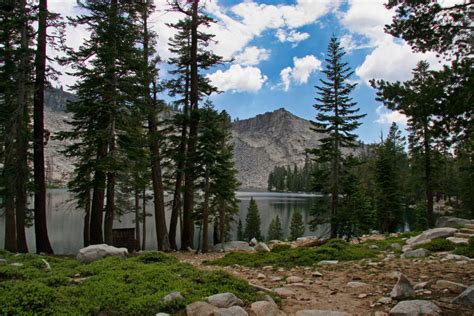
Ostrander Lake in Yosemite National Park.
Built by FDR’s Civilian Conservation Corps in 1941, Ostrander Hut is one of California’s few shelters open to backcountry skiers on public land. The Civilian Conservation Corps (CCC) built the Ostrander Ski Hut in 1941. The ski hut is a two-story stone structure, in the classic National Park rustic style. The hut sits in a small glacial cirque at the edge of Ostrander Lake. The ski hut is still intact and pretty much in its original condition.
Within a park that is such a monument to accessibility, the Ostrander Hut is an anomaly - a destination recalling the days when a park visit required a modest expedition. It was an exquisite lodge. The walls are two-foot-thick granite, cut from nearby blocks of glacial moraine. The rafters and beams are local lodgepole, joined with heavy iron bolts. Even in the fiercest of storms the place doesn’t creak or sway.
Experience the Wilderness
A trip to the Ostrander Ski Hut is a wilderness experience. As with all wilderness experiences in Yosemite National Park, it is important to plan a trip that is suited to your interest, timeframe, and ability. A good planning process is essential for your safety and success. All routes to the hut are arduous and should only be attempted by experienced skiers. Winter weather conditions may severely limit your ability to make it to the hut in one day. You must be prepared to make camp and sleep on the way in or out if necessary. Your travel to and from the hut will not be tracked. Wilderness travel requires self-reliance, and you should not be expecting a rescue.
Ostrander Ski Hut attracts backcountry skiers and snowboarders looking to ski the steep slopes in the cirque above Ostrander Lake. Finding great cross-country skiing, a rustic and comfortable cabin, fellowship around a warm fire, and free ice skating is hard to find all in one place in California. Ski huts like Ostrander allow visitors to enjoy winter sunsets close to a warm shelter. Skiers who climb Horse Ridge above Ostrander Lake earn a rare backcountry view and a rewarding descent.
Backcountry Skiing: What to pack for a day of touring
Essential Information for Your Trip
Skill Level and Requirements
All routes to the Hut are at least 10 miles long and arduous. All routes require considerable stamina and cross-country skiing experience. It is not recommended for novice skiers. Snowshoeing is not recommended. Snowshoers must remain on the outside edge of the Glacier Point Road and avoid all ski tracks on the way to the hut. DO NOT TRAVEL ON FOOT WITHOUT SKIS OR SNOWSHOES TO THE OSTRANDER SKI HUT! Walking to the Ostrander Ski Hut without winter travel equipment creates postholes which are hazardous to the person walking, skiers, and other winter travelers. Climbing skins are strongly recommended.
Routes to the Hut
There is no easy way to the Hut. All routes are at least 10 miles from Badger Pass and require considerable stamina and cross-country ski experience. Winter route markers may be damaged or obscured by wind or snow, requiring advanced navigation skills.If you start from Badger Pass and ski the Horizon Ridge or Bridalveil Creek routes, you are on the groomed Glacier Point Road for about the first half your journey. This is the easiest skiing of the trip and no indication of how difficult it becomes.
The Bridalveil Creek trail is one of two trails to the hut. At ~4 miles, we turned off Glacier Point Rd to Bridalveil route. Bridalveil-likely since the ranger deters you from this path-is an abundance of solitude and trees. Bridalveil Creek is longer and less steep than Horizon Ridge but has many creek crossings, making it especially hazardous if it has been raining above 7,000 feet elevation.
The other - Horizon Ridge - has better views, but more elevation gain. Following a storm, Horizon Ridge is more likely to have a broken ski trail than Bridalveil Creek. Merced Crest is a much more remote and difficult route to follow, and the terrain has more climbing and dropping.
If all the above does not sound challenging enough, it is also possible to start from the Chinquapin trailhead along Wawona Road. The Chinquapin trailhead is accessible year-round and offers an alternative route to reach the Hut when Badger Pass Road is closed. This 2.5-mile segment begins at the junction of Glacier Point Road and Wawona Road (Hwy 41) at 6,000 feet elevation and climbs nearly 1,300 feet before arriving at Badger Pass Ranger Station. This extra challenge may add 2 to 3 hours or more to your total travel time to the Hut.
Reservations and Permits
Yes, reservations are limited to 15 people. Group sizes for wilderness travel are also limited to 15 people. Reservations to Ostrander Ski Hut are non-refundable. *Many weekend dates are fully reserved. If there is no space available when you select one of the multi-night packages, we recommend using the “Ostrander Ski Hut - 1 night” view and checking availability for consecutive single nights. Reserve your stay at Ostrander Ski Hut today!
Yes! You must obtain a free wilderness permit from the Badger Pass Ranger Station (A-Frame). The A-Frame opens every day at 8 am. 24-hour self-registration is available when the A-Frame is not staffed. The ranger who issues your permit will have information on current route conditions and answers to other questions you may have. Be sure your wilderness permit is in hand when you are headed to the hut.
Road Closures and Alternate Routes
If the Wawona Road (Hwy 41) is closed and the trailhead is inaccessible, reservation holders will be notified and given the option to reschedule for another date in the season if space allows or to be refunded. The 3.5% transaction fee is non-refundable. If the road closes, we will endeavor to contact all impacted reservation holders immediately. Your reservation is valid whenever the Hut is open. If the Hut is open but the Badger Pass Road is closed, the Hut is accessible beginning at the Chinquapin trailhead at the junction of Glacier Point Road and Wawona Road (Hwy 41). This alternate start adds approximately 1,300 feet of elevation gain and 2.5 miles-each way-to your trip. Anticipate this extra challenge adding 2 to 3 hours or more to your total travel time to the hut.
Parking Information
Overnight parking is available at the Badger Pass Ski Area. The rangers who issue your wilderness permit will also give you a parking permit with specific instructions for overnight use. Follow their directions. If the ranger station is not staffed, the Wilderness Permit Self-Registration Information Board to the left of the permits clearly shows where you should be parked and how to fill out your parking permit. For travelers beginning from Chinquapin: Overnight parking is at the trailhead, on the south side of the junction of Glacier Point Road and Wawona Road (Hwy 41). Parking here is limited; minimize your vehicle footprint and park smart! Park beside the bathrooms.
What to Expect at the Hut
There are 25 bunk style beds with mattresses. Beds are single bunks, one bed per person. There is a common kitchen with propane burners and some basic kitchenware, two toilets, solar-powered evening lights (no electricity), and a woodstove for heat. A propane stove burns in the kitchen, but the only source of heat is that wood stove. A few light bulbs hang from the ceiling - recent additions powered by solar panels on the deck. The outhouses shelter portable toilets that along with the propane and firewood, are hauled in each fall by mule teams. There are many books, games, and decks of cards for entertainment. Water is retrieved from a hole that is cut into the ice at Ostrander Lake. Guests are expected to help haul buckets of water from the lake for all to use. Whilst we love your four-legged friends, Ostrander Ski Hut is located deep in the Yosemite Wilderness and pets are not allowed.
Triple-decker bunk beds in a common sleeping room, a small shared kitchen, and primitive toilets may not appeal to some. At the cabin itself, visitors frequently engage in informal cooking competitions, trying to outdo each other with extravagant meals miles from the nearest real kitchen. Monopoly, Jenga, poker, and other games help pass the long winter nights. Hut visitors, who share a love of skiing and the outdoors, enjoy a warm camaraderie.
Weather Considerations
This weather map will direct you to the National Weather Service forecasts for the different regions in Yosemite. Remember, especially in winter, conditions can vary greatly depending on the elevation you are visiting. It may be sunny and in the 50’s on the Yosemite Valley floor and blizzarding and below freezing at Ostrander.
We recommend arriving to the Badger Pass Ranger Station by 8 am to set your group up for success. An early start is critical to ensure you arrive at the hut during daylight. The route is long, difficult and not well marked.
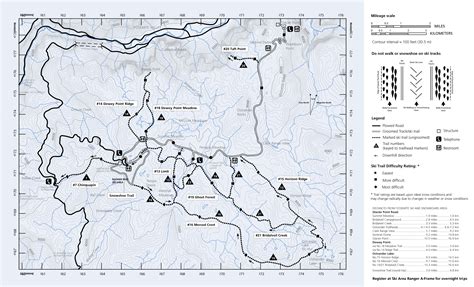
Map of Ostrander Ski Hut Routes.
Gear Recommendations
Back country skis with metal edges and skins (canvas strips which stick to ski bottoms, providing traction to climb hills) are essential. Beginners should not attempt it without experienced companions and emergency overnight gear (sleeping bag, thermal bedroll, winter tent, stove and a pot for melting snow). Ski rentals are available when the Nordic Center is open. Climbing skins are not available for rent and are strongly recommended. You will need to bring your own climbing skins or purchase them and cut them to size yourself.
Ostrander Ski Hut is a wilderness experience, and it is important to be prepared for a night in the wilderness. All routes to the Hut are long and arduous, and many unexpected situations may arise-such as a sudden storm, illness, or injury-that result in your group being delayed. Search and Rescue efforts may be impossible or take many hours to mobilize depending on the situation. Carrying overnight gear can make the difference in surviving the night.
Packing Essentials:
- Pillow
- Skins, skis, poles, beacon, probe, shovel (didn’t need to crampons or axe)
- Socks 2x, sun hoodie, patagonia houdini, patagonia r2, thicker jacket, down jacket, beanie, thin gloves, warm gloves) (didn't use extra socks)
- Headlamp
- Charger, chord headphones, phone, extra battery, airpods, watch
- First aid kit, skin wax
- Toothbrush, toothpaste, sunglasses, sunscreen
- Baby wipes & hand sanitizer
- Baseball hat (didn't bring helmet)
- Tevas (cozy slipper would have been better)
- Water filtration (didn’t use this)
- Electrolytes
- Tent (only for emergencies, didn’t use)
- Jetboil (only for emergencies, didn’t use)
- Trash bag ziplock
- Sunglasses
Food:
- 2x oatmeal
- Pancake mixture (just requires water)
- Pairing knife (didn’t need this but glad I had it)
- snacks: 2 gummies and 1 luna mint bar per day (would have liked 1 more bar on some days)
- Premade chicken, premade potatoes, carrots, hummus
- Pasta, sauce, squash, more homemade chicken
- Rice crispy treat materials (parchment paper, olive oil, rice crispies, marshmellow)
- Tortillas (16 - should have brought 8)
- PB & Jelly
- Olive oil
Contact Information
Calling ahead: I recommend calling ahead to check conditions.
Questions to ask ranger: Which route to to take? Are both routes covered in snow? Do they both have skin tracks on them?
A Culinary History
There's a long culinary history at Ostander. For decades, groups have packed in decadent meals to enjoy, and left their menus on the wall of the kitchen to taunt those who follow. The interior of the kitchen is decorated with menus that span 80 years, showcasing a rich culinary history of steak, crab, and French wine-remarkable feats of transportation by those who visited. At Ostrander, claim one of 25 bunks on the bottom floor (a hutmaster lives upstairs) and whip up a meal in the open kitchen before exploring the front yard.
Example Meals:
- Chicken Burritos: Fried premade chicken with onions and premade potatoes in a pan with olive oil. Wrapped in a tortilla with hummus and shredded carrots. Oreo dessert.
- Mac & Squash: Boil macaroni pasta. Roast cut squash with pasta sauce and premade chicken in a pan and pour in pasta.
- Rice Krispie Treats: Boil olive oil and marshmallows until melted, then stir in Rice Krispies.
Environmental Health
Environmental Health Surveys conducted on the Ostrander Ski Hut in 2008 and 2011 by the National Park Service in cooperation with the California Department of Public Health, Vector-Borne Disease Section identified areas of concern that could have an effect on the visitors and keepers of the Ostrander Ski Hut. This project will correct these interior and exterior deficiencies to contribute to a safe and healthy environment for the visiting public and administrative staff. The Ostrander Ski Hut has been determined eligible for listing on the National Register of Historic Places by Yosemite's Branch of History, Architecture and Landscapes and the California State Historic Preservation Officer. The non-historic woodshed addition that will be modified as part of this project does not contribute to the Ostrander Ski Hut's overall eligibility for the National Register of Historic Places. All work will be performed in accordance with "The Secretary of the Interior's Standards for the Treatment of Historic Properties".
Project actions include:
- Place a concrete slab with raised (12 inch high) stem walls under the attached wood storage shed on the north end of the hut. The total area of the wood shed is 108 square feet. The concrete slab and stem wall will be isolated from the exterior stone wall of the hut with 6ml plastic sheeting to prevent the concrete from bonding with the stone.
- Repair the roof and roof structure of the wood shed.
- Repair the wall framing of the wood shed.
- Repair and replace the damaged wood siding of the wood shed to prevent rodent intrusion and firewood theft.
- Prevent rodent intrusion between wood shed walls and the stone exterior of the hut.
- Improve the wood shed door.
- Strip and refinish both kitchen countertops.
- Repair the bathroom compartment wall damage.
- Replace the stove cap on top of the chimney.
- Replace the 42 gallon hot water tank in the hut keeper's kitchen.
- Replace the 200 gallon water tank in the upstairs hut keeper's quarters.
- Continued rodent exclusion work on the hut.
- Selective pointing of failed mortar in the walls of the hut.
- Preservation treatments of the exterior log components of the hut.