Para-alpine skiing is an adaptation of alpine skiing for athletes with disabilities. Skiing as a sport for people with disabilities traces its origins back to the Second World War, which produced large numbers of wounded soldiers.
In Germany, Franz Wendel, an amputee who had lost a leg, successfully attached a pair of crutches to short skis. Sepp "Peppi" Zwicknagel, an Austrian veteran who had lost both his legs to a hand grenade, taught himself to ski and eventually became a ski instructor at Kitzbühel, founded a division of the Austrian Ski Association for disabled skiers. By 1947, annual races were being held in Austria. Ludwig Guttmann, a key figure in the history of paralympic sport, helped organise ski events. In the United States, Gretchen Fraser began teaching skiing to amputees in army hospitals.
By the 1960s, a number of organisations had been founded. For a long time, disability skiing was restricted to amputees, but in 1969, blind skier Jean Eymere, a former ski instructor before he lost his eyesight, began a skiing program in Aspen, Colorado for blind skiers.
Alpine skiing was one of the foundation sports at the first Winter Paralympics in 1976 with Slalom and giant slalom events being held. Different disciplines were added to the Paralympic programme over time.
The sport evolved from the efforts of disabled veterans in Germany and Austria during and after the Second World War. It is governed by the International Paralympic Committee Sports Committee.
Read also: Thrills and Victories in Beaver Creek
Governing Body and Rules
Skiers from 39 different countries actively compete in para-alpine skiing in a sport is that one of eight governed by the International Paralympic Committee Sports Committee, with rules for para-alpine skiing set forth in the IPCAS Rules and Regulations. Event specific rules may be created for events like the Paralympic Games.
One set of rules was created in 1994 and were specified in the IPC Handbook. This was used to govern IPC-sanctioned events like the Paralympic Games for many years. Competition rules for classes use rules set by or modified from rules created by the International Ski Federation (ISF). These rules were set at the 42nd International Ski Conference in 2000.
🇬🇧 Great Britain's Neil Simpson Makes History With Para Alpine Skiing Gold Medal! | Paralympic Games
International and national events for the sport include the Winter Paralympics, World Championships, World Cups, Continental Cups, National Championships, IPCAS Races and IPCAS Para-Snowboard.

Past Paralympic Events
- The 2010 Winter Paralympics para-alpine skiing events were held at Whistler Creekside. The disciplines at Whistler included downhill, super-combined, super-G, slalom and giant slalom. It was the first time the super-combined was on the Paralympic programme.
- At the 2002 Winter Paralympics, women's Downhill and men's visually impaired Downhill were held on day 1 with men's standing and sitting Downhill taking place on day 2. Men's standing and sitting Super-G took place on day 3, with men's visually impaired and women's Super-G taking place on day 5. Men's standing and sitting giant slalom took place on day 7, with women's and men's visually impaired giant slalom taking place on day 8.
- The 2014 Winter Paralympics para-alpine skiing took place at the Rosa Khutor Extreme Park. Added to this discipline these games was the para-snowboard cross which was held at Rosa Khutor along with the super-G, downhill, super-combined, slalom and giant slalom.
Para-Alpine Skiing Equipment
The primary equipment used in the sport includes outrigger skis, sit-skis, and mono-skis. Depending on the classification, other equipment may be used by skiers including guide skiers, cut-down ski poles, orthopedic aids, or prostheses. At the Paralympic Games, this equipment is prohibited from having advertisements on it.
Beyond this equipment, skiers also gear up wearing special boots, helmets, ski suits, and goggles. The boots attach to the ski at the heel and toe, and are designed to provide support to foot and ankle with the use of materials in boot construction like hard plastics.
Read also: Alpine Ski Brand Comparison
Skis
There are minimum lengths for skis used in competition, with men's skis needing to be at least 165 centimetres (65 in) long and women's skis needing to be at least 155 centimetres (61 in) long.
- Skis for women must be at least 200 centimetres (79 in) long with a tolerance of 1 centimetre (0.39 in). For men, the ski length must be at least 205 centimetres (81 in) long with the same tolerance. Women and men's skis need a minimum radius of 45 metres (148 ft).
- Skis for women must be at least 200 centimetres (79 in) long with a tolerance of 1 centimetre (0.39 in). For men, the ski length must be at least 205 centimetres (81 in) long with the same tolerance. Women and men's skis need a minimum radius of 33 metres (108 ft).
Sit-Skis and Mono-Skis
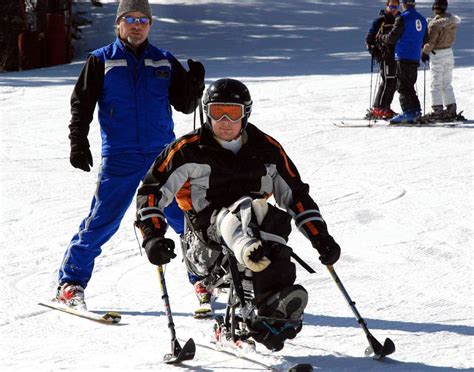
Sit-skis are designed for wheelchair users or other skiers with a form of paraplegia. The first sit-ski was built in 1967 by Josef Shrall from the Bavaria region of Germany. Early sit-skis used in para-alpine skiing had two wide skis, brakes, and were custom built to fit the specific skier. The weight of the ski prevented skiers from skiing moguls or steep slopes.
Sit-ski development continued into the 1980s, with a more modern version demonstrated in Engelberg, Switzerland in 1987 at a workshop hosted by the Swiss Paraplegics Association [fr; de]. As the technology advanced, a chair was developed that could be attached to the skis which were used by non-disabled skiers.
Sit-skiers use a specially designed ski called a mono-ski, sometimes called a maxi mono-ski. It is used by skiers with lower limb disabilities including paralysis. A variation of the mono-ski exists for skiers with bilateral, above the knee amputations.
The mono-ski was developed in Austria in the early 1980s by bilateral above-the-knee amputee Josef Feirsinger and engineer Horst Morokuti. The fundamental design they created is still the one used for mono-skis currently used in competition. The mono-ski was quickly used by German skiers who built their own at a workshop in Tübingen.
Read also: Utility and Innovation: Ski-Doo Alpine
The mono-ski uses the same skis used for non-disabled alpine skiing, adapted so that the skier sits on a chair attached to the ski via a spring. A monoski, also known as a sit-ski, consists of a molded seat mounted on a metal frame. A shock absorber beneath the seat eases riding on uneven terrain and helps in turning by maximizing ski-snow contact.
Modern monoskis interface with a single, ordinary alpine ski by means of a "ski foot," a metal or plastic block in the shape of a boot sole that clicks into the ski's binding. A monoskier uses outriggers for stability; an outrigger resembles a forearm crutch with a short ski on the bottom.
As alpine ski technology has advanced, so has monoski technology. In North America in the 1970s and early 1980s, early "sit-skis" took the form of fiberglass sleds with metal runners. The first downhill sit-ski in the US, the Arroya, was invented by American Peter Axelson in 1978.
Dragging very long poles or "slicks" in the snow were the method in which turns were actually made harder, although not effectively. Few users became proficient enough to descend even intermediate terrain without assistance from a "tetherer." By the early '80s, Europeans were experimenting with "ski-bobs" that mounted on two small skis. In place of today's minimal bucket seats were large fiberglass or Kevlar shells, and leaf springs at first were used instead of slide absorbers. The three-ski design proved accident prone, and it was soon abandoned for a single ski by most manufacturers.
By the middle of the decade, the technology had migrated to Canada, and on both continents the modern monoski began to emerge. In the United States, Enabling Technologies' Unique, Sunrise Medical's Shadow, and Dan Fallon's Fallonski were some of the first commercially available monoskis.
For standing competitors, outrigger skis can be used in some classifications.
Para-Alpine Skiing Disciplines
Developed in the 1980s, the Super-G is less technical than others, and is known for the speed of the skier, who navigates a course that has a vertical drop between 400 metres (1,300 ft) to 600 metres (2,000 ft) from top to bottom. Compared to other para-alpine skiing disciplines, this course tends to be mid-length.
With a vertical drop of 300 metres (980 ft) to 400 metres (1,300 ft), this is one of the more technical of the para-alpine skiing disciplines. This discipline involves two runs down a course straighter and shorter than the downhill, but longer and having fewer turns than the slalom course.
The winner is determined based on the combined time for both races. After the first run, the bottom 20% of finishers can be eliminated from the competition at the discretion of the judges. The starting order for the second run is starts with the slowest of the top 15 skiers, with the fastest skier in the first run skiing 15th. Any skiers who finished outside the top 15 then ski in order based on their times from the first run. The name for this event is from a Norwegian word meaning "sloping path."
This event is the most technical para-alpine skiing disciplines, with a vertical drop of only 140 metres (460 ft) to 220 metres (720 ft) on an intentionally iced course. This is the shortest of all the para-alpine skiing events and uses two different courses.
Skiers go down each course once, with their finishing position being determined based on their combined course completion time. There are gates in this event, about 55-75 for men and 40-60 for women, and if a skier misses a gate, they are disqualified from the race.
After the first run, the bottom 20% of finishers can be eliminated from the competition at the discretion of the judges. The starting order for the second run is starts with the slowest of the top 15 skiers, with the fastest skier in the first run skiing 15th. Any skiers who finished outside the top 15 then ski in order based on their times from the first run.
The Super Combined event is a combination of two disciplines such as the slalom and the Super G, or the downhill and the slalom. In the event, skiers go down the downhill course once, and the slalom course twice.
Snowboard has vertical drops between 100 metres (330 ft) and 240 metres (790 ft) for both men's and women's races with the course being run over a distance of 400 metres (1,300 ft) to 900 metres (3,000 ft).
Para-Alpine Skiing Classification
Para-alpine skiing classification is the classification system for para-alpine skiing designed to ensure fair competition between alpine skiers with different types of disabilities. The classifications are grouped into three general disability types: standing, blind and sitting. Classification governance is handled by International Paralympic Committee Alpine Skiing.
Skiers are classified based on medical assessment, and their body position when they ski. Blind skiers are evaluated purely on a medical assessment. Prior to that, several sport governing bodies dealt with classification including the International Sports Organization for the Disabled (ISOD), International Stoke Mandeville Games Federation (ISMWSF), International Blind Sports Federation (IBSA) and Cerebral Palsy International Sports and Recreation Association (CP-ISRA).
Some classification systems are governed by bodies other than International Paralympic Committee Alpine Skiing for systems not used in international competition.
The sport is open to all competitors with a visual or physical disability. A factoring system was created for para-alpine skiing to allow the grouping of classifications into three general groups: sitting, standing and visually impaired.
One medal event can then be held for each group even though there is a wide range of functional mobility and medical differences. The factoring system works by having a number for each class based on their functional mobility or vision levels, where the results are calculated by multiplying the finish time by the factored number. The resulting number is the one used to determine the winner in events where the factor system is used.
Table of Paralympic Alpine Skiing Classifications
| Classification Group | Description |
|---|---|
| Standing | Athletes who ski standing using one or two skis, with or without the use of outriggers. |
| Sitting | Athletes who ski using a sit-ski. |
| Visually Impaired | Athletes who ski with a visual impairment, often with the assistance of a guide skier. |
tags: #paralympic #alpine #skiing