Renaming a well-known business is tough, and moving a well-known business is equally challenging. Jeff Proctor, who for 30 years partnered with the late Nashua ski legend Ken Jones in the business that bears Jones’ name, understands this well.
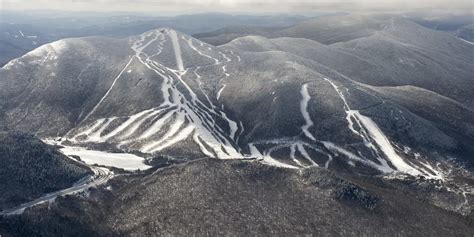
Cannon Mountain Ski Area, Franconia, NH
Ken Jones died in April at the age of 86. The company’s Manchester store will continue to be owned by his family and will keep that name, but within a year, Proctor has to change the name of the Nashua store, now that he and his wife Marilyn have bought out Jones’ share.
“Ken was clear: If there’s not a Jones in the business, you shouldn’t use the name,” Proctor said. Proctor, of Litchfield, is moving the ski and snowboard shop about a mile north of its longtime Spit Brook Road home to a long-abandoned former shoe store, and plans to open by mid-August.
The log-cabin building at 195 Daniel Webster Highway was built as a Dexter Shoe store in 1982, but has been vacant for 6 or 7 years. “We cleared out tons of trees and bushes - there’s surprising visibility,” he said, gesturing from atop the small hill toward La Hacienda restaurant and Funworld on the other side of Daniel Webster Highway. Proctor said that with the flexibility from extra parking, he may look into adding some sort of summertime business.
Ken Jones Ski Mart was started in 1968 out on Amherst Street by Jones, known in local ski circles for having owned the former Indian Head Ski Area in Pepperell, Mass. In 1984, Proctor became Jones’ partner, and they moved to the upper story of a building on Spit Brook Road, near the road’s intersection with Daniel Webster Highway. The shop has been there three decades, sitting atop what was first D.B.
The shop flourished during the ski boom of the 1970s, when almost every town had its own ski hill, and survived as the industry contracted in the 1980s when insurance and snow-making costs crippled small- and mid-sized resorts. The latter is important because most of its business comes from the area, Proctor said.
Proctor said parking was often an issue at the old store and described a recent disagreement with the cigar store about the ventilation system and smoke. The move isn’t trivial: When all is said and done, Proctor estimated, it will cost almost $1.1 million to buy the property, buy Jones’ share of the business and move.
Considering that two years ago, the winter was notoriously snow-free and terrible for snow-sports business - Proctor, 69, calls it “the worst season in memory” - this is not a small undertaking. In the meantime, despite the heat of mid-June, preparation for winter in a new location go on. “I’ll be unpacking K2 snowboards tomorrow,” he said. “I think we can make this a great family place,” said Proctor, taking a break Monday from working on the site.
Dartmouth College and Skiing
Dartmouth College has a long and storied history with skiing, contributing significantly to the sport's development in America. The Dartmouth College Ski Team was once organized under the aegis of the Dartmouth Outing Club and is now operating under Dartmouth Athletics. The alpine teams train at the Dartmouth Skiway in Lyme, New Hampshire.
The Dartmouth Ski Team won the NCAA national championship in 1958, 1976 (tied with Colorado), and 2007. The Dartmouth Ski Team hosted the 2025 NCAA national championship in March 2025 at The Dartmouth Skiway (alpine events) and Oak Hill (nordic events). Twelve Dartmouth athletes were selected by the NCAA to participate in the championship, and the team finished third.
On March 6, John Steel Hagenbuch D25 won the Men’s 7.5km Individual Classical event after finishing second in the Men’s 20km Individual Freestyle event. Other notable finishers included Jasmine Drolet D25, who placed 3rd in the Women’s 7.5km Individual Classical event, and Benny Brown D27, who finished second in the Giant Slalom.
Who Invented Skiing? | A Brief History of Skiing
Notable Figures in Dartmouth Skiing
Dartmouth alumni have made significant contributions to skiing, both as athletes and in other roles. Here are some notable figures:
- John B. Charles N.
- A. Lincoln Washburn D35 (Alpine Slalom)
- Warren H. Chivers D38 (Nordic Combined)
- Edgar H. Hunter Jr D38 (Alternate)
- Richard H.
Athletes named but did not compete due to World War II:
- Selden J. Hannah D35 (Nordic Combined)
- David J. Bradley D38 (Nordic Combined)
- Stephen J. Bradley D39 (Nordic Combined)
- Warren H. Chivers D38 (Nordic Combined)
- Richard H. Durrance D39 (Alpine Combined)
- John P. Litchfield D39 (Nordic Jumping)
- Edward P. Wells D39 (Alpine)
- Harold Q.
- Colin C.
- John H. Caldwell Jr D50 (Nordic Combined)
- Brooks Dodge Jr D51 (Alpine Giant Slalom)
- William L.
Other notable figures include:
- Brooks Dodge Jr D51 (Alpine)
- Charles N. Tremblay D52 (Nordic Combined)
- William L. Beck D53 (Alpine Downhill)
- Thomas A. Corcoran D54 (Alpine)
- Chiharu Igaya D57 (Alpine)
- Ralph E.
- Thomas A. Corcoran D54 (Alpine)
- Chiharu Igaya D57 (Alpine)
- Richard W.
- Richard W. Taylor D59 (XC)
- James W.
- Edward G. Williams D64 (Biathlon)
- Edward F.
- Scott W. Berry D71 (Jumping)
- Walker T. Weed III D71 (Nordic Combined)
- David H. Currier D74 (Alpine)
- Thomas A. Reaper D74 (XC Jumping)
- Timothy J.
- David H. Currier D74 (Alpine)
- Donald M. Nielsen D74 (XC)
- Douglas J. Peterson D75 (XC)
- Timothy J.
- Donald M. Nielsen D74 (XC)
- Douglas J. Peterson D75 (XC)
- Timothy J. Caldwell D76 (XC)
- Walter A.
- Donald M. Nielsen D74 (XC)
- Timothy J. Caldwell D76 (XC)
- William K. Carow D80 (Biathlon)
- Landis A. Arnold D82 (Jumping)
- Glen R. Eberle D85 (Biathlon)
- Dennis McGrane D84 (Jumping)
- Gale H.
- William K. Carow D80 (Biathlon)
- Dennis McGrane D84 (Jumping)
- Gale H. Shaw III D85 (Alpine)
- Leslie Thompson D86 (XC)
- William H.
- Katie Bono[39] D10.
Other notable figures include:
- Howard Chivers D39. Inducted into the US Ski and Snowboard Hall of Fame in 1973. 1942 National Nordic Combined Champion.
- National Ski Hall of Fame on 1978 as both a Skisport Builder and Ski Athlete.
- Ski Association.
- Peter Dodge D78. Dartmouth men's alpine coach.
- Jack Durrance D36. Brother of ski team member Richard H. Durrance D39, attempted to climb K2 in 1939.
- He completed the first recorded traverse of the Grand, Middle and South Tetons in Wyoming (with Butterworth).
- He completed the first recorded ascent of the Grand Teton via the northwest ridge (with M. Davis).
- Ned Gillette D67. In addition to attending the 1968 Winter Olympics, Gillette wrote a book on cross-country ski technique Cross-Country Skiing, first published in 1979.
- In 1981, Gillette climbed and descended by skiing the Pamir peak Mustag Ata (24,757 feet).
- Gillette was an adventurer, notably rowing 600 miles across the Drake Passage between South America and Antarctica.
- Fred H. Harris D1911.
- John McCrillis D1919. Early advocate for alpine (vs nordic) ski racing.
- Malcolm McLane D46. World War II fighter pilot, POW, Distinguished Flying Cross recipient.
- Rhodes Scholar, captain of the Dartmouth ski team, director of the US Olympic Committee.
- Gale Shaw III (Tiger) D85.
- Sandy Treat D46.
New Hampshire: Birthplace of American Skiing
Many people may not realize that New Hampshire is the birthplace and cradle of American skiing and boasts a long connection to the Winter Olympics. Dartmouth can boast a long, unbroken lineage of Olympians since John Carleton, ’22, competed in cross-country in the first Winter Games in Chamonix, France, in 1924 - as “downhill” skiing had not yet been invented.
The Richard Taft Racing Trail at Cannon Mountain - the first downhill skill trail in the country cut specifically for skiing. The first ski trails were treacherously narrow. The Taft became a favorite because of its width and pitch.
The story of American skiing has European roots going back to the 1840s in Berlin, New Hampshire. Scandanavian immigrants recruited to lay track for the Atlantic and St. Lawrence Railroad from Portland to Montreal, eventually took up logging for the Winslow Co., settling in Norway Village on the outskirts of Berlin.
In February 1872, they formed the first “skiklubben” in America, renamed the Nansen Ski Club in 1912 for the famous Norwegian explorer Fritjof Nansen, who skied across Greenland. Two years before that, in 1910, Fred Harris, ’11, founded the Dartmouth Outing Club which organized the first Winter Carnival and instigated pioneering efforts in skiing.
On Jan. 31, 1912, Carl Shumway and G.S. Foster led the first ski exploration of Mount Moosilauke. On Feb. 4, 1914, Dartmouth physics professor Charles Proctor led a party of 12 students and faculty to Canada to challenge McGill skiers in the first collegiate ski race.
Skiing developed simultaneously in three directions in the mountains of New Hampshire - ski instruction, ski racing and ski trail design. When British tourists became intrigued by skiing and began to take lessons, Germans and Austrians - used to skiing for practical reasons - realized there might be a livelihood in ski instruction.
By 1937, it was in its eighth printing. They also produced the first ski film shown at the National Ski Association meeting in Chicago. The film became a key tool in the promotion of downhill and slalom skiing as competitive sports.
In the meantime, the dramatic topography of the White Mountains - particularly bowl-shaped Tuckerman’s Ravine - inspired “extreme skiing” as early as 1914. The first slalom race in the country was held at Dartmouth in 1923, one year after the first race in Murren, Switzerland.
On March 8, 1927, a DOC down-mountain race on Mount Moosilauke was the first official downhill ski race in the country, won by Dartmouth professor Charles Proctor. In 1933, Kate Peckett mobilized the Civilian Conservation Corps to cut the first official ski trail in the country - the Richard Taft racing trail at Cannon Mountain, named after the proprietor of the Profile house, the inn that burned down a decade before.
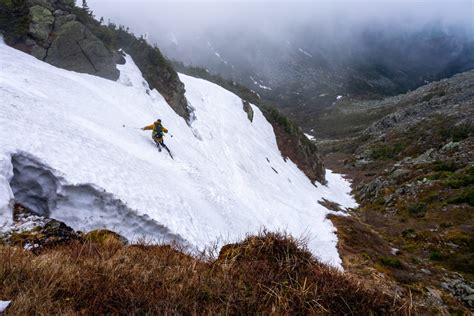
Tuckerman Ravine, Mount Washington, NH