The history of the Detroit Red Wings is deeply intertwined with the iconic ice rinks that have served as their home. From the early days at Olympia Stadium to the more recent era at Joe Louis Arena, these venues have witnessed countless memorable moments in hockey history.
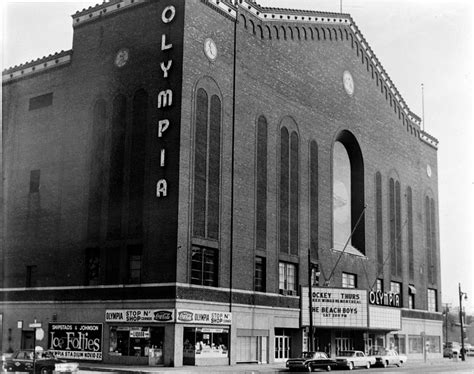
Olympia Stadium: The Old Red Barn
To the legions of Detroiters who passed through the turnstiles of the iconic Olympia Stadium, its name alone conjures memories of legendary entertainment that spanned more than six decades. Nicknamed the “Old Red Barn,” Olympia Stadium stood at the corner of Grand River and McGraw avenues in Detroit for nearly 60 years before its demolition in 1986.
In the 1920s, Detroit was experiencing a financial boom thanks to the success of the automobile industry. Henry Ford’s introduction in 1922 of the $5 workday and the ensuing 40-hour workweek gave Detroiters not only more disposable income, but also more time for leisure. Detroiters were quick to embrace the rapidly growing phenomena of American professional sports.
It was in 1926 that the Detroit Cougars began play in the NHL. Though the Cougars were based in Detroit, the team had a significant problem: It had nowhere to play. As such, the team’s inaugural season of 1926-1927 was played in Windsor. That plan came to fruition in 1927, when they began play at Detroit Olympia (also known as Olympia Stadium or just the Olympia).
The stadium was initially conceived of as just a simple hockey arena at a cost of $600,000 (a paltry $8 million today, when adjusted for inflation). But city leaders soon stepped in with the vision of a far more ambitious project. Working with the Olympia’s builders, the plan was expanded to a $2.5 million project ($33 million today, when adjusted for inflation).
Read also: A Look at Red Wings Coaches
The man chosen to blend the vision of a hockey arena and a convention center was C. Howard Crane. Crane had established himself as a noted architect of theaters, designing Detroit’s Orchestra Hall, the Capitol Theatre (now the Detroit Opera House) and others. Crane was considered a master of architectural acoustics, so it is little wonder that Olympia Stadium would be known as a place where fan excitement was amplified into a near hysterical pitch.
On Oct. 15, 1927, an eight-day rodeo began, with ceremonies on Oct. 17, while on Oct. “Detroit has leaped into big-time fight circles as a result of the first boxing card staged at this city’s new sports palace - the Olympia,” the Detroit Times reported. A little more than one month later, on Nov. 22, the first National Hockey League game was played in Detroit, when the Cougars faced off against the Ottawa Senators.
Before the first face-off at the Olympia, Detroit Mayor John W. Smith went to center ice and presented Cougars coach Jack Adams with a huge floral piece. “Detroit got its first real taste of big league hockey and liked it,” the Detroit Times wrote of the event.
Although Olympia was packed with fans on opening night, it soon became apparent that hockey was far from “catching on” in Detroit. Detroiters didn’t know or understand hockey. Hockey was viewed as a Canadian curiosity, and many of the fans who attended the games came over from Windsor.
Compounding the indifference of most of the city’s sports fans was the fact that their “hometown” NHL club had played its first season across the Detroit River in Windsor, Ontario. “I’ve never seen a place like this in my whole life,” a disillusioned Adams moaned one night after a loss to a visiting Canadian contingent.
Read also: Red Wings Hockey
Despite the early struggles of Detroit fans embracing hockey, the future of Olympia Stadium itself appeared to be bright as numerous bookings for circuses, bicycle racing, basketball, wrestling and boxing was supported by a citizenry with plenty of disposable income. All of this changed, however, on Oct. 29, 1929, “Black Tuesday.”
As the attendance and event bookings began to dwindle, Olympia's management started to focus more on its signature attraction, hockey. Though the team had been terrible over the course of its first six years, Adams, doing double duty as coach and general manager, had been laying the foundation for a franchise that would carve a niche in the very soul of the city.
First and foremost, it is important to understand that there wasn't just one hockey team calling Olympia home from 1927-1936, there were two. With this idea in mind, the Detroit Olympics were born.
In 1930, the team was renamed the Detroit Falcons. However, while things were looking up for the team, the finances of Olympia Stadium were so dire that in 1931-32, the stadium's owners had gone bankrupt, and Adams was working for the bankers who were managing the organization through receivership.
It was at this moment, that a savior arrived. James Norris was an immensely wealthy Chicago grain magnate and hockey fanatic who had long dreamed of becoming an NHL owner. Norris switched his attention to the struggling Detroit franchise and bought Olympia in 1932, along with all of its interests (including the hockey teams) for $100,000, the equivalent of $1.7 million today, when adjusted for inflation.
Read also: Detroit Red Wings Trade News
Retaining Adams and settling the debts for the stadium, Norris decided to change the team's name again. In their first season as the Red Wings (1932-33), the team reached new heights of success, tying the Boston Bruins for first place and winning its first playoff series. In 1933-34, the Wings were even better, winning first place outright and advancing to the Stanley Cup Finals. With this success, Detroiters finally began to embrace their team, but still not at the level that would guarantee the franchise's future.
For the first time in the team's history, the Red Wings became the darlings of Detroit, and as they fought for their first championship, many people who may have never even thought about hockey were now swept up in the excitement of a team playing its hearts out in pursuit of something more than just a Stanley Cup.
During that time, hundreds of thousands of Detroiters cheered the Detroit Red Wings, the Detroit Pistons, and boxing luminaries like Joe Louis within its distinctive red brick walls. Though built as a hockey rink, conventions, political rallies, expositions and concerts were held there. The Beatles, Led Zeppelin, Elvis Presley and the Rolling Stones all performed at Olympia.
The stadium was designed by noted architect C. Howard Crane, who designed the Fox Theatre and Orchestra Hall, among 50 other Detroit theaters. The cornerstone was laid on March 8, 1927 and the first hockey game played on November 22, 1927 by the then-named Detroit Cougars. The team became the Falcons in 1930, and adopted their permanent moniker, the Detroit Red Wings, in 1932.
When it opened, the five-level stadium featured the largest indoor skating rink in the United States, at 242 feet by 110 feet.Capacity ranged from 11,563 seats when opened to 13,000 when the stadium was expanded in 1965. The arena was noted for its rafters’ area standing room for 3,000, the steep pitch putting fans on top of the game.
Olympia was host to the Red Wings famous “Production Line” players, Gordie Howe, Sid Abel and Ted Lindsay, who during the 1950s led the team to win four Stanley Cups, and finish first seven times in a row.
The Red Wings played their final game at the Olympia on December 15, 1979, a contest that resulted in a 4-4 tie against the Quebec Nordiques. On December 27, 1979, the Red Wings played their first game at the new venue-Joe Louis Arena. The enthusiasm and intensity of the Red Wings’ fan base that had defined the Olympia carried over to Joe Louis Arena, where the Red Wings would experience more success.
The final official game at Olympia Stadium was played on December 15, 1979, although an exhibition game was played there in February 1980. After the Red Wings left for their new home at Joe Louis Arena, there were no other tenants, and the building was demolished in 1986.
Construction started on March 8, 1927. Olympia was the first home of the Detroit Cougars, later renamed the Red Wings, who played their first game in the stadium on November 22, 1927. Though people crammed into Olympia to see the game, they were probably more excited about the arena than their team.
Olympia Arena saw much of the glory days of Detroit’s sporting history. It was home to the Red Wings during their first season as Stanley Cup Champions, and it saw Joe Louis fight when he was a relatively unknown local boxer.
The arena was more than just a sports venue, however. It became a symbol of Detroit and brought Detroiters together to celebrate their victories and mourn their losses. After a well-fought Red Wings game, it wasn’t uncommon for Detroiters to take to the streets and celebrate together.
Beginning in the 1950s, Olympia started hosting concerts, and the number of events held their only increased into the 70s.
Unfortunately, Olympia couldn’t stand up to the test of time. After the 1967 riots, the neighborhood around the building began to deteriorate. After the City of Pontiac managed to lure the Lions away from Downtown, it went for the Red Wings, too. The city offered the team a new arena, and the Red Wings seriously considered the offer.
On December 15, 1979, the Red Wings played their final game in Olympia. The team played the Quebec Nordiques, and they tied, 4-4. It was a rather lackluster goodbye to a building that had served Detroit for over 50 years.
For seven years Olympia remained, a fixture of Detroit’s storied past, slowly becoming an eyesore. Today, the Michigan National Guard’s Olympia Armory occupies the site where the Old Red Barn once thrilled Detroiters.
| Arena | Years Active | Capacity | Key Events |
|---|---|---|---|
| Olympia Stadium | 1927-1979 | 11,563 (original) to 13,000 (expanded) | Red Wings' first Stanley Cup season, Joe Louis fights, concerts by The Beatles, Led Zeppelin, Elvis Presley, and The Rolling Stones |
| Joe Louis Arena | 1979-2017 | 20,058 | Four Stanley Cup Championships, 25 consecutive playoff appearances, concerts, and other sporting events |
Joe Louis Arena: The Joe
The Joe: The Detroit Red Wings & Joe Louis Arena
For almost 40 years, the Detroit Red Wings called Joe Louis Arena home. After opening its doors in the winter of 1979, "The Joe" quickly became one of the most iconic venues in all of hockey.
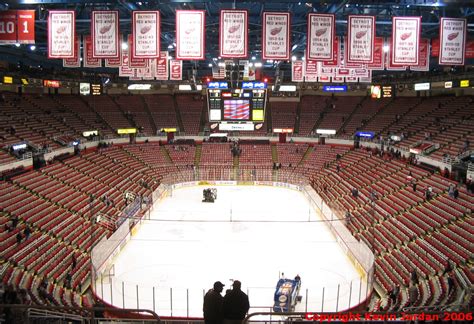
The Red Wings accepted the offer, and the Joe Louis Arena became their new home in December 1979. On December 27, 1979, the Red Wings played their first game at Joe Louis Arena, hosting the St. Louis Blues.
Over a period that ended with the 2016-17 campaign, the Red Wings made 25 consecutive playoff appearances. Joe Louis Arena also played host to a unique slate of non-NHL events. Over time, however, the Red Wings began exploring their options for a new arena, leading them to pursue a new facility in downtown Detroit. Joe Louis Arena hosted its final NHL game in April 2017, with the last ticketed event occurring in July of that year.
The Red Wings played their final game at Joe Louis Arena on April 9, 2017, against the New Jersey Devils. The Red Wings were victorious, winning by a score of 4-1. The game was historic for many reasons, and signaled the end of an era in Hockeytown.
The final game at Joe Louis Arena also served as the 1,000th career game for Red Wings captain Henrik Zetterberg. To make the night even sweeter, Zetterberg scored a goal of his own in the victory. Zetterberg was named captain of the Red Wings on January 15, 2013, following the retirement of Nicklas Lidström.
Zetterberg became the seventh player in Red Wings history to play 1,000 games for the Original Six franchise. He joined elite company, which includes Gordie Howe (1,687), Nicklas Lidström (1,564), Alex Delvecchio (1,550), Steve Yzerman (1,514), Kris Draper (1,137), and Tomas Holmstrom (1,526). Zetterberg would retire following the 2017-18 season after accumulating 960 points on 337 goals and 623 assists over 1,082 games with the Red Wings.
Riley Sheahan scored two goals on the night, which served as his only goals of the 2016-17 season. His second goal of the game became the final goal to be scored at the iconic arena.
Joe Louis Arena saw the Red Wings appear in six Stanley Cup Finals (1995, 1997, 1998, 2002, 2008, and 2009), winning four (1997, 1998, 2002, 2008).
The Red Wings said goodbye to Joe Louis Arena in 2017, but its legacy lives forever in the hearts of Red Wings fans.
Little Caesars Arena: A New Era
After closing down Joe Louis Arena in 2017, the team moved to the state-of-the-art Little Caesars Arena for the 2017-18 season. Little Caesars Arena is a spectacular venue to watch a hockey game.
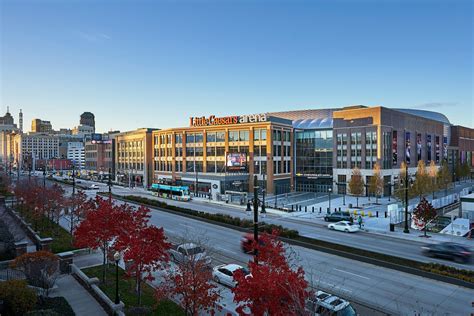
Now, the Red Wings are preparing for their regular season debut at Little Caesars Arena. Intended as part of a larger development known as The District Detroit, the arena will play host to both the Red Wings and the Pistons-who announced their intention to move to the venue during its construction period last fall-but the Red Wings will be the first of the two teams to make their regular season debut.
However, Red Wings fans miss the history, charm, and winning of the old barn. The arena also saw Detroit put together a magnificent run of 25 straight postseason appearances from 1991 to 2016. The Red Wings have yet to make the playoffs since moving to Little Caesars Arena.