Skate Canada (Canadian French: Patinage Canada), the national governing body for figure skating in Canada, is recognized by both the International Skating Union (ISU) and the Canadian Olympic Committee. Skate Canada oversees the rules and standards of figure skating in Canada while promoting its growth and development.
For over a century, Skate Canada has enabled Canadians to participate in the joy of skating. As the largest skating instruction organization in the country, it boasts over 6,700 NCCP-certified coaches who deliver learn-to-skate and skill development programs. These programs cater to athletes of all ages, ambitions, and abilities, helping them find their footing on the ice.
In relentless pursuit of excellence, Skate Canada provides performance and financial support to Canada’s Junior and Senior National Figure Skating Team athletes to power their dreams of topping the podium.

The Origins and Evolution of Skate Canada
The earliest skating association in Canada was the Amateur Skating Association of Canada, formed by Louis Rubenstein of Montreal's Victoria Skating Club in 1888 for both speed and figure skating. In 1914, the Figure Skating Department of Canada was formed as a section of the Amateur Skating Association of Canada, stemming from the recognition of figure skating as a sport distinct from speed skating.
In 1939, the Figure Skating Department of Canada was renamed as the Canadian Figure Skating Association (CFSA). In 1947, it became independent from the Amateur Skating Association of Canada, and instead operated in direct affiliation with the International Skating Union. An ISU national office was correspondingly established in Ottawa by Charles H. Cumming.
Read also: Ice Skating in Central Park
Louis Rubenstein was the first president, a position he held until 1930. In 2000 the organization changed its name to Skate Canada.
Key Milestones in Skate Canada's History
- 1888: The Amateur Skating Association of Canada is formed.
- 1914: The Figure Skating Department of Canada is established.
- 1939: Renamed as the Canadian Figure Skating Association (CFSA).
- 1947: CFSA becomes independent and joins the International Skating Union.
- 2000: The organization is renamed Skate Canada.
Skate Canada International: A Premier Figure Skating Competition
Skate Canada International is an annual figure skating competition sanctioned by the International Skating Union (ISU), organised and hosted by Skate Canada. The first Skate Canada competition was held in 1973 in Calgary, Alberta.
When the ISU launched the Champions Series (later renamed the Grand Prix Series) in 1995, Skate Canada International was one of the five qualifying events. It has been a Grand Prix event every year, except for 2020, when Skate Canada was forced to cancel the event due to the COVID-19 pandemic.
Medals are awarded in men's singles, women's singles, pair skating, and ice dance.

Notable Achievements and Innovations
Compulsory figures, which had been a required element of men's and women's single skating since the beginning, were retired after the 1988 competition.
Read also: Ramsey County Skating
In 1989, Skate Canada unveiled three new events: men's artistic programs, women's artistic programs, and four skating. The artistic events - later rechristened "interpretive programs" - required each skater to present a 2:30 minute program with an emphasis on musical interpretation.
Four skating was not simply two sets of pair skaters performing together; but rather, four individual skaters performing a single routine.
The Grand Prix Series and Skate Canada's Role
Beginning with the 1995-96 season, the International Skating Union (ISU) launched the Champions Series - later renamed the Grand Prix Series - which, at its inception, consisted of five qualifying competitions and the Champions Series Final.
The five qualifying competitions during this inaugural season were the 1995 Nations Cup, the 1995 NHK Trophy, the 1995 Skate America, the 1995 Skate Canada, and the 1995 Trophée de France. Skaters earned points based on their results in their respective competitions and the top skaters or teams in each discipline were then invited to compete at the Champions Series Final.
Skate Canada International has been a qualifying event of the Grand Prix Series every year since, except for 2020, when rising COVID-19 cases in Ontario forced its cancellation.
Read also: Keystone Skates: A Historical Overview
This series also provided the viewing public with additional televised skating, which was in high demand. This allowed skaters to perfect their programs earlier in the season, as well as compete against the same skaters whom they would later encounter at the World Championships.
Champions and Medalists
Patrick Chan of Canada currently holds the record for winning the most Skate Canada titles in men's singles (with six), while Michelle Kwan of the United States and Joannie Rochette of Canada are tied for winning the most titles in women's singles (with three each). Meagan Duhamel and Eric Radford of Canada, and Aljona Savchenko and Robin Szolkowy of Germany, are tied for winning the most titles in pair skating (with four each).
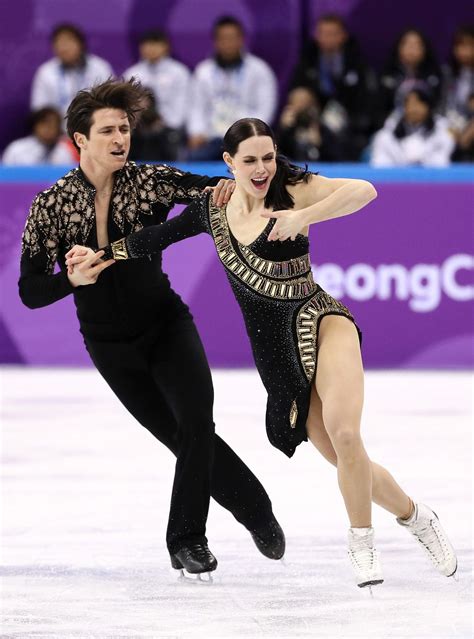
There were four medals won at PyeongChang 2018, highlighted by a gold medal in the team event by Patrick Chan, Kaetlyn Osmond, Gabrielle Daleman, Meagan Duhamel & Eric Radford, and Tessa Virtue & Scott Moir.
Virtue and Moir also won gold in the ice dance event, giving them five Olympic medals in their careers to become the most decorated figure skaters in Olympic history.
The Structure of Figure Skating Disciplines
There are four figure skating disciplines: men’s singles, women’s singles, pairs, and ice dance. In each discipline, the skaters perform two routines-a short program/rhythm dance and a free skate/free dance.
There is also a team event which brings together all four disciplines.
Scoring System
For each program, skaters receive two sets of scores: the Technical Elements Score (TES) and the Program Components Score (PCS). The TES is based on each element performed (jumps, spins, footwork, lifts, etc.) having a set point value which can increase or decrease depending on how it is executed.
The PCS evaluates the program as a whole and is divided into three areas (skating skills, presentation, composition) with each scored on a scale of 0.25 to 10. The TES and PCS are calculated by discarding the highest and lowest scores from the nine judges for each element/component and averaging the rest. Added together, the TES and PCS produce the Total Segment Score (TSS) for a program.
Skate Canada's Commitment to Safe Sport
Skate Canada has worked for some years to make its sport more inclusive, regardless of gender. It has reworked the language of its bylaws and in 2019 it provided that teams in its non-elite programs would be defined as two skaters, rather than one male and one female.
On December 16, 2025, Skate Canada announced that it would no longer host any national or international events in Alberta, in response to that province's legislation requiring participants in sporting events to compete based on their gender assigned at birth. Skaters in Alberta could continue to participate in local skating events and Skate Canada events in other parts of the country.
SKATE CANADA is designated by the ISU as the official sanctioning body of figure skating in Canada and oversees the rules and standards of the sport at the development, national and international levels of competition within Canada.