Water ski slalom is an exciting and challenging sport that requires technique, balance, and precision. This article provides a detailed overview of the rules and guidelines for water ski slalom, covering everything from course layout and scoring to equipment recommendations and techniques for success.
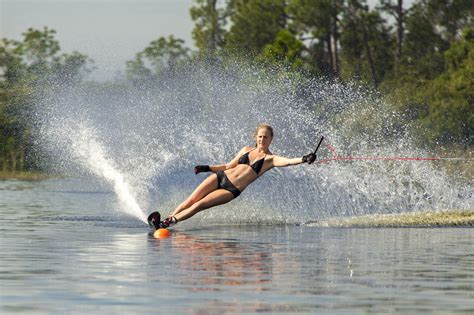
Water Ski Slalom
Slalom Course Layout
The buoys are arranged into a course of six turns that the skier must complete. There is a pair of buoys at the beginning and end of the course that serve as entrance and exit gates. The skier begins each pass at the course by skiing through the entrance gates on his or her way to the first turn buoy. Then the skier continues through the course rounding each of the six turn buoys, finally skiing through the exit gate buoys.
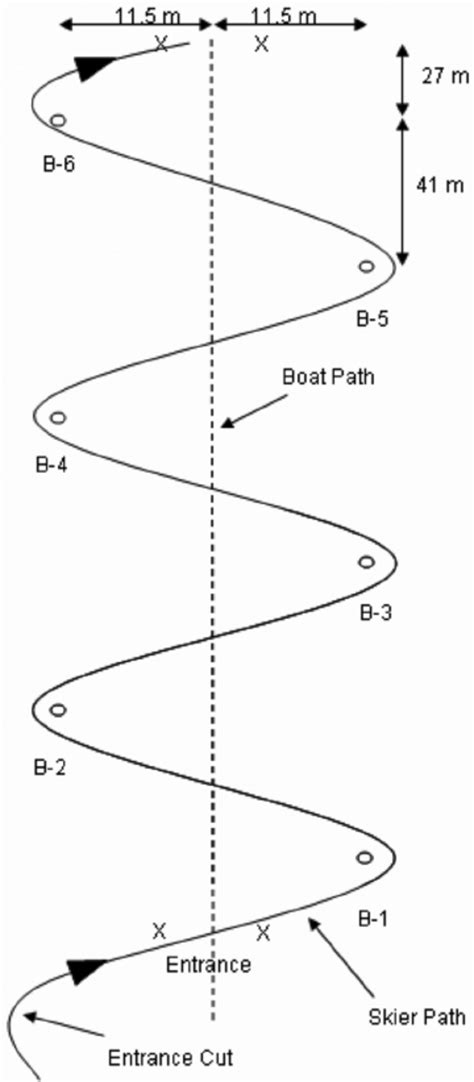
Slalom Course Layout
Scoring in Slalom
Slalom is scored by counting the number of buoys the skier can successfully round without displacing the buoy or losing skiing position (falling). After a successful pass through the course, the skier will be brought back through the course at a speed that is two miles per hour faster than the previous pass. This continues until the skier completes a pass at the top speed for the skier’s division. Then, the rope is shortened to increase the difficulty. This process will continue until the skier either misses a buoy or falls. The score is the total number of buoys accumulated by the skier. If the skier began his or her first pass at a speed higher than the listed minimum speed for the skier’s division and if the skier completed at least one full pass through the course, this buoy total also will include buoys for those passes skipped. If the skier falls near a turn buoy, the judges may award a partial buoy to the total score. If the skier skis outside of the turn buoy but does not continue back towards the wake, the resulting score may include a quarter buoy.
Read also: Celebrating Water Skiing
Speed Guidelines for Slalom Skiing
First time in the course? For open-water skiing, skiers should ski at a speed that is comfortable to them. This may be between 24 MPH to 34 MPH. This again is dependent upon the weight of the skier. However, for the first time in the slalom course, many people should ski the course at the slowest speed that he or she can comfortably cross the wakes and make turns without sinking. For average size men, this speed ranges from 26 MPH to 32 MPH. For average size women, the best speeds are between 24 MPH to 28 MPH. Many times advanced open-water skiers (never skied a course) have progressed to speed well above those used in the course. For men, the top speed used in the slalom course is 36 MPH and for women the top speed is 34 MPH. When they attempt the course for the first time, the speed should be lowered considerably to the ranges listed above.
Choosing the Right Ski Length
The length of ski a skier should use depends upon a few things: the skier’s weight, the speed at which he or she skis, and the level at which he or she skis. As the speed increases and the weight decreases, the proper ski’s length shortens. Conversely, as the skier’s weigh increases or if the speeds are slower, a longer ski is best. In the slalom course, a ski that is too long will be hard to slow down and execute a proper turn. Beginning skiers will typically ski at a slower speed. They will ski less aggressively and will want a smooth stable ride. Skis with a softer flex will be less responsive and more forgiving to the beginning skier. Intermediate skiers will typically need a ski that is moderately stiff and responsive. They will be skiing at faster speeds than a beginner and will be cutting across the wakes. Intermediate skiers will use a normal sized ski for their weight. Many charts are available suggesting ski length based upon height.
Here is a table summarizing the recommended ski lengths based on skier weight and boat speed:
| BOAT SPEED | 26-28 mph | 30-32 mph | 34-36 mph |
|---|---|---|---|
| 90-150 lbs. | 64″-66″ | 64″-65″ | 64″-65″ |
| 150-180 lbs. | 66″-69″ | 65″-68″ | 64″-67″ |
| 180-225 lbs. | 69″-70″ | 67″-70″ | 66″-69″ |
| 225 lbs. |
Determining Your Forward Foot
Your front foot should be the foot with which you have the best balance. There are many ways to determine this. One way is determined while skiing on two skis. On two skis, transfer your weight over to one ski with you body centered over that ski. Then lift up the other ski out of the water keeping the tip up. See how stable you feel skiing on this one ski. Then try the same process on the other ski. You will soon learn that one leg is more stable than the other. This leg has better balance and should be your front foot on a slalom ski. Another method is to stand in front of a stable chair. Make sure your feet are together and about 12 inches form the edge of the chair. Then step up onto the chair. The foot you used to step up with first is the one you have in which you have the best balance. You can also stand with your feet together and have someone push you unexpectedly from behind. The foot you step forward to recover your balance is your balance foot.
12 (or so) Water-Ski Tips to Perform Your Best
Slalom Skiing Technique
Technique is the absolute most important factor for success in the slalom course. Many skiers who have accumulated many years of skiing in open water have attained some habits that are counterproductive in the slalom course. You should note that in the slalom course, the goal is to cross the wakes as fast as possible then slow the ski down quickly and make a tight turn and head back to the other side. As you should notice, these bad habits involve body position and the timing of effort.
Read also: Surprising Nude Water Skiing
Novice Skiers in Ohio
Here in Ohio, we LOVE coaching new three-event water skiers to success. In Ohio, a novice slalom skier is anyone who has never run six or more buoys on their opening pass at any speed in a class C or higher sanctioned tournament. If you are unsure, find the chief judge or the chief scorer at the tournament you are going to, they will be happy to help! We consider you a novice until you complete a full scoring pass. Essentially, novice skiers receive one mulligan per round. A mulligan is defined as a fall or a missed buoy. So, if you miss your opening pass, don't worry, we'll give you another go! Novice skiers in Ohio have the opportunity to begin their competition round with the mini-course for their first two passes before they move to the regulation course. The mini-course shall be defined as the 1, 3, 5 red turn buoys on the right and the 2,4,6 yellow boat guide buoy(s) on the left. The boat driver shall make his best attempt to drive a straight path centered between the turn buoys on the right and the outer most boat guide buoy on the left. There are no start gates or end gates in the mini-course. The mini-course shall not score towards any AWSA ranking lists, however it will be scored toward overall standings in Ohio tournaments which utilize handicap scoring.
Read also: Water Ski Charters