Biathlon is a winter sport combining cross-country skiing with rifle marksmanship. Biathlon is a sport in which skiing and shooting is done in order to win the race. It is one of the most challenging winter games which gives a thrilling experience in the chilled winter.
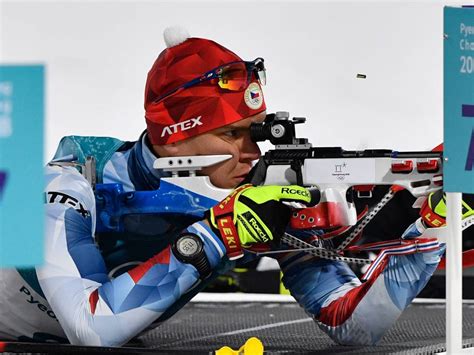
Biathlon combines cross-country skiing and rifle shooting.
Historical Roots
The sport is rooted in the skiing traditions of Scandinavia, where early inhabitants revered the Norse god Ull as both the ski god and the hunting god. Ull’s goddess wife Skadi was also celebrated as a hunter-skier. The combined skills of skiing and rifle marksmanship were first developed by the region’s militaries. Documents describe Norwegian and Swedish ski units fighting in the Second Northern War (1700-21), and, in 1767, the first recorded biathlon competition took place along the Norway-Sweden border between patrol companies.
The sport was thought to provide valuable training as well as recreation. In 1861, the Trysil Rifle and Ski Club, the first biathlon club, was established in Norway, and thereafter similar clubs were found throughout northern Europe.
Early Olympic Inclusion
The growth of the sport was aided by its inclusion as a demonstration event at the first Winter Olympics, held in Chamonix, France, in 1924. The event was then called “military patrol” and was again included (still with demonstration status) at the Winter Games of 1928, 1936, and 1948.
Read also: Skiing at Brighton at Night
The Union Internationale de Pentathlon Moderne et Biathlon (founded 1948) worked for the development of both sports and instituted an annual world championship for the biathlon in 1958. The biathlon was added to the Winter Olympics program as an official men’s event in 1960. International biathlon competitions for women were first held in 1981; a world championship was established three years later. Women’s biathlon made its Olympic debut at the 1992 Winter Games in Albertville, France.
Dominance and Governance
International biathlon competition has been dominated by northern Europeans over the years, particularly by athletes from Russia, Finland, Germany, and Norway. It is the only skiing sport regulated worldwide by the IBU (International Biathlon Union).
Basic Rules and Regulations
In biathlon events competitors cover a cross-country course, carrying a specially designed 5.6-mm (.22-caliber) rifle. Either classical or freestyle (skating) techniques can be used in biathlon competitions. At intervals competitors stop at firing ranges to shoot at five targets located 50 meters (164 feet) away. In most races competitors are required to shoot from both standing and prone (lying on the stomach) positions.
The target size varies according to position, with standing shooters aiming at an 11.5-cm (4.5-inch) target and prone contestants shooting at a 4.5-cm (1.8-inch) target.
Passing and Overtaking
An athlete who wants to pass another skier must let the lead competitor know their intention. The skier who is in front must move to the side of the trail to allow the trailing competitor to pass him easily. The skier who is being overtaken must move to the side on demand even if the trail is wide enough for passing. An athlete must yell “track” if they want to pass another skier. A competitor who is about to be overtaken must clear the course in front of the passing competitor at the first yell of “track” or another voice signal, even if the course is wide enough. Athletes cannot disturb or obstruct other athletes with their body or equipment when taking their shooting position on the mats.
Read also: Maine ski conditions
Rifle Handling
When a rifle is brought into or is taken out of the stadium area, it must be in a case or a cover bag. Rifles must be unloaded after each shooting bout. A round cannot be left in the chamber or in the inserted magazine.
Competition Events
The IBU authorizes six types of biathlon events-individual, sprint, relay, pursuit, mass start, and team.
Individual
Individual competition covers a distance of 20 km (12.4 miles) for men and 15 km (9.3 miles) for women. Skiers start at 30-second or 1-minute intervals and race against the clock. They carry 20 rounds of ammunition and stop for four firing sessions. For this competition, shooting positions alternate in the following order: prone, standing, prone, standing. A minute is added to the athlete’s final time for each failed shot.
Sprint
The sprint events also use interval starts and race against the clock. In the men’s and women’s sprint events, covering 10 km (6.2 miles) and 7.5 km (4.7 miles), respectively, there are only two shooting sessions (prone, then standing) for which contestants are allowed to carry 10 rounds of ammunition. Each missed target in sprint competition costs competitors a 150-meter (492-foot) penalty loop. The loop is relatively short for accomplished skiers; sprint contestants tend to shoot quickly, confident that a penalty can be easily overcome.
Pursuit
Pursuit races (12.5 km [7.8 miles] for men; 10 km [6.2 miles] for women) use interval starts based on the results of a previous race, whereas relay, mass start, and team events require all competitors to start at the same time. In relay events team members ski and shoot one at a time; in team events the entire team skis and shoots together.
Read also: Night Skiing Guide: East Coast
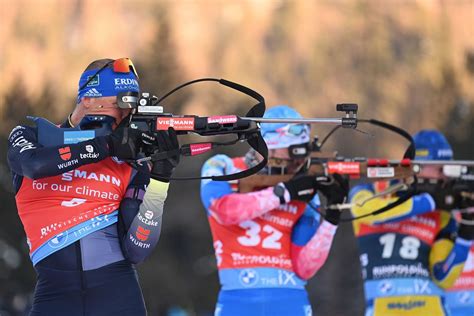
IBU authorizes six types of biathlon events.
Mass Start
In the mass start, 30 athletes start simultaneously. Women compete over 12.5km and men over 15km. They stop four times to shoot at five separate targets, only using one shot for each.
Relay
The relay is a four-person team speed event where each athlete tackles a section of the course: 7.5km each for a total of 30km for men and 6km each for a total of 24km for women. It begins with a mass start with the first skiers from each team. Each team member has two shooting sequences and three extra bullets (for a total of eight) to hit the five targets required for each shooting phase. In the mixed 4x6km relay, there are 20 teams, each composed of four athletes - two women and two men - who each ski six km. The event starts with the first skier from each team. Each team member has two shooting sequences: one in the prone position and one standing.
Olympic biathlon events include men’s and women’s individual, sprint, relay, and pursuit races. In 2011 a mixed relay event was added to the schedule for the 2014 Olympic Winter Games in Sochi, Russia.
What Are The Rules For Biathlon In The Olympics? - The Winter Sport Xpert
Event Timing and Penalties
A race is finished in Olympic biathlon at the moment when an athlete's or a relay team’s competition time ends. The competitor’s time is the time between their start and finish plus any penalty time that may be imposed. The finish either is determined electronically by a sensor or manually when the athlete crosses the finish line with one or both feet.
Start Types
In events with an interval start (individual and sprint), competitors leave the starting gate at fixed intervals. In the pursuit events, biathletes start according to their performance in the sprint events. The winner of the sprint starts first, and the rest of the competitors start at intervals that correspond to their time behind the winner in the sprint competition. In other words, if the sprint’s second-place finisher lost the sprint by eight seconds, they would start the pursuit eight seconds after the sprint winner starts. In mass start events (the men’s 15km, women’s 12.5km and the three relays), all competitors line up across the starting line and start together.
Determining Winners
In the individual races, the athletes who cross the finish line first are the winners. In relays, the first competitor for each team starts together, and each subsequent team member begins when tagged by the incoming team member in the relay hand-over zone. In the interval start events (the individual and the sprint), competitors are ranked according to their net times after any penalties (in the individual) have been assessed. There are no ties in the mass start, pursuit or relay events, in which the first competitor to cross the finish line is the winner. In those events, a photo-finish camera is used to record the finish.
Electronic Devices
Competitors must carry the electronic transponder device provided by the event timing firm, during the competition, attached to one or both ankles as directed.
Shooting Procedure
Each time a competitor stops at the shooting range, they fire five rounds at five targets. There are two shooting positions in Olympic biathlon events: prone and standing. In Olympic biathlon events, if an athlete misses a target during a shooting bout they incur a penalty.
Course Errors
If competitors ski on a wrong course section or the wrong sequence during an event, they must return to the point where they made the wrong turn or the part of the course they have skied in error. Athletes may have to ski against the correct ski direction to return and are fully responsible for not obstructing or endangering other competitors.
In relay events, the first skier for each team must use the classic technique for the first 100m, so that the tracks are not disrupted for their fellow competitors.
Equipment
Biathletes have to possess two different skill sets - accuracy and endurance. It is no easy task to ski at breakneck speed only to stop and accurately shoot a target. Of course this event also requires a few more piece of equipment than other winter sports.
- Lycra suits -The tight suits reduce resistance while skiing and allow free movement.
- Rifles - In 1978, the .22 caliber rifle became the international standard. Today’s Biathlon rifle uses non-optic sights and straight-pull-bolt action (no full or semi-automatics). The rifles have a specially made lightweight stock, though by international rule they must weigh a minimum of 7.7 pounds.
- Rifle harness - Used to carry the rifle on the back while skiing.
- Ammunition - Standard .22 caliber ammunition is used for the Biathlon. It is loaded into magazines which hold five rounds. For the relay race, biathletes may carry an additional three rounds, but those must be placed into the rifle individually as they are needed.
Italian champions
Fun facts about Italian champions