Snowshoe Mountain Resort, nestled in Pocahontas County, West Virginia, stands as the state's largest ski resort. To honor the snowy decades of delight and development that have followed, the resort will kick off a celebration on December 19 with dozens of festive and nostalgic events lined up for guests.
“We’re kind of leaning into the ’70s,” says Shawn Cassell, marketing director at Snowshoe. Nods to the decade include plans for block parties at the village, a Bloody Mary bar in the mornings, an Eagles tribute band, and a Soul Train Dance Party. The Snow Sports Museum of West Virginia will set up in the village, with patrollers from the first season there to share their experiences. A Golden Ticket Rail Jam will be held, as well as a scavenger hunt the whole family can enjoy.
“Looking back through Snowshoe’s history, it has just continued to grow and add more offerings. It’s a lot different now than it was in the ’70s,” says Cassell, who is marking his 10th winter season at Snowshoe this year. “In the early days, it was more of a serious skier’s mountain and basically had one building up here for the first two seasons. People were sleeping in sleeping bags-it wasn’t really like a family destination like it is today.”
Luckily, sleeping bags are no longer necessary. Snowshoe boasts a wide variety of winter activities for guests to make the most of their time on the mountain, ranging far beyond skiing. Snow tubing, snowmobiling, RZR adventure dining tours, and more are available seasonally. But whatever time of year guests are hoping to escape, they’ll find Snowshoe nestled away in the sublime mountains of Pocahontas County, ready to welcome them with open arms.
The resort was founded in 1974 by Alabama dentist Thomas "Doc" Brigham, who had already built two ski areas in North Carolina. Looking for the snowiest location in the South, Brigham invested in the Cheat Mountain location which receives an average annual snowfall of 200 inches. The area's unusually cold weather makes it the most southerly home of snowshoe hares, which gave the resort its name. Snowshoe differs from most ski resorts because the majority of its facilities are found at the top of the mountain, while slopes plummet to the east and west ridges. Because of the isolation of the area, the owners built an entire community, which is now home to the state's highest post office.
Read also: Rent Snowshoes Bend
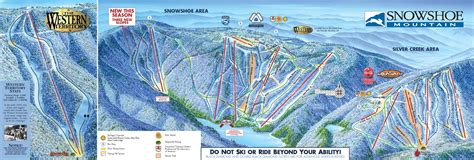
Snowshoe Mountain is the name of the resort, not the name of the mountain itself; the resort is located on Cheat Mountain. Cheat's privately owned highpoint is Thorny Flat, which reaches an elevation of 4,848 feet (1,478 m). The resort makes up 244 acres (99 ha) in total, which includes the Snowshoe Mountain and Silver Creek areas; the mountains have a total of 60 slopes and trails plus many acres of backcountry. Two trails, Cupp Run and Shay's Revenge, have a 1,500 feet (457 m) vertical drop, the highest in the Southeast and Mid-Atlantic. The former was designed in part by Jean-Claude Killy, the triple gold medalist at the 1968 Winter Olympics.
Snowshoe had originally been envisioned as a four season destination, although it would take years for mountain bike and horseback riding trails to become a significant draw. One key advantage for the mountain has continued to be its lower temperatures, due to its elevation. The resort has a base of 1,400 condominium and lodge hotel units, most of which are independently owned but managed by the resort. Snowshoe Mountain opened for skiing 51 years ago on December 13, 1974.
The area had been logged from about 1905 to 1960, after which it was virtually barren and abandoned. Thomas "Doc" Brigham discovered the mountain and believed it would be a good location to build a new ski resort. Although Brigham had high hopes for Snowshoe, the mountain went through a difficult first decade plagued by financial problems. The resort was purchased in 1990 by Tokyo Tower Development Company Limited, a Japanese developer of leisure and recreational facilities. Five years later in 1995, it was sold to Intrawest, a Canadian ski-resort operator which had become well known for expanding mountain resorts through village-style commercial and condominium real estate development.
In 2006, Intrawest was acquired by the private equity firm Fortress Investment Group. The Snowshoe Bike Park is considered one of the largest, best, and most challenging parks in the world. Snowshoe is a regular stop on the UCI Mountain Bike World Cup. Snowshoe's downhill track is considered one of the hardest courses on the circuit. The track is located on the Western Territory, the other face of the mountain. It runs through many roots, rocks, and jumps, one of which, by the curious name of "Threading the Needle," runs through a narrow gap between two trees.
If you’ve been to the Shoe, you’re probably baffled by the names of the slopes, lifts, and lodging units around the mountain. Names like Powder Monkey, Widowmaker, and Hootenany make you wonder just who it was that made up these strange names. We’re here to help set the record straight. But first, you’ll need some details on the Mountain’s history to make sense of these unique names.
Read also: Snowshoe Pack Functionality
Logging History and Slope Names
The land on which Snowshoe now stands was previously home to loggers and railroaders. The time between 1901-1910 and 1945-1950 were periods of the most intense activity.
The slopes are named for the industry that preceded skiing on Cheat Mountain, logging. Names such as Skidder, Ballhooter, Whistlepunk, Gandy Dancer, and Powder Monkey are mostly logging and railroading terms. A steep railroad up Cheat Mountain from Cass was graded in order to log the virgin forests on the mountain for the West Virginia Pulp and Paper Company. A special 40-ton Shay locomotive was developed to tackle the steep grades of 5 to 10%. A special type of grab or coupler that’s used on steep slopes. Red Spruce is the dominant evergreen tree on the highest ridges in West Virginia.
The ski trails and lifts were given names that recalled the local history of logging, such as Grab Hammer, J-Hook, Ball Hooter, and Skidder. Two trails, Shay's Revenge and Heisler Way, were named for brands of gear-driven steam locomotives that ferried men and logs around the mountains during the logging era.
Detailing the hardships of the logging lifestyle, Blackhurts’s book was published just after the decimation of the largest spruce-hardwood forest south of Maine. By 1960, Cheat Mountain-and most peaks in Appalachia-were stripped completely barren by timber companies who set out to leave no sapling standing. But Cheat Mountain began to recover. As the recovery took place, construction of a ski resort began. In December of 1974, just 14 years after the final tree was cut, Snowshoe Mountain Resort opened to the public.
In a nod to Cheat Mountain’s legacy, the names of Snowshoe’s ski trails and lifts double as a glossary of logging terms. Whistlepunk, Ballhooter, Skidder, and others are now household names among local skiers.
Read also: Best Dining in Snowshoe
Skiing at Snowshoe Mountain Resort.
Snowshoe Mountain - Making Opening
The Western Territory: Cupp Run and Shay's Revenge
Cupp Run’s drainage cradles the Western Territory, home to some of West Virginia’s most storied expert-level ski terrain. When Snowshoe set out to design its slopes, it knew the resort needed a dynamic trail that traversed the rugged terrain and took advantage of several distinct fall lines along Cupp Run. The resort brought Jean-Claude Killy, a world-famous French alpine ski racer, overseas for the job. Killy’s magnum opus of Cupp Run is a heart-thumping, leg-burning romp down the mountain that he considered one of his favorite ten lift-served runs in the world.
Snowshoe’s most famous trail gets its name from the stream that creates the steep drainage bowl of the Western Territory. The stream was named for Daniel Cupp, the first settler of the rugged drainage. Historic accounts show his cabin sat just below where Arbuckle’s Cabin now sits by the lower lift terminal. When Snowshoe first opened, Cupp Run was served by a triple-chair lift that was the longest triple in the country at the time. Nowadays, the Western Territory is served by the Western Express, a high-speed quad lift that can handle 2,400 skiers per hour and cruises along at 13 miles per hour. The Western Express slashed the lift ride from 20 minutes to six.
Killy’s alpine racing legacy continues via the annual Cupp Run Challenge, a giant slalom race in which Killy put down the first winning time some 45 years ago. He frequently returned in the race’s early history to set the time to beat. At the age of 76, Killy no longer sets the pace, but the Cupp Run Challenge lives on each February.
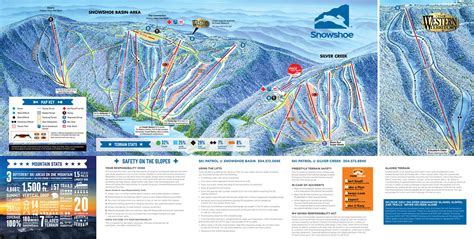
Snowshoe Mountain Trail Map.
Cupp Run remained in a class of its own until 1997 when Intrawest, the corporate owners of Snowshoe at the time, met with then-vice president Ed Galford to figure out how to further leverage the world-class terrain of the Western Territory. After discussing the route, budget, and timeline, Galford and his team got to work creating Shay’s Revenge. Snowshoe’s steepest trail is an homage to the Shay locomotive, a geared steam engine designed by Ephraim Shay that was used extensively in Appalachian logging operations.
“We knew we always wanted another black-diamond slope [on the Western Territory],” Galford says. But looking at a rugged mountainside and having the vision to create that slope proved to be a monumental effort. Galford’s team hand-cleared the trail with chainsaws and had to extract large rocks with a dozer. Galford says the biggest challenges were placing the trail to catch shade from the tallest spruce trees and tackling the flat area to reach the steep face of Lower Shay’s. Just five months and some $5 million later, the project was complete. Shay’s Revenge opened for the 1998-1999 ski season to the joy of expert skiers and snowboarders.
Joe Stevens, West Virginia Ski Areas Association chairman and former Snowshoe communications director, has been skiing and snowboarding for over thirty years in the Mountain State and says the Western Territory holds the best expert terrain in the region. His favorite run links the wide, upper section of Shay’s Revenge to the steep chute and high-speed runout of lower Cupp Run. For Becky Sharp, a veteran member of the Snowshoe Mountain Patrol, it doesn’t get any better than the 29-degree face of Lower Shay’s. As soon as she gets the assignment to head west, she skis both trails to check trail conditions and make sure all equipment and signage is placed. While this usually happens early in the morning, Sharp’s favorite time to ski the Western Territory is at sunset.
Snowmaking and Powder Daze
It takes a village to craft a mountain, and the operations team that functions out of Snowshoe Village work around the clock to pull it off. Ken Gaitor, vice president of mountain operations, has been the architect of a massive overhaul at Snowshoe, including a $4 million state-of-the-art snowmaking system that allows the Western Territory to open earlier and stay open deep into the spring skiing season.
Over the past four years, the snow guns on the Western Territory have been replaced with high-efficiency guns that automatically turn on and adjust water content with input from air temperature sensors. They’ve also added nearly 50 new guns to create slope-wide riding throughout the season. Not many are aware that Cheat Mountain has more landmass above 4,000-feet elevation than New York, Vermont, and Maine combined. Snowshoe’s strategic position on the high point of Cheat Mountain results in 180 annual average inches of the white stuff.
Gaitor, who got his start in the ski industry in Utah, compares the Snowshoe region’s low-density snow to Utah’s legendary powder. “Our natural snow, when it comes, is a nice, dry power,” he says. “You can almost breathe it in sometimes.”
| Trail | Vertical Drop | Difficulty |
|---|---|---|
| Cupp Run | 1,500 feet (457 m) | Expert |
| Shay's Revenge | 1,500 feet (457 m) | Expert |
Now that you know what some of our slopes are named after, you can drop this knowledge on your friends (or strangers) next time you’re making turns. We guarantee they’ll be impressed.