Historic Sugar Bowl, the Grand Dame of California ski resorts, is celebrating its anniversary since it opened on Dec. For skiers and snowboarders, Sugar Bowl is the jewel of Donner Summit, as well as the oldest of all major Tahoe Sierra ski areas. Sugar Bowl is a ski and snowboard area in northern Placer County near Norden, California along the Donner Pass of the Sierra Nevada, approximately 46 mi (74 km) west of Reno, Nevada on Interstate 80, that opened on December 15, 1939.
This classic, European-styled alpine resort caters to skiers and riders who like their powder deep, their friends close and their mountain experience extraordinary. Sugar Bowl was founded by Hannes Schroll and a group of individual investors and is one of the few remaining privately owned resorts in the Lake Tahoe area. Sugar Bowl is a medium-sized ski area in the Lake Tahoe region, and is well known for its long history, significant advanced terrain, high annual snowfall and being one of the closest ski areas to the San Francisco Bay Area.
The mountain peaks of Mt. Judah and Mt. Lincoln, which eventually became the ski slopes of the Sugar Bowl ski resort, were a part of the American pioneers route, back in the 1800s. A part of the California wagon trail called Roller Pass ran between Mt. Judah and Mt. Lincoln. It was one of the wagon trails through Donner Pass that was used by settlers and prospectors, on the Emigrant Trail, coming from the eastern United States across the Sierra Nevada. Today the same pass can be reached by way of the Pacific Crest Trail or a new trail created by Sugar Bowl ski resort, in 1994, called the Mt. Judah Loop Trail.
The Central Pacific Railroad first began train services to Donner Pass in 1868 after the completion of the First transcontinental railroad across the United States. A new tunnel constructed two-miles (3 km) through virtually solid granite, dubbed The Big Hole tunnel, was later constructed through Mt. Judah in 1925, offering trains better protection from snow storms on the summit. The area became more accessible to tourists in 1913 when the Lincoln Highway, the first road across the United States opened over the Donner Pass. Route 40, although snow plowing operations by the state of California didn't start until 1932, making travel to the area by car difficult in the winter. In 1924 Charlie Chaplin filmed scenes upon Mt. Lincoln for his silent movie classic The Gold Rush.
The land that Sugar Bowl ski resort is built on was originally purchased in 1923 by Stephen and Jennie Pilcher. They paid $10.00 for 700 acres (2.8 km2) to the Southern Pacific Railroad, who by then had taken over for the Central Pacific Railroad by lease and acquired its operations by 1885.
Read also: Exploring Sugar Bowl's Past
During the early 1930s, before Sugar Bowl installed the first chair lift, skiers who wanted to ski the Donner Pass mountain peaks, like Mt. Lincoln, would have to climb up to the peaks on foot in order to get the chance to ski. In 1936, Austrian ski instructors Bill and Fred Klein opened the Klein ski school, serving the Sierra Club out of the Clair Tappaan Lodge in the area and local skiers from Sacramento and San Francisco. The Klein brothers and a few other instructors they had taught, were often teaching 100 to 150 students a weekend, taking the more advanced students up to the crest of Mt. Lincoln on foot. The term "leisure" was beginning to take hold in America during this time, after the passage of the Wagner Act and other labor laws of the 1930s.
The Founding of Sugar Bowl
The following year in 1937, the 700 acres (2.8 km2) around Mt. Lincoln and Hemlock Peak were put up for sale by the daughters of the Pilchers. Bill Klein contacted Hannes Schroll, a famous Austrian skiing champion and ski instructor he personally knew, who was working at Yosemite at the time, about the sale of the land. When he and Klein saw the steep boulder field sloping down towards Donner Lake, they could not believe that it would all be covered in snow by winter. By March 1938 Schroll had made a deal with the Pilcher sisters for the purchase of the land for $6,740.
But when Schroll tried to retrieve funds from his home in Austria, the war had just broken out and his funds had been taken. Schroll then had to borrow the funding to buy the property from Hamilton McCaughey, a local realtor, and ice-skating champion George Stiles. Schroll had also sent a wire via Western Union to Walt Disney while seeking funding to purchase the property, but Disney was out of town and did not receive the wire in time. Schroll then became president of the Sugar Bowl Corporation in 1938 with the help and support of Wellington Henderson, Sherman Chickering, and Donald Gregory.
Shortly after, Schroll began seeking other investors to help build a Slope side Tyrolean style village and ski resort modeled after those in his hometown of Kitzbühel, Austria. The Southern Pacific Railroad agreed to build a facility adjacent to the Norden telegraph office to accommodate 600 people, to support the opening of Sugar Bowl. Walt Disney, who had taken ski lessons from Schroll at Yosemite was approached again for funding and became a shareholder when he gave Schroll $2,500. Schroll then changed the name of "Hemlock Peak" to "Mt. Disney" to honor Disney's support. Soon after, others followed suit, and Schroll was able to raise $75,000 by June 1939 to help start and build the resort.
Construction of the Sugar Bowl lodge and the first chairlift began during the summer of 1939. The lodge was designed by William Wurster and was erected with a sloping roof so that snow would slide off towards the back side. The chairlift was designed by Henry Howard and built by the Riblet Tramway Company. Moore Dry Dock Company was hired to install the 13 towers in Howard's design to span the 1,000 vertical feet up to the top of Mt. Disney. Miners were brought in from Nevada City and used shovels, picks, and sometimes dynamite to clear away trees and dig footings for the towers by hand. Lava formation in the mountain was encountered during construction and some of the footings had to be set within it.
Read also: Maine ski conditions
Sugar Bowl opened on December 15, 1939, but it hadn't snowed enough to open the mountain for skiing, so a makeshift ice rink the size of a tennis court was quickly set up for everyone to enjoy. Towards the end of the very first ski season at Sugar Bowl, Schroll held the inaugural Silver Belt race in April 1940. The race was won by Gretchen Fraser and Friedl Pfeifer. Prior to the international World Cup ski competition, the Silver Belt race was considered one of the most challenging of that era and often attracted the top European and American skiers.
Because Sugar Bowl had the first chair lift in the Sierras with full lodge accommodations, the resort quickly became a popular skiing destination for many notable guests and Hollywood personalities. Storytelling, dancing on the open deck, and wearing suit jackets to dinner was the norm during this colorful time. Guests included King Vidor, Robert Stack, Norma Shearer, Margaret Sullavan, Jean Arthur, James Bryant Conant, Doris Duke, Claudette Colbert, Lowell Thomas, Leland Hayward, Errol Flynn, Sterling Hayden, and Marilyn Monroe. Actress Janet Leigh was even discovered at Sugar Bowl ski resort by actress Norma Shearer. Leigh's father, Fred Morrison, was a front desk clerk and had his daughter's photo visible when the actress checked in at the lodge. After seeing the photograph, Shearer brought Leigh into contact with MGM.
The movie Two-Faced Woman, starring Greta Garbo, Melvyn Douglas, Constance Bennett, Roland Young, and Ruth Gordon, was filmed at Sugar Bowl in the spring of 1941. Sugar Bowl was also featured in the 1941 Disney cartoon The Art of Skiing.
Operations to a temporary halt when the US became involved in World War II. The resort had few guests and Schroll retired as president of Sugar Bowl in 1945. Klein returned to Sugar Bowl in 1946 as Sugar Bowl's ski school director and held the position until 1957. Klein believed skiing was a fashionable sport and started his own ski shop, out of the Sugar Bowl lodge. Howard Head, who invented the first metal skis, asked Klein to test his new laminate skis he was developing at the time and then offered Klein a one-fourth interest in his ski company.
A second chairlift was installed at Sugar Bowl in 1950. The new double-chair lift made new terrain on Mt. Lincoln accessible to skiers without hiking. Two years later in 1952, the original ski lift going up Mt. Disney was replaced with a new lift.
Read also: Buying Fischer Skis
Based on the original design plans of Sugar Bowl, Jerome Hill determined that a gondola would be necessary to move people better into the ski area. In 1953 Heron of Denver installed "The Magic Carpet", the first aerial tramway on the west coast. The Gondola has been rebuilt and upgraded twice since the original installation. It brings guests from a parking lot on the north side of the railroad line, crosses over the tracks just past the west portal of Tunnel No.
Skiing was becoming more popular and better, with over 3 million skiers hitting the slopes each year and improved equipment entering the market. Filmmaker Warren Miller came to Sugar Bowl in 1963 to shoot scenes for his film "The Color Of Skiing", Junior Bounous the ski school director at Sugar Bowl in 1958 and the first American-born ski school director in the US, was also featured in over 10 Warren Miller films.
Sugar Bowl is one of the oldest and longest running ski resorts on the west coast, having been in operation for over 70 years. During the last several decades Sugar Bowl ski resort has replaced its older double chair lifts and added new quad lifts to open up new trails on its 4 mountain peaks, Mt. Judah, Mt. Lincoln, Mt. Disney and the Crows Nest Peak.
A 10-year expansion of the resort began in 1992, with addition of a new parking lot and a lodge at the base of Mt. Another addition came in 1999 with the founding of the Sugar Bowl Academy (SBA), a college preparatory high school for competitive skiers. A new ski race was added at Sugar Bowl in 2004, modeled after the Silver Belt races of the past that descends down the same slopes of Mt. Lincoln, called the Silver Belt Banzai. The race differs from the traditional Silver Belt races that were held during the 1940s, in that 4 to 6 skiers or snowboarders race down the hill at the same time, known as a skier cross-style format.
Mt. Judah is named after Theodore Judah who was the railroad design engineer for the Central Pacific Railroad, who surveyed and planned the route that the rail road tracks follow through Donner Pass to Nevada. Bill Klein’s Schuss is a moderately steep blue square towards the bottom of Mt. Lincoln, named in honor of Bill Klein, once the ski school director and ski shop owner at Sugar Bowl ski resort. Jerome Hill is named after Sugar Bowl stockholder Jerome E.
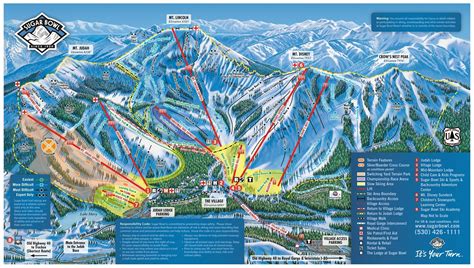
Sugar Bowl Trail Map
The Evolution of Snowmaking at Sugar Mountain
On a more recent visit to Sugar Mountain, I see, next to the lift ticket line, an information sheet that reads, “Snizzle possible till early afternoon.” But Gunther Jochl, the Austrian owner and de facto head snowmaker at the resort, doesn’t want to talk about snizzle. Leaving out all the tropes about how many words the Inuit (and people who make snow for a living) supposedly have for snow, Gunther avoids using the made-up term.
Though, it must be said, the tiny, featherlike drops of snow that whirled in the air as I’d earlier approached Sugar Mountain by car struck me as exactly the snow equivalent of a thin drizzle. I’m here at the resort to learn about the process of snowmaking, and, as the therapists say, I am conflicted, which is not unusual for the Northerner-down-South that I am when the topic of snow comes up. Nor am I conflicted about response: Regarding plowing and driving, I heap scorn on those Northerners who heap scorn on the Southern response to snow.
Do you think we should buy and maintain garages full of plows for our twice-a-season snows? Then quit complaining when it snows and everything shuts down. Do you think Buffalo would effortlessly prepare for and withstand a hurricane? On the other hand, the half-inch or almost-inch snows that elicit squeals from children and sighs from adults? I confess that when I first moved down here, I rolled my eyes. This isn’t snow, I would say, a lifetime of lake-effect blizzards in my rearview mirror. Then an editor sent me out to do a weather story one snowy-ish Raleigh day, and my hostility evaporated.
Snow still hisses when it falls among the silent pines, inch or foot, North or South. So when the opportunity to visit the snowmaking infrastructure at Sugar Mountain arose, I bundled up and drove across the state. I love snow, and I love infrastructure, so in some ways, my return to Sugar Mountain is a dream come true.
First, that snizzle sets up an instant internal hot-chocolate wiggle. If he doesn’t like “snizzle,” Gunther admits that he talks about “graupel,” a more granular snow, and “corn snow,” which is the granularized version after it’s on the ground. But, really, “We just use the word ‘snow,’ ” he says, and begins waxing if not lyrical, then technical about snowmaking. He explains how, for beginning skiers, made snow is actually better than natural snow. “Man-made snow is denser; natural snow, you could catch an edge,” he says. “Hardly anybody breaks a leg anymore.” Which helps explain that run of mine three decades ago.
Positioned along the slopes of Sugar Mountain are dozens of snow guns, which automatically kick on when the temperature dips to 29 degrees. A pipe network and enormous pumps deliver pressurized water to the blowers; there, the water is atomized, mixed with pressurized air, and blown out over the slopes. From his laptop, Gunther clicks through big screens above his desk: It looks like a SCADA system - that’s “supervisory control and data acquisition,” for those who are not infrastructure nerds - as complete as those for small-town water systems. About four or five miles of water and air lines can pump thousands of gallons of water a minute, with five air compressors that can work as hard as the water pumps.
But if you want to talk snowmaking, you need to leave the lodge and go see it being made. So snowmaker Dave McManus outfits me in skier-style overalls and takes me out onto the slopes, where we visit snow guns, many of which sit on sleds. Each one sounds like a 737 and sprays out a freezing mist of particles whose quality Dave checks by sticking his arm in front of the blower and examining the particles in the creases of his jacket. He can check size, quality, and how they clump, and then he can adjust, snow gun by snow gun.
Roaring machinery churning out industrial snow may lack charm, but still: snow. I love this capacity, and I love the cheerful, burly, let’s-do-this way that snowmakers go about their business.
When I approached Sugar Mountain earlier in the day, it appeared as an island of production snow in a mountainscape distinctly lacking in white. It felt kind of weird, which brought out my latent snauvinism. I grew up in snow country, and when the snow came, I would wait until nighttime and locate a streetlight. Then I’d sit and watch through the window, sit and absorb, as snow filtered silently down through the cone of light that the streetlamp cast. No jet-engine roar, no industrial systems.
I know. It’s not fair to compare ski slope-generated snow with the glitter-globe magic of childhood memories. It’s pure snauvinism. Moreover, although my sons have grown up with at least a few Piedmont snows most winters, I do fear for a world where snow is in short supply. So it’s a comfort that snowmakers like Gunther Jochl and Dave McManus are on the job, keeping skiers on the slopes and piling up 10 feet of soft base to cushion them when they go astray.
One day, maybe my sons will ski themselves, and go on skiing trips with their crews. If they do, they’ll surely have a few unforgettable wipeouts.
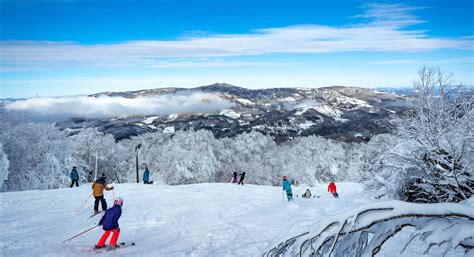
Snowmaking at Sugar Mountain
We talked to three experts to find out their best tips for winter-sports beginners and what makes North Carolina ski resorts so special.
IMPORTANT: Your lift/slope ticket and rental equipment are non-refundable and non-transferable. The Resort does not assume any responsibility for lost lift/slope passes. No replacements. Everyone must have a valid lift/slope ticket and proper equipment at all times to enter any slope system or embark on any lift. No grace period at Sugar Mountain ski area. Management reserves the right to revoke ticket for misconduct. All prices and policies subject to change without notice. Operation and event dates and details are subject to change at any time due to weather and other variables. Our lift equipment requires routine maintenance. Although every precaution is taken; in rare cases, grease may drip from lift equipment. Sugar Mountain Resort is not responsible for grease on clothing or equipment. This is an inherent risk of the sport. The speed of lifts may be reduced due to wind or other factors.