Shopping for ski boots can be overwhelming, especially with terms like LV (Low Volume), MV (Mid Volume), and HV (High Volume) being thrown around. Understanding these concepts is crucial for finding the right fit and maximizing your performance on the slopes. This comprehensive guide will break down the key aspects of ski boots, including volume, flex, and how they impact your skiing experience.
Ski Boot Volume: Finding the Right Fit
Picking volume is essentially getting the correct size within a size. Think of volume as how the boot matches your foot’s width, instep height, and overall shape. You could buy the right length boot (say a 26.5), but if you’re in the wrong volume, it won’t fit properly. Too small a volume and the boot will crush your foot; too big and your foot will swim around. We want ski boots to feel snug, secure, and with pressure as consistent as possible.
A standard Mid Volume (MV) last is listed at 100 mm, but here’s the catch: that measurement is only true at a 26.5 shell size.
Consequences of Incorrect Volume:
- Too much volume: Feet ache, your heel lifts, and you may feel like you’re skiing in the backseat.
Don’t default to “roomier” just because it feels easier at first. The idea is to start with the most precise fit you can realistically tolerate. Molded liners and break-in will help a little bit, but you still need to pick the best starting point.
If you’re experiencing these issues, it doesn’t always mean you bought the wrong boot entirely. Sometimes it’s just a matter of making small tweaks: stretching, punching, grinding, or adjusting the liner.
Ski boot volume isn’t about performance labels - it’s about fit. LV, MV, HV, and EHV exist so every skier can find a boot that matches their foot shape, not just their shoe size. Start with the boot that feels snug, secure, and evenly pressured - that’s the best foundation.
When we do custom boot work, that’s always the end goal: pressure that feels even, balance that feels natural, and control that feels precise.
Flex Index: Stiffness and Performance
What ski boot flex is best, how it works, and misconceptions explained.
Shopping for ski boots is hard enough-and ski-boot marketing makes it harder, especially around flex index. Ski boots have flex index' range from 60 - 150 in most cases, basically, higher the number stiffer the boot. But if you are someone that has tried on a given flex ski boot side by side by side, you've noticed that they all flex differently. In order to answer that question the flex index numbers would have to be standardized, they are not.
A ski boot’s job isn’t just to fit your foot - it’s to transfer energy so the ski bends and to keep you balanced and ready. Stiffer, heavier (more damp) boots do this more effectively. In the shop, what we’re really looking for is the cuff engaging the lower shell when a skier flexes forward. For skiers with little to no dorsiflexion, the only way to transfer energy is through a stiffer, more upright boot that works with their anatomy.
Too often skiers sell themselves short. In what world does being less balanced and transferring less energy to the ski actually help a skier? It doesn’t. Since flex index isn’t standardized, how can you tell at home how one boot compares to another? Pro tip: Go heavier if you want more downhill performance. Within its fit class, the heavier ski boot always skis better -e very single time.
A common misconception skiers have about ski boots is that softer-flexing boots are less work. The reality is the opposite. When you’re buying boots, don’t sell yourself short-and don’t let a boot fitter sell you short either. In truth, skiers end up in the backseat when boots are too upright or too big, not because they’re too stiff. Stiffer boots don’t shove skiers back-they provide the support to keep you balanced and driving the ski. And just because soft-flex boots exist doesn’t make them a minimum viable product-they often exist simply to hit a price point.
For example: pick your favorite elite-level skier and put them in boots that are too big, too upright, or too soft-or a combination of the three-and watch their skiing fall apart. Flex index isn’t standardized.
Width and Foot Shape Considerations
In ski boots, “last” refers to the internal width of the shell at the widest point of the forefoot. A standard Mid Volume (MV) last is listed at 100 mm, but here’s the catch: that measurement is only true at a 26.5 shell size.
It’s common for foot width measurements to exceed the numbers listed on the widest ski boots available-but not to worry. Wide feet aren’t automatically a problem. Higher-volume feet often have more soft tissue, which means they can compress comfortably inside a ski boot. Narrow feet, on the other hand, tend to be more rigid and bony, so even small amounts of pressure can feel sharp or painful.
Understanding and Preventing Shin Bang
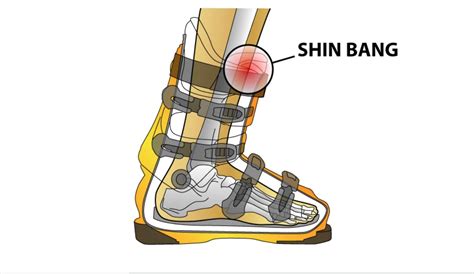
Forums are littered with threads about shin bang and how they can get rid of it or keep it from happening. The list goes on and all these questions are being asked to the skier that has shins that are killing him or her when skiing around and of course when they land. What is Shin Bang?
If your ski boots are too big, your heel isn't being held in place very effectively. Your foot is able to slide to the front of the boot. When you land in ski boots that are too big, it's very easy for your foot to slide to the front of the ski boot. Maybe your boots are the right size, but the liners have gotten packed out. The stock footbed in boots and that packed out liner aren't holding your heel in place very well, a foot bed can help tremendously.
If you're boots are loose at the top (upper cuff/top buckle) you tend to stand more upright in the boots and it makes the boot feel a bit softer. It's not only softer flexing forward it will flex backwards more easily too. If it can do that, you're more susceptible to landing in the backseat.
Ok so maybe you have all those things dialed in but you're still having issues. Everybody talks about the flex of boots and the different tongues you can put in a boot for a smooth feeling flex forward. If you're a bigger guy or a strong skier that's stomping stuff, your putting a lot of pressure on the spine of that boot, you could be too much for that particular boot. Maybe you have a lower end ski boot which is softer flexing forwards and of course backwards. Higher end ski boots are going to be stiffer forwards and of course backwards. So what's happening to your shins when you ski?
Now, lets take a step back and talk about the biomechanics of efficient skiing. When you’re skiing, you want to keep you center of gravity forward to progress down the mountain. To avoid shin bang, you simply need to avoid skiing or landing in the backseat. One thing that can prevent this is a proper boot. First you need a boot that keeps your heel in place and does not allow your foot to shift forward and backward. If your shifting forward and backward that will cause a constant battle between your dorsiflexors and plantar flexors and you will waste a lot of energy that you want to preserve to moving fast and efficiently down the mountain with the least amount of effort as possible.
Lastly you need a boot with a strong spine. This means the back side of the boot does not bend easily. This will further encourage dorsiflexion and prevent you from skiing backseat. So that's how a Doctor of Physical Therapy describes Shin Bang. Get a decent pair of boots, a pair of footbeds and stay on top of your skis.