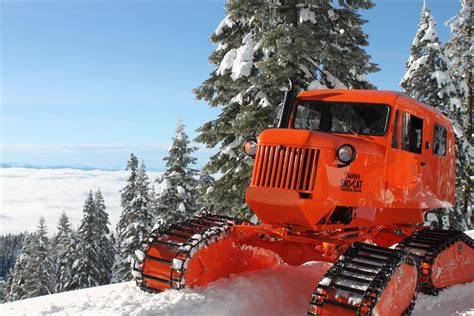
The Tucker Sno-Cat is a family of articulated, four-track over-snow vehicles designed for extreme winter conditions. Manufactured by the Tucker Sno-Cat Corporation in Medford, Oregon, it is recognized as the world's oldest successful producer of such machines.
The Tucker Sno-Cat has not only survived more than a half century of unbound snowy travel in the harshest of environs, it’s outdone much of its competition due to its ruggedness, versatility and technological evolution. This is an icon all its own in an industry that has few competitors.
Your closest encounter with the winter beast known as the Tucker Sno-Cat was probably watching as scientists and explorers with frozen beards made their way through parts unknown in an episode of National Geographic. Not just overgrown snowmobiles, Sno-Cats look like nothing else out there and are easily the winter wheels we’d imagine James Bond using to run over a herd of enemy skiers.
The History of E.M. Tucker
The Tucker Sno-Cat was birthed in the mind of E.M. Tucker, Sr. of southwest Oregon. Born in 1892, Tucker started his quest for better snow travel when he was just a boy. The late E. M. Tucker, Sr., was one of 13 children, born in a log cabin on Jump-Off Joe Creek in 1892, near Grants Pass, Ore.
He spent his early boyhood near Trail, Ore., in a stone house built by his father in 1901. When Emmitt Tucker was a young boy in northwest Jackson County, he walked to school in the deep snow, just like his schoolmates. What was different about Tucker is that he did something about it.
During his youth he walked to school through deep snow, and even at this early age he began working on different devices for transportation over snow which eventually led to the development of the world famed Tucker Sno-Cat® vehicle. As a young man in the 1920s, he recognized that there was a market for machines that would travel on snow.
In the early 1920s, Tucker built several spiral driven machines, but had very little success with the principle involved. Screw-propelled vehicles also lacked the ability to perform over uneven terrain, and their ability to steer was essentially absent. After these experiences, Tucker worked in Los Angeles on prototypes, perfecting the idea of an over-snow transportation.
As a result, Tucker rethought his methodology and sought to develop an entirely new form of winter transportation, one that would overcome all of the drawbacks of the screw-propelled machines. He wanted something reliable and easy to maintain, something that could handle miles of snow-covered terrain without difficulty. His idea was to use tank-like tracks, enabling high amounts of traction, a previously unknown degree of maneuverability in snow, excellent ground clearance, and the ability to travel on top of the snow as opposed to going through it.
He then moved to Grass Valley, Calif., where the first production line was established. This successful venture was terminated by a move to Medford, Ore., a decision driven by Tucker’s long expressed desire to return to the Rogue River Valley. In 1942, Emmitt M. Tucker filed a patent for his over-snow vehicle design on October 20, 1942, describing a power snow sled with an endless traction track featuring side chains and cross members for gripping snow, along with a front keeled runner for directional control.
The patent, issued on June 12, 1945, to Emmitt M. Tucker, Emmitt M. Tucker Jr., and Joseph M. World War II presented significant hurdles to commercialization, forcing Tucker to delay full-scale manufacturing until after the war. This move facilitated access to local resources and a supportive manufacturing environment, allowing production to continue from a dedicated facility.
Tucker built the first Sno-Cat in 1942, and in the following decades continued to develop the beasts for enhanced capability and maintenance. By altering the vehicle’s design and materials, Tucker vastly improved its cold-weather utility - the Sno-Cat became not just a tool for temperate transportation and agricultural purposes, but a hardy standby for long-range expeditions in extreme environments. Following Emmitt M. Tucker's death in 1964, the company transitioned to family leadership under his son, Emmitt M.
What Tucker achieved was no small feat; other attempts that mimic the Sno-Cat’s design have failed to flourish. Sno-Cat has since become a general term for this segment of vehicles, but the Tucker Sno-Cat remains as the sole success story that’s spanned seventy years. The company’s motto is "No snow too deep. No road too steep."
Evolution of the Tucker Sno-Cat
Tucker's snow machines have evolved over the years. In modern form, the Tucker Sno-Cat is a remarkably easy vehicle to drive, as it’s built around automotive-style controls, requiring little training for the inexperienced rider; those familiar with car operations can helm it sufficiently should an emergency require its immediate operation.
E.M. Tucker’s early designs utilized two sets of steel tracks that rotated around a pair of steel pontoons at the rear of the vehicle, aided by robust skis at the front for steering. While the majority of Tucker Sno-Cats utilized four sets of tracks, a few experimental models and early production models used two sets of tracks.
Initially Tucker Sno-Cats employed two front-mounted steering skis and two sets of tracks mounted to the rear. However, there are at least three production models that only employed dual tracks-the small 222 Tucker Kitten, the 322, and the 323 models were all two-track Tucker Sno-Cats with a conventional front engine design. There are at least two variants of the Tucker Kitten, some have square corner doors while others have rounded corner doors. The Kitten was powered by a 10 hp engine.
One early compact model, sadly called the Kitten (“Yes, I drive a Kitten at work”), made use of only two sets of tracks that were powered by a rousing 10 horsepower. The Kitten’s presence and power were nothing short of paltry. Tucker eventually changed his two-track system to a full four tracks, one at each corner of the vehicle.
The doubling of the tracks provided greater mobility over deep snow and a much increased level of agility that two tracks/skis design never could. The more common four track Tucker Sno-Cats are considered to be the classic Sno-Cats in American history and have been used extensively in both polar regions for exploration, as well as for transportation, trail grooming and industrial applications.
Though this new system proved more capable than early models, the materials used still posed a problem. The steel tracks and pontoon system initially provided good traction but did not hold up well in the extreme elements. Corrosion and rust made for a maintenance nightmare on the early Sno-Cats and kept the lifespan of the track belts and the pontoons short.
The early Tucker Sno-Cat's track system utilized four steel pontoons, each surrounded by a continuous steel track fitted with cleats to provide superior traction on snow and ice surfaces. That early design was never the right combination of flotation and traction, but by 1938 Tucker came up with a revolutionary new design that allowed the pontoons to float on the snow, surrounded by a steel track.
Located at the top center of the pontoon is a drive sprocket with teeth that drive the chain-like tracks around the steel pontoon. This design, pioneered in the late 1940s, emphasized flotation and stability through the pontoons' broad surface area, which distributed the vehicle's weight to prevent sinking in moderate snow depths.
Front augers were integrated into the initial models to displace accumulated snow ahead of the pontoons, clearing a path and reducing drag during forward motion, while the rear pontoons enhanced overall balance and load-carrying capacity. The chassis formed the backbone of these vehicles, built from robust welded steel frames that withstood the rigors of off-road snow travel and supported modular attachments for various tasks.
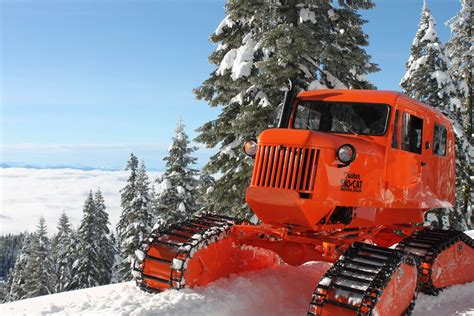
Perhaps the most significant modification to the Tucker Sno-Cat was the replacement of the steel tracks with rubber belts. These tire-like belts were also embedded with metal grousers for traction, providing the bite of steel tracks without the major corrosion problems. This new system was both more resilient and easier to maintain than the old steel system.
Steel tracks revolving around pontoons were replaced with a system that employed two rubber belts with metal cleats, or grousers, attached to the outside perimeter to grip the snow. A series of wheels and guides were used inside the belts. Two drive sprockets on a hub drive the rubber belted track. As the models evolved, the steel tracks were replaced with a suspension system that employed rubber belts that were carried by a series of small wheels.
Beginning in the mid-20th century, Tucker Sno-Cat transitioned from steel pontoons surrounded by steel tracks to rubber tracks with the introduction of the Terra Track system in 1973, improving flotation, flexibility, and reducing weight compared to earlier steel-rubber hybrids. The most modern version of the Sno-Cat track is the all-rubber Terra Track system.
This system uses a wide single rubber belt, constructed with a multi-ply design similar to a modern car tire. The current four-track system gives each track an independently sprung unit that pivots at the drive axle, allowing for a great degree of articulation on uneven terrain. This evolution allowed for better maneuverability in deep, soft snow while minimizing ground disturbance.
They’re no longer shuffled along by a measly 10 horsepower engine, either. Today’s Cummins diesel engines range from 160 hp to a hulking 300 hp and provide the torque and power necessary to get up and over the deepest of drifts.
Powertrain upgrades shifted toward diesel engines for greater efficiency and torque, with Cummins models becoming standard in the late 20th century and electronic variants introduced in 2003. Additional modern features like an Allison 2500 Automatic Transmission, bucket seats, a 50-gallon fuel tank, a 36,000 BTU cabin heater and heated exterior mirrors certainly help long-range cold weather transport and provide a level of comfort that early Sno-Cat drivers could only dream of in their frozen heads.
Cab designs have evolved significantly from open, two-seat configurations in early models to fully enclosed, heated compartments accommodating multiple passengers. In the 2020s, Tucker Sno-Cat incorporated advanced features such as GPS integration for navigation in remote areas with challenging topography and weather.
Frames were refined with steel-welded truss designs to handle heavier loads and stresses from tasks like snow pushing with 12-foot blades. Mid-1950s variants in the 300-900 series featured an enlarged chassis accommodating up to 6-8 passengers, along with options for heated cabs and winches to support extended operations.
Applications and Models
Tucker’s commitment to building a truly robust machine has resulted in the longest operating and most successful snow vehicle in the world. Tucker’s four-track Sno-Cats continue to be used all over the globe, covering ground in locations and conditions impassable by the toughest 4x4s.
Tucker Sno-Cats are still considered a premier extreme condition vehicle,[citation needed] and are still in use in both the Arctic and Antarctic regions. The various iterations of Sno-Cat fulfill a wide range of use that includes polar exploration, search and rescue, military applications, avalanche control, mining, and of course, snow removal.
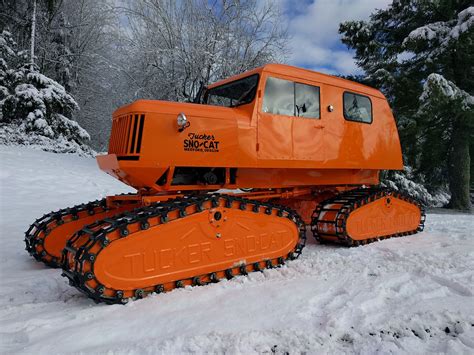
From single seaters to sedans, open bed to closed cabin, large to small models, the sheer variety of the line is impressive. The body style could be configured in many ways and sedan styles, enclosed cargo styles and open bed configurations were all available. Model numbers designated the configuration of the unit, for example a Model 342 was a "300" series, four-track, two-door Tucker Sno-Cat. A Model 443 would be a "400" series, four-track, three-door unit.
In the early models, there were ultimately series 200 through 900, with the higher numbers being larger units. The 500 series Tuckers employed extra wide tracks which allowed them to carry heavy loads in very deep soft snow conditions. Tucker makes custom snow machines for extreme environments, such as the North slope of Alaska.
Custom-built machines include an ambulance and the Agri-Cat®. The snow machines can accommodate blades, brush cutters, and snowblowers, and models are available with ice drills, forklifts, dump trucks, and knuckle booms. There are models for trail grooming and snow removal, for exploration, mining and drilling, for agriculture and telecommunications, for military and cargo transportation, for search-and-rescue, and for avalanche control.
During the second half of the 20th century, different models have been used for expeditions in the Arctic and Antarctica. One of the original Tucker Sno-Cat 743s from Sir Vivian Fuchs’s 2,158-mile 1958 Trans-Antarctic expedition, a journey that constituted the first land crossing of Antarctica, is on display in all its radiant orange glory in the London Science Museum.
With four custom-made Sno-Cats, Fuchs was able to cross the continent in 100 days, all the while conducting seismic readings and measuring ice cap thickness. Navy's Operation Deep Freeze I in 1955-1956, where two units were deployed to support the establishment of research stations in Antarctica as part of preparations for the International Geophysical Year (IGY) of 1957-1958.
These vehicles facilitated the transport of supplies and personnel across challenging ice terrains, enabling the construction and initial operations at sites including the precursor to the Amundsen-Scott South Pole Station. In the late 1950s, Tucker Sno-Cats gained prominence during the Commonwealth Trans-Antarctic Expedition (1955-1958), led by Sir Vivian Fuchs, marking the first overland crossing of Antarctica via the South Pole.
Four modified Model 743 units, equipped with enhanced tracks for soft snow and auxiliary fuel systems, transported teams, sleds, and scientific instruments over approximately 2,000 miles from Shackleton Base to Scott Base, enduring crevasses, blizzards, and temperatures as low as -50°F. Adaptations for polar use included extended fuel tanks holding up to 110 gallons or more in custom configurations for extended range, insulated cabs with heating systems to protect against sub-zero temperatures, and reinforced chassis to handle heavy sled loads.
One notable incident involved a Sno-Cat teetering over a crevasse, highlighting the vehicles' structural resilience as the team recovered it without loss of life or major damage. By the 1980s, Tucker Sno-Cats continued supporting resupply operations at Amundsen-Scott South Pole Station, integrating with surface traverses to deliver fuel, food, and scientific gear overland from McMurdo Station, reducing reliance on airlifts and enhancing logistical sustainability in remote Antarctic interiors.
Tucker Sno-Cats have supported the U.S. Navy expeditions in polar regions. Since its inception in 1942, early models were developed amid World War II demands for over-snow mobility in alpine and arctic environments. In rescue operations, Tucker Sno-Cats have been instrumental in search-and-rescue missions, particularly for avalanche response in mountainous regions such as the Alps and the Rocky Mountains from the 1960s through the 1980s.
Equipped with winches, medical bays for on-site treatment, and reinforced cabins, these vehicles enabled rapid access to remote, snow-bound areas where helicopters or standard ground transport failed. Modern military applications continue to leverage the Tucker Sno-Cat's capabilities, including deployments in high-altitude environments up to 15,000 feet for supply transport.
For contemporary rescue specifications, Tucker Sno-Cats feature a towing capacity of up to 10,000 pounds, enabling the recovery of stranded vehicles or personnel in avalanche zones. They incorporate integrated communication systems and survival kits designed for extended 72-hour missions, ensuring self-sufficiency in isolated emergencies.
1956 Tucker Sno-Cat ®
Today, the Tucker Sno-Cat® Corporation continues manufacturing and selling over snow vehicles. The company also has an agricultural division that specializes in soft ground applications as well as a full factory service department. The Tucker corporation remains a family-owned business in Medford, with distributors around the snowy world.
With a workforce of about thirty-five employees, Tucker produces as many as 120 snow machines a year, depending on economic and weather conditions. The newest model in production is the Tucker-Terra. It has four all rubber tracks.
“Tucker Sno-Cat® manufactures over snow vehicles for many different applications,” said Tucker Sno-Cat sales manager John Meilicke. “Tucker’s largest market would be snowmobile trail grooming, while utility in the Western United States and Canada would be a close second. I would say the model 2000 Tucker Trail Groomer would be our most popular product.
“Our Tucker Sno-Cat vehicles are known for having four articulating tracks that provide the ultimate traction advantage in steep terrain and blizzard conditions while leaving a gentle footprint over snow covered ground. Over the years, Tucker Sno-Cat has had to overcome many challenges to maintain success on a global scale. For example, United States Environmental Protection Agency requirements and keeping up with the current emission standard can be very time consuming and costly.
“Price increases can be a challenge. Especially with the limited budgets that are associated with snowmobile trail grooming,” said Meilicke. Recently, Tucker Sno-Cat has also branched out a little in their business with its Classic Cats program which buys, sells and restores classic cats.
The company saw the demand for restored or operational classic cats and parts. “Tucker was so successful building quality Cats from the beginning, that many of the early models are still in existence today and so the idea was born to restore these Classic Cats,” said Meilicke. “The clean lines and craftsmanship of these original Cats are timeless, so whether they are restoring a Cat to its original glory or updating it with a custom look, the charm of the Sno-Cat® shines through. Clyde Moody is the vintage restoration manager at Tucker Sno-Cat and his help depends on what needs to be worked on (i.e. welding, track work or painting).
“Restoration has many levels depending on what the customer wants,” said Moody. “You start by talking with the customer and finding out what they like such as the color, finishes, interior materials, options: i.e. winches, roof rack, stereo, etc., and then how they will use it. Then you start stripping the cat to the ground, pulling the motor and getting it sent out to get rebuilt. The transmission and transfer case we rebuild in house. Once all the skins are off you send the frame, pontoons and major parts to sandblast and on their return, you check for any damage and/or cracks that may have occurred in the last 50 or so years of use.
“At the same time there is also a massive amount of smaller parts that are getting sandblasted, painted, going to chrome or being coated. We upgrade some parts to modern technology and put in bushings, bearings and this type of thing where back in the day it was metal on metal or something - we can update and make it safer. Once the cab comes back from paint, we put the motor, transmission and transfer case in and then move to electrical and interior. Each Classic Cat restoration is quite the project and the finished product shows just how much work goes into each one. If customers are interested in purchasing a restored cat, Tucker Sno-Cat has a couple stock models in their yard or people can bring in their own to be refurbished.
Classic Cats by Tucker is proud to be a part of history and continuing the legacy that E. M. Tucker Sr. started in the early 1900s. The company also offers maintenance training seminars for both grooming and utility customers. “These seminars are a great opportunity for customers to meet the Tucker team here in Medford, Ore.,” said Meilicke. When asked what accomplishments the company is most proud of, Meilicke falls back on tradition.