Yamaha's journey into the world of snowmobiles began with a meticulous study of a Bombardier snowmobile in 1965. This led to the creation of the YX15 prototype, with significant efforts focused on adopting double tracks to enhance handling stability.
The development team faced numerous challenges, including a disastrous test in North America where the prototype was ridiculed as a "snow submarine" due to its heavy front end sinking in the snow. Despite these setbacks, Yamaha persevered, addressing issues and steadily improving the product.
Finally, in July 1968, Yamaha introduced its first snowmobile, the SL350, to the market. However, initial feedback from North America highlighted issues such as track slackening during deceleration and cornering, insufficient engine power, and breakage of the steering skis.
In response to customer complaints, the running test group worked to solve the problems using a vacant part of the airport as a test track in Shibetsu, Hokkaido. Yamaha bolstered the development organization for snowmobiles in May 1969 and three new models were successively launched on the market. These models earned hard-won praise from North American customers. It had taken four years, but snowmobile development at Yamaha was finally fully underway.
The Rise of the Exciter
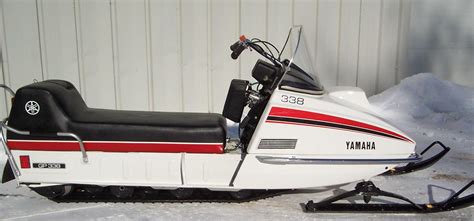
The Exciter burst onto the scene during the evolution from snowmobiles as family utility machines that could play a little bit to pricey personal recreation devices. Initially offered with a choice of 340 or 440 engines, both of which were stronger than average for their displacement, the Exciter was also well very equipped for the day. And the Exciter was also one of the first snowmobiles to be fitted with a shock absorber charged with compressed nitrogen over oil instead of the usual air over oil, resulting in better rear suspension performance.
Read also: Evolution of Ducks Jerseys
Snow Goer evaluators were really pleased with the new model, saying that “all we had to write about (previously) was Yamaha’s durability and consistently strong engine. According to an owner’s survey published the following season in Snow Sports magazine, first year Exciter buyers were generally happy with their new ride, praising its handling and stability, overall performance and oil injection. But on the other hand, many did not like the fuel economy or the grabby clutching that quickly wore belts and required frequent lubrication.
As one owner put it, “It has bugs. The Exciter really hit stride with the 1977 model. Revised porting provided a modest power increase. But the real improvement resulted from another race track technology transfer, the drive clutch from the SRX suitably retuned for the fanner’s power band.
The Exciter was continually improved in typical Yamaha fashion. The 1978 model brought a new Keihin carb that improved fuel economy, new bearing materials in the drive clutch for better reliability, a more tapered tunnel, new seat and footrests, an 8-gallon gas tank and relocated larger instruments for better readability. And the 1979 version changed hood color to black with red trim. It was also the last year for the 340 version.
By the end of its initial six-year run, the original Exciter had been a huge asset for Yamaha in weathering the final stages of the great manufacturer shake-out. My buddy Tony “Yammiegod” Bellucco sums up the Exciter as “One of the best Yammies of all time. Engine: 433cc Yamaha reed valve 7-port “Torque-Induction” axial fan-cooled twin with one Keihin PW42-38 slide valve carb.
The SRX and VMAX Era
The SRX of 81 and the VMAX of 82 were machines of which Yamaha wasn't't exactly proud. Rather than just ignoring the problem, Yamaha never has released the last year's VMAX, and has offered excellent terms for trading in the 81s.
Read also: A History of Bogner Ski Wear
Tom Berkley, Assistant Product Manager- Snowmobiles, discussed the development of these "Lake Rockets." He explained that the concept originated from oval racing, where manufacturers developed small, lightweight, very fast sleds. As oval track racing declined, manufacturers realized there was still a market for these machines as super, hot trail sleds.
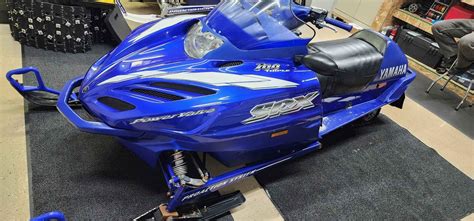
The 1981 SRX was designed for lake racing, boasting a lot of horsepower for a 440, capable of exceeding 100 mph. While it offered good acceleration, top speed, and suspension, Yamaha learned that customers desired a high-performance machine that was also a good trail machine.
Many people are interested in general snowmobiling. Of course there are some who would buy them as status symbols, but the demand is good for low end torque, excellent mid range performance, and smooth clutching-- so the machine can be ridden on the trails.
The primary change from the 81 SRX to the 82 VMAX was to increase the displacement from 440cc to 500cc to maintain a high level of horsepower. This gave the machine more horsepower at engagement rpm and at mid- range.
However, Yamaha didn't think the 82 was significantly better than the 81 in terms the average customer was looking for. Machines like the SRX, with radical porting and carbs to match, have a tendency to be very sensitive to carburetion. They require frequent adjustment to suit the temperature and the altitude.
Read also: High-Speed Yamaha
The SRX has a rather narrow tolerance for fuel mixture. So, if you went a few sizes too rich, it was really rich. If you go a size on the lean side it seizes. That is a narrow fuel tolerance. It was an intolerant engine fuel wise.
Despite the excellent promotion on the 82 VMAX, Yamaha chose not to release the sled. They felt it was the right decision for the majority of customers. Almost all of the 82 VMAX sleds are still being housed. We have not yet decided what to do with them. We did use some in our distributor racing program in Alaska which is a series of about five or six races, anywhere in length from about 100 miles to 600 miles. Tim bender of Aaen Performance won three races with one. It was actually a very good machine and very reliable in the right hands.
Yamaha values its high-performance customers, because we realize that the people who buy the SRV's and the SRX's are interested in and have the capability of buying a new machine every year. Usually the influence the purchase of many more snowmobiles. They are usually the leader of their clubs or their family groups.
I have one to day, it was sold as new in April 1982 and with licenseplate on it 6 april 1982 .. No mather what else they say, the sled became a hit in Norway and there where a lot of them sold up here! i still remember it, and i had one my self back in 1985 to 1988.
1982 Yamaha SRX 500
tags: #vintage #yamaha #snowmobiles