Warren Miller, a dedicated skier and World War II Navy veteran, began his filmmaking career shortly after his 1946 discharge. Using his mustering-out pay, he acquired an 8mm Bell & Howell camera to document his passion for skiing.
His earliest experiments included capturing skiing footage during a 1944 Christmas vacation in Yosemite National Park using a borrowed camera. However, it was not until 1949, while instructing at the newly established Squaw Valley Ski Resort in California, that he systematically filmed material for a full-length production.
The launch of Miller's inaugural feature, Deep and Light in 1950, marked the origin of his annual ski film series, self-financed on a $600 budget amid significant production hurdles such as rudimentary equipment and the absence of synchronized sound.
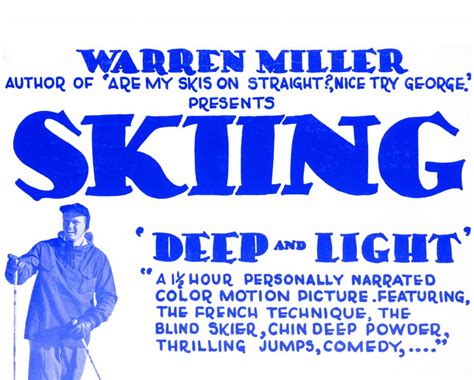
From these local origins, Miller's operation expanded rapidly in the 1950s, evolving into national tours that screened his films in auditoriums across the United States and helped propel skiing's popularity beyond regional enclaves. By the mid-decade, milestones like the inclusion of European footage in Have Skis Will Travel (1956)-featuring Switzerland's slopes and the first downhill race in a Miller production-signaled growing international ambition, built on earlier 1953 scouting trips to the Alps.
This progression reached a pinnacle with Around the World on Skis (1962), which documented skiing across Europe and other continents via Pan American Airways, broadening the series' scope and appeal. Warren Miller personally directed 38 annual ski films from 1950 to 1987, personally handling cinematography, editing, narration, and production for every entry in the series. These films covered everything from local ski resorts to international adventures and emerging extreme styles.
Read also: Examining the Mitchell Miller Case
Miller's hands-on approach emphasized dynamic action footage, humorous narration, and a sense of adventure, often filmed in locations like Sun Valley, Aspen, Squaw Valley, and European Alps.
Warren Miller enters 75th year of ski filmmaking
Key Warren Miller Films and Their Significance
Here is a detailed look at some of Warren Miller's most influential films, highlighting their primary locations, notable innovations, and key events:
| Year | Title | Runtime | Primary Locations Filmed | Notable Innovations or Events |
|---|---|---|---|---|
| 1950 | Deep and Light | Approx. 90 min | California (primarily Squaw Valley) | Debut film; shot on a $600 budget with 16mm equipment; focused on powder skiing and early West Coast scenes. |
| 1951 | California Skis | Approx. 60-90 min | California resorts | Early emphasis on regional skiing culture and technique. |
| 1952 | Wandering Skis | Approx. | terrains. | |
| 1953 | Ski Fantasy | Approx. | West | Highlighted freestyle elements and fantasy-like ski sequences. |
| 1954 | Symphony on Skis | Approx. | and European resorts | Musical synchronization with skiing action; early international scope. |
| 1955 | Ski on the Wild Side | Approx. | mountains | Explored off-piste and adventurous skiing styles. |
| 1956 | Have Skis, Will Travel | Approx. 60-90 min | National/World Championships; Nordic sites | Captured competitive skiing, bobsledding, and championships. |
| 1958 | Are Your Skis on Straight? | Approx. | and international | Featured rock climbing, glacial flying, and toboggan events alongside skiing. |
| 1960 | Swinging Skis | Approx. 60-90 min | Various global | Emphasized swinging turns and rhythmic skiing. |
| 1961 | Many Moods of Skiing | Approx. | resorts | Explored emotional and stylistic variations in skiing. |
| 1962 | Around the World on Skis | Approx. 60-90 min | Worldwide (Switzerland to Morocco) | Global travel narrative; early extreme elements. |
| 1963 | The Sound of Skiing | Approx. | and Europe | Audio-focused editing with natural ski sounds. |
| 1964 | The Skiers | Approx. 60-90 min | Various | Portrait of skier lifestyles and competitions. |
| 1965 | The Big Show | Approx. | events | Showcased large-scale ski demonstrations. |
| 1966 | The Way It Was | Approx. | sites | Reflected on skiing's past and present. |
| 1967 | No Boundaries | Approx. 60-90 min | Remote terrains | Pushed limits of accessible skiing areas. |
| 1968 | The Last of the Ski Bums | Approx. 60-90 min | Iconic resorts | Definitive overview of modern skiing. |
| 1970 | Sound of Winter | Approx. 60-90 min | Winter landscapes | Immersive sound design for seasonal vibes. |
| 1971 | Winter People | Approx. 60-90 min | Community-focused sites | Highlighted social aspects of winter sports. |
Ski Country, with its ski ballet, monoskiing, and oddly hypnotizing demo-team segments, encapsulates the hedonism of the time. From there, the movie transitions straight into a Miller classic: making fun of newbie skiers struggling to ride lifts or carry their ski gear. Then it heads to Chamonix and heli-skiing in British Columbia.
Steep and Deep heralded the dawn of extreme skiing. It made ski films cool instead of goofy, it introduced the idea of big-mountain skiing to the masses, and it gave a new generation of skiers the idea that they could make a living from chasing snow. The extra-1980s, synth-filled soundtrack underscores the ballsiness of skiers like Scot Schmidt and Tom Day as they drop cliffs in the Palisades.
Beyond the Annual Series
During the period from 1985 to 2004, Warren Miller Entertainment produced seven standalone ski films outside the main annual series, often focusing on instructional techniques, behind-the-scenes insights, or specialized extreme skiing themes. These works overlapped with the primary releases, such as the 1985 instructional film released alongside the feature Steep and Deep, providing supplementary content for enthusiasts seeking targeted skill-building or niche explorations.
These films generally ran 30 to 60 minutes, making them accessible for targeted audiences rather than full evening tours. Distributed primarily via VHS tapes and later DVDs through home video markets or ski shop networks, they avoided the annual theatrical cycle and instead supported promotional efforts, such as skill clinics or regional ski events.
For instance, the instructional titles like Learn to Ski Better and its sequel addressed niche demands for technique refinement amid evolving equipment, while Behind the Skis offered intimate looks at the filmmaking process to engage fans beyond on-slope action.
Retrospective Compilations
Warren Miller Entertainment has produced several retrospective compilations that draw from the extensive archive of over 70 years of ski footage, highlighting key moments and themes from the brand's history. One prominent example is Fifty (1999), a special production marking the 50th anniversary of Warren Miller's filmmaking career, which features narrated segments blending new international skiing action with reflections on five decades of winter sports evolution.
Recent Films
An adventurous ski tour of two sisters, who follow the tracks of their father, across the pristine landscapes of New Zealand. 30 years ago, Gottlieb Braun-Elwert set out on an incredible expedition. He traversed the major glaciers of the Southern Alps, covering 40km and 4000 vertical meters, from the heart of the South Island to the West Coast in just 18 hours. A route of astonishing beauty, immense freedom, breathtaking vistas and dealing with the challenges of an untamed wilderness. He called this route Symphony on Skis. Now, his daughters Carla, Elke and a small team of adventurers embark on the same journey. This film is a homage to their late father who found a love and home in New Zealand's Southern Alps.
Director: Carla Braun-Elwert.
Stars: Carla Braun-Elwert, Elke Braun-Elwert, Keith Payne.