Boot choice may be the most important thing to get right for nordic skiing.
Cross country skis are measured in European (EU or Euro) sizing, so if you know your US shoes size or mondopoint size, just use the chart below to get in the right ballpark.
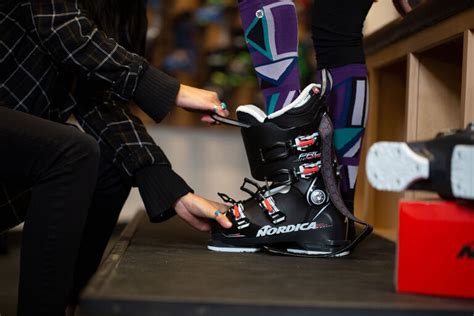
THIS IS HOW SKI BOOTS SHOULD FIT
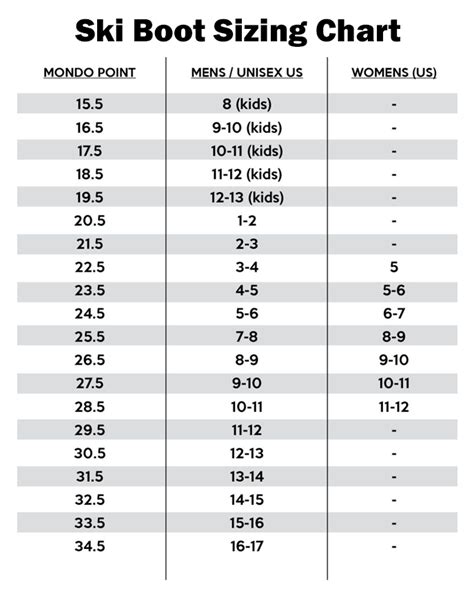
Here is a cross-reference chart to help you find the correct EU size:
| US Men’s | US Women’s | US Kids | Euro | Mondo point (mm) |
|---|---|---|---|---|
| - | 4 | - | 35 | 223 |
| - | 4-1/2 | - | 35-1/2 | 225 |
| 4 | 5 | 5 | 36 | 230 |
| 4-1/3 | 5-1/3 | 5-1/2 | 36-1/2 | 233 |
| 4-1/2 | 5-1/2 | 6 | 37 | 235 |
| 5 | 6 | 6-1/2 | 37-1/2 | 240 |
| 5-1/2 | 6-1/2 | 7 | 38 | 245 |
| 5-2/3 | 6-2/3 | 7-1/2 | 38-1/2 | 248 |
| 6 | 7 | 8 | 39 | 250 |
| 6-1/2 | 7-1/2 | - | 39-1/2 | 253 |
| 7 | 8 | - | 40 | 255 |
| 7-1/2 | 8-1/2 | - | 40-1/2 | 260 |
| 8 | 9 | - | 41 | 265 |
| 8-1/3 | 9-1/3 | - | 41-1/2 | 268 |
| 8-1/2 | 9-1/2 | - | 42 | 270 |
| 9 | 10 | - | 42-1/2 | 273 |
| 9-1/2 | 10-1/2 | - | 43 | 275 |
| 9-2/3 | 10-2/3 | - | 43-1/2 | 280 |
| 10 | 11 | - | 44 | 283 |
| 10-1/2 | 11-1/2 | - | 44-1/2 | 285 |
| 11 | 12 | - | 45 | 290 |
| 11-1/2 | 12-1/2 | - | 45-1/2 | 295 |
| 12 | 13 | - | 46 | 297 |
| 12-1/3 | - | - | 46-1/2 | 300 |
| 12-1/2 | - | - | 47 | 305 |
| 13 | - | - | 47-1/2 | 308 |
| 13-1/2 | - | - | 48 | 310 |
But remember, a lot goes into choosing the right size, and looking at a chart won't always get you exactly what you need.
How Should a Cross Country Ski Boot Fit?
Here are some general principles for those who have not participated in snow sports.
Read also: Versatile Cross-Country Skis: Alpina Discovery
- All boots should fit like a firm handshake.
- They should not allow your heel to move up and down.
- Make sure you can wiggle your toes.
The boots should allow room in the toe box so that your toes are not “scrunched”. Toes and metatarsal bones are important for balance. Too much pressure (too narrow) can compromise your balance and circulation. Boots that are too short can also lead to injury and loss of circulation.
More Ski Boot Fitting Tips
Ski boots should be tighter than regular shoes. Any ski boot fit is not the same as the shoes you may wear at work, in the house or while enjoying watching world cup racing on TV. They are supposed to be snug and supportive.
Spend some time in the fitting process. This will pay off by getting it right the first time. Each boot company develops their own lasts (forms on which they make the boots).
A Fischer size 43 is not the same fit as an Alpina 43 or a Salomon 43. It's best to try a few and see what feels best.
The high priced, stiffest, lightest boots tend to have a more narrow fit. This is what the racers want. The recreational skier is not demanding the same fit/control as the competitor.
Read also: Types of Ski Boots Explained
Types of Cross Country Ski Boots
When shopping for cross country ski boots, it helps to have a clear view of the type of skiing you are planning.
Do you like skate skiing, classic skiing, or backcountry touring? Are you looking to race or ski recreationally?
Cross Country Ski Boots for Racing
Top level competition boots, skate or classic, should fit more snuggly than lots of people like.
The people who are seeking a top level comp boot tend to ski often, ski with a high heart rate, wax their skis often for speed, dress lightly (think lycra) because they work hard enough to get warm.
Cross Country Ski Boots for Recreation
People who are more inclined to see cross country skiing as a great way to get some exercise in the winter, ski once or twice a week or less often and wear heavier gloves and pants may be seeking a boot with a “performance” or recreational fit.
Read also: Guide to Snowboard Boot Inserts
Boots for classic track skiing are supposed to be flexible, almost like a running shoe. These boots are a little wider, somewhat heavier, not as stiff as skating boots, and have more padding/insulation than the comp boots. These boots are made with less expensive components (less carbon fibre) and cost less.
Combi Cross Country Ski Boots
Combi boots are boots with a flexible sole that can be used for classic striding and it has a cuff (stiff collar) around the ankle for support in a skate motion.
They will be heavier than a classic boot and softer than a dedicated skate boot, but they are often the choice for the skier who wants one pair of boots that will accomplish the task in two different disciplines.
We see many high school age skiers who are new to the sport who choose a combi boot for the first season on the ski team. If they like the sport and stick with it, they generally get dedicated skate and classic boots the following year. The prices on combi boots will run from $200 t0 $350.
Another good use of the combi boot is for what we call light touring or cruising. This is the skier who may ski in the classic track some of the time and into untracked trails part of the time. This skier may be new to the sport and is seeking a boot that gives more control of the ski than a boot for classic track skiing. The combi boot is often the choice for entry level into nordic skiing.
Cross Country Ski Boot Brands
Fischer Cross Country Ski Boots
Fischer boots tend to fit many kinds of feet. They are one of the wider fits of the brands we carry. The Speedmax boots are narrower than the Carbonlites or the RCS. Heel width is “normal”, instep accepts a fairly high instep/arch.
Alpina Cross Country Ski Boots
Alpina boots tend to fit low volume, narrower feet. Again, lower price points are wider.
Salomon Cross Country Ski Boots
Salomon boots fall in between the Fischer and the Alpina. I have a low volume, narrow foot and usually ski in an Alpina boot. Last year the higher end Salomon boots came for me to try and I liked them.
Madshus Cross Country Ski Boots
The Madshus boots also fit a lot of different feet.
Cross Country Ski Boot FAQs
What is my cross country boot size?
Head back up to our cross country ski boot size chart to compare your US shoe size to the EU size that XC boots use for sizing.
How should my cross country ski boots fit?
Cross country ski boots should fit snugly, tighter than your regular shoes. Your heel should not move but your toes shouldn't be too scrunched.
Those are the basic guidelines, but how you ski is also an important factor to consider when trying to get the right fit. For instance, race boots should be tighter than boots for casual recreation.
Do all cross country boots fit all skis?
The issue is that not all cross country boots fit all ski bindings. You need to make sure the bindings on your skis will work with your boots, or buy new, compatible bindings for your skis.
Should I size up or down for ski boots?
You shouldn't size up or down without trying on the cross country ski boots you're considering. You need to make sure you have a snug fit that's not too tight or too loose, so don't solely use the size chart to find your size. Come in and try a few pairs on!
Are cross country ski boots different?
Cross country boots are different than regular alpine, or downhill, ski boots. The heel on cross country ski boots is designed to lift up off the ski so you can push forward in a gliding motion. Also, within the cross country discipline there are different kinds of boots.