Selecting the right snowboard boots is crucial for comfort, control, and performance on the slopes. Different boots are made for riding in specific conditions, so knowing your preferred riding style is the first step to finding your ideal pair of boots. This guide will help you understand the key features and how to find the perfect fit for your backcountry adventures.
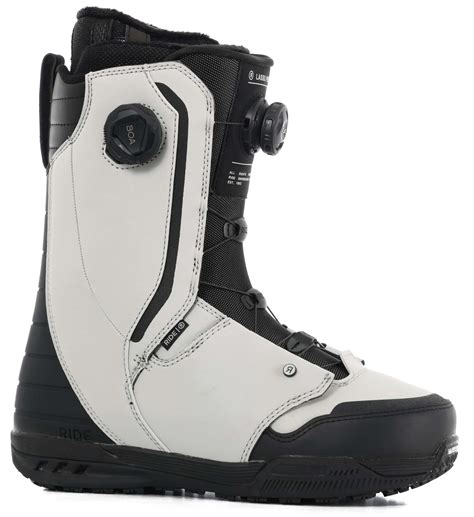
Understanding Snowboard Boot Fit
Snowboard boots should fit snugly but comfortably. Here's how to assess the fit:
- Toe Fit: When standing straight, your toes should lightly brush the front of the boot. When flexing forward, your toes should pull back slightly.
- Heel Fit: Your heels should stay down with minimal lift when flexing. Heel-lift is the enemy of performance-minded snowboarders; when you lean forward you want your board, not your heels, to rise.
- Shell Fit: Remove the liner and slide your foot into the shell. Stand up straight, and your toes should lightly touch the front. Flex forward; there should be minimal heel lift.
Remember, liners pack out with use, so boots may feel slightly looser after several days on the mountain. Don't be tempted to buy a boot that feels loose or sloppy out of the box. It's OK for toes to just barely graze the boot's toecap. Ensure that the fit in the rear of the boot is snug.
When it comes to fit, each boot and each brand will be different. Some brands will fit narrow, and others will fit wide. Overall, you want your boot to be snug (like a firm handshake), and ideally, your toes to be touching the front of the boot.
Some snowboarders like to cram their feet into boots that are a size too small for extra performance. Though this may work for some at the resort, where you can just jump in the lodge when your feet fall asleep, it’s not the best option for splitboarding-sometimes you’ll be out all day, and you don’t want to be the one who has to stop the group every mile so you can take your boots off.
Read also: Ski Shovel Buying Tips
It’s always best to try a boot on before buying it. If you can’t try it on ahead of time, wear the boot around your house once it arrives for about 30 minutes. If there’s pain in that short amount of time, it’s probably not a great fit-return the boot and try another brand. There’s not much worse than having foot pain out on the mountain, let alone in the backcountry.
Snowboard Boot Flex and Riding Style
Your goal: Find boots designed to perform where and how you usually ride.
Boot flex refers to the stiffness of the boot and should align with your riding style. Finding snowboard boots with a flex that matches your riding style can make a big difference. Snowboard boots are typically categorized as soft, medium, or stiff.
Boot flex is often a personal preference, but flex does align roughly with the type of snowboarding you do.
Here's how each riding style is defined:
Read also: Choosing Backcountry Ski Pants
- All-mountain: Refers to any terrain suited to a snowboard-groomers, untracked powder and even some park-and-pipe. The majority of riders are all-mountain riders, and the majority of all-mountain riders will gravitate toward more flexible boots. Softer boots are ideal for beginners. For fast riding, however, choose stiffer boots. Backcountry splitboarding usually falls into this category.
- Freeride: Encompasses off-piste (untracked backcountry) terrain and some groomed runs, but not terrain parks. Freeride is sometimes also referred to as "big mountain" riding. Freeriders place a premium on speed and precision, so stiffer boots are preferred. This rigidity helps generate edge power for scribing lines across icy (firm) snow.
- Freestyle: Fun-focused terrain (half-pipe, rails, jumps, spins, jibbing, and tricks). Maneuverability, feel, and quick responses are vital to the park experience, so softer, more flexible boots are the usual choice.
Understanding Flex
- Soft Flex: Ideal for beginners and park riders seeking comfort and maneuverability. Soft boots are ideal for freestyle minded riders as they offer more amounts of maneuverability, allowing for more expressive styles of snowboarding. The downside to soft boots is that they lack support and response compared to medium and stiff boots. This means your legs have to pick up the slack and can lead to more leg fatigue during a day on the hill.
- Medium Flex: Suitable for all-mountain riders desiring a balance of support and flexibility. Most snowboard boots fall under a medium flex rating. A medium amount of flex is ideal for riding all types of terrain and is what we suggest for most beginners, weekend warriors, and experienced rippers who ride everything. If you’ve done your research and are still unsure of what flex rating is best for you, a medium flexing boot is usually a very safe buy.
- Stiff Flex: Best for advanced riders and freeriders who prioritize control and responsiveness at high speeds. Stiff boots are designed for hard-charging, freeride-focused riders who want the best performance on the steepest, most challenging terrain. By increasing the boot’s stiffness, riders get added leg and ankle support that allows them to drive more immediate pressure into their snowboard’s edge, creating more secure edge hold and response on steep, challenging terrain. Stiff boots don’t leave as much room for correcting mistakes while riding though and are a bit overkill for most newbies so we don’t recommend them for beginners.
Here are general flex recommendations to get you started:
| Snowboard Riding Style | Terrain | Snowboard Boot Flex |
|---|---|---|
| All-Mountain | Groomers, untracked powder, some park | Soft to medium boots for most riders; stiffer boots for fast riding, racers |
| Freeride | Off-piste (untracked backcountry), some groomed runs | Stiffer boots for edge power and control at high speeds |
| Freestyle | Park terrain (half-pipe, rails, jumps, tricks) | Softer, more flexible boots for quick responses and maneuverability |
Flex by rider weight:
- Bigger rider → needs stiffer boot
- Smaller rider → needs softer boot
Rider level & style:
- Beginners → softer boots (comfortable, forgiving, easier to control). Example: Vans Aura OG
- Advanced/all-mountain → stiffer boots (more control, precision). Example: K2 Thraxis
- Freestyle riders → often prefer softer boots (playful, forgiving)
Boot cost and flex:
- Entry-level, less expensive = usually softer
- Premium, more expensive = usually stiffer
Bottom line: best flex = personal preference.
Read also: Explore Vail's Backcountry
What Is The Proper Snowboard Boot Fit?
Snowboard Boot Lacing Systems
Choosing the right lacing system can enhance convenience and performance. Snowboard boot lacing is important. Boots should be laced tightly yet feel comfortable and be free of blister-causing pressure points. Ankles and heels ought to remain securely in place, with minimal heel-lift-no foot shimmying at all (front to back, side to side), if possible.
Most snowboard boots offer one of three lacing systems-traditional, quick-pull, or Boa. Some boots feature a hybrid design that blends 2 of these systems. Each system is fast, handy and secure, and no single system decisively outperforms the others. The system you choose is mostly a matter of personal preference and budget.
- Traditional Laces: Offers customizable tightness but can be challenging to adjust with gloves on. These are tried-and-true and, for the most part, foolproof. On some boots it's possible to replace stock laces with specialty or designer laces.
Pros:
- Tightness of the fit can be customized by hand.
- Inexpensive.
- Replacement laces are easy to locate.
Cons:
- Difficult to tie while wearing gloves or when bare hands are cold.
- Vulnerable to unintended loosening.
- Quick-Pull Laces: Allows for fast adjustments and zonal tightening. This single-pull, corset-like lacing system is fast and accommodates zonal tightening. That means you can fine-tune the tightness of forefoot lacing independently from the ankle and lower leg.
Pros:
- Fast and convenient.
- Can be tightened while wearing gloves.
- Lace-pulls usually tuck away neatly.
- Several systems offer independent high-low (ankle-foot) laces for a customizable fit.
Cons:
- May initially appear complex.
- A few riders find they cannot exert enough pull to tighten laces as snugly as they would like.
- Points (usually eyelets) where laces attach to boots can sometimes create pressure points.
- Somewhat vulnerable to unintended loosening.
- If lace wears out or breaks, it could prematurely end a day of riding.
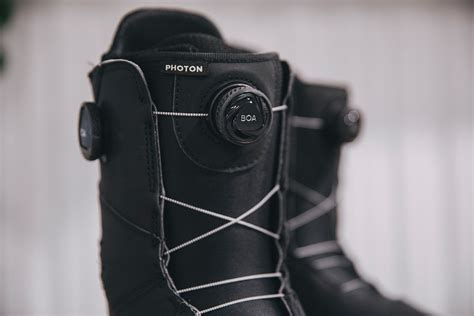
- BOA System: Provides precise, one-handed adjustments and is easy to use with gloves. The Boa system consists of small-diameter cables (usually small strands of stainless steel) attached to one or two knurled wheels or dials that adjust the snugness of the fit. If two dials are used, one is on the top of the boot tongue and another is near the ankle. Boa permits a very precise fit around the foot and lower leg.
Pros:
- Fast, easy and convenient.
- Usually requires just one hand.
- Simple to modify during a pause in activity.
- Can be adjusted while wearing gloves.
- Offers a precise, fine-tuned fit.
- Excels at shedding grit and slop.
Cons:
- One-dial system applies uniform snugness throughout foot, so upper and lower foot regions cannot be independently customized.
- Points where strands attach to boots can sometimes create pressure points.
- If a strand breaks, it could prematurely end a day of riding.
- Adds to boots' overall cost.
Snowboard Boot Liners
Liners provide cushioning, insulation, and support. "Liner" refers to the entire inner boot of a snowboard boot. Liners are commonly made from ethylene vinyl acetate (EVA), which is a lightweight, moldable polymer that most people associate with foam rubber. As it does in running shoes, EVA provides cushioning, stability and insulation for a snowboarder's feet.
Some boots have removable liners that can be removed from a boot when you're done riding. This allows them to air out and dry faster than nonremovable liners.
Liners fall into three basic categories:
- Non-Moldable Liners: Offer basic comfort and are suitable for casual riders. Less pliable than other options, stock liners provide generic padding and stability for your feet. Over time the sustained pressure of your body weight will likely cause the liner's forefoot section to conform to that section of your foot's shape.
- Thermoformable Liners: Use body heat to mold to your foot over time, enhancing comfort. Thermoformable foam liners use your foot's heat to achieve a custom fit. They break in after a day or so of snowboarding.
- Custom Moldable Liners: Can be heat-molded in a shop for a personalized fit. Custom moldable liners use an artificial heat source to achieve a custom fit. Though best done at REI or other ski shops with boot-fitting expertise, it is possible to do at home.
Many dealers offer heat molding services to customize your liners for optimal fit and comfort.
Specific Boot Models for Splitboarding
A common question we get at Outdoor Gear Exchange is, “Do I actually need a specific boot for splitboarding?” Thankfully, the answer is no. But if you're in the market for new boots and you find yourself out on the skin track from time to time, but you don’t want to dish out the money for one of the boots listed above, there are resort-style boots that will cater more towards splitboarding than others.
Deeluxe Spark XV
Deeluxe went all out on the build of the Spark XV: An ultra-durable mesh outer lightens things up, while a stiff, semi-automatic crampon-compatible mountaineering sole provides climbing prowess. Inside the boot, a TFP liner with Sympatex Moisture-Tech membrane keeps your feet dry and warm. Finally, Deeluxe’s C3 construction allows you to customize the stiffness, flex, and feel of the boot with just two lace pulls, making them ultra-quick to adjust in the backcountry. The Spark XV is one of the best and most reliable splitboard mountaineering options on the market today. Though designed to be an aggressive splitboard mountaineering boot, it offers great performance at the resort as well.
Salomon Trek S/Lab
The Trek S/Lab was designed in the French Alps with splitboarding performance in mind. If your days look like multiple pow laps or hikes before and after work, then this may be the boot for you. The key feature to the Trek S/Lab is its Trek and Ride boa system: Allowing the upper cuff to articulate forwards and back, Trek and Ride provides the “hike mode” splitboarders have been missing out on until now. It’ll give you optimal glide and hike performance on the way up, then you just lock and spin the boa for a true snowboard boot feel on the ride down. Salomon’s STR8JK heel locking technology is another one of the best enhancements to the ride of this boot. The lower lace system has an easy-to-use quick lock and a gaiter, so freezing into your boots is a problem of the past. A Full Custom Fit Pro liner that is fully heat-moldable and an Ortholite C3 insole that features a molded heel cup will keep those feet feeling great pow lap after pow lap, morning or night. This boot seems to be the best option out there for a purely splitboard-specific boot. While there are some varying reviews of Salomon’s STR8JK feature, the trick is to fine tune the feel.
Salomon Dialogue Focus Boa
The Dialogue Focus Boa from Salomon is designed to be a stiffer, more freestyle-oriented boot. It would be ideal for someone who comes from a freestyle background, or for someone who still spends their days in the park when they’re at the resort but will get out to splitboard when the snow is good. The Dual Zone Boa and Salomon’s Winter Contagrip are the key splitboarding-specific features to this boot. The Dual Zone Boa-as its name suggests-consists of two zones: the Lower Zone controlled by the side Boa, and the upper zone controlled by the front Boa. The lower lace zone on the boot locks in the lower part of the boot to create a snug feel for the foot. The upper lace zone on the boot allows the snowboarder to gain more ride control the tighter the laces become. For splitboarding, you may decide to keep the lower zone snug for as little movement in the foot as possible, and the upper zone on the looser side to allow for a greater range of motion on the ascent. Once you transition over to snowboard mode, you can tighten the upper zone for a responsive snowboard feel on the ride down. Salomon’s Winter Contagrip is their patented durable outsole technology (AKA: the part of your boot that connects you to your snowboard or the ground). Since a splitboard binding does not have EVA foam on its baseplate, it can be considered less comfortable to ride.
Salomon Ivy Boa SJ
Salomon’s Ivy Boa SJ is designed with the female freestyle rider in mind. This mid flex boot has a narrower foot and lower boot cuff. It's ideal for the woman rider who sees the mountain as a playground: Popping in and out of the trees finding powder, but also spending some time in the park. The Ivy Boa's mid flex also makes this boot more forgiving for a woman transitioning from a beginner to intermediate splitboarder, and who may only be taking their splitboard up their local ski resort or on their first few tours into the backcountry. The highlight features of this boot are Salomon’s STR8JK heel lock technology (which we covered on the Trek S/Lab boot above) and Salomon’s Contagrip, which absorbs vibrations to create a more comfortable ride (also covered above on the Dialogue Focus). This is a great quiver killer boot.
K2 Maysis
As the number-one-selling snowboard boot in the US, the K2 Maysis is stiff in its performance and equipped with a few extra-epic features for a resort boot: K2 uses a Vibram Pro-lite Outsole on the Maysis. This outsole, like Salomon’s Contagrip, allows for a more comfortable ride by absorbing vibrations, and it’s grippy for walking around in winter conditions. Additionally, for the rider that has a wider foot, the Maysis comes in a wide version. Another key feature to the Maysis’ superb ride performance is the Boa Conda, a K2-patented urethane harness that locks the heel in place while riding. The Boa Conda is controlled by the Boa knob on the side of the boot. The boot’s Intuition Control Foam 3-D liner is built for comfort, and includes J-Bars for added ankle support.
Burton Photon Boa
Burton’s Photon Boa is the Swiss Army Knife of the Burton boot line. It’s a stiff-flexing boot that has a number of drool-worthy features that allow it to excel from park to backcountry. Burton includes B3 Gel cushioning combined with Vibram’s 30% recycled EcoStep Rubber outsole to give the Photon ultimate grip in wintery conditions and to absorb vibrations. The dual-zone Boa uses New England Ropes, and allows a rider to use the side boa to lock the lower foot while giving them customization options for the upper when hiking uphill. Combine these features with Burton’s Imprint 3 liner and you have one fantastic boot!
Burton Felix Boa
If you’re looking for a boot that delivers on performance, while also being cushy on both your wallet and your feet, Burton's Felix Boa is your boot. This mid-flexing boot has the customizability for performance on the up and down with its New England Ropes Dual Boa, and it keeps your feet warm with sleeping bag-comparable heat reflective foil. This boot is for the rider who takes it to the whole mountain: That means in the park, on steep groomers, or in the trees.
Additional Tips for Choosing Snowboard Boots
- Sock Selection: Wear thin, synthetic or merino wool snowboard socks when trying on boots to ensure an accurate fit. These thin, smooth-faced socks allow moisture to pass through easily while producing less friction and fewer hot spots.
- Overall Flexibility of the boot: If the boot is stiff, you can ideally open or loosen up the upper for comfort on the hike up, or choose to sacrifice some efficiency on the hike up for exceptional performance on the way down.
As always, if you have any questions, hit us at our live chat, by phone, social media DMs, or simply come into the shop.
tags: #backcountry #snowboard #boots