In the late Victorian era, cities from Montreal to Moscow embarked on an unusual trend: erecting large "ice palaces" as novel attractions during winter festivals. These magnificent structures captured the imagination of the public and provided unique entertainment experiences.
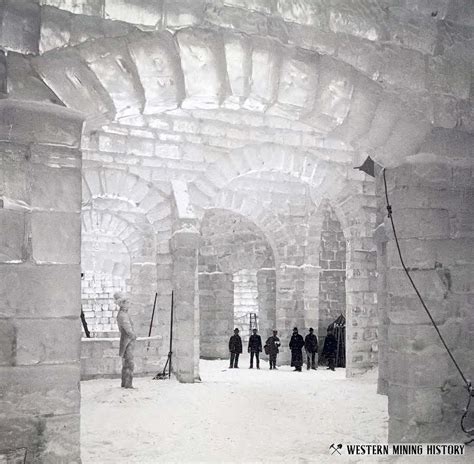
Leadville Ice Palace, 1896
The Leadville Ice Palace: A Glimmer of Hope
Leadville was born from the fabulous gold strikes in 1860, and for two decades, the town thrived with fortunes made from the rich ore of the surrounding mines. But in 1881, some of the largest, wealthiest mines began to play out after years of exploitation. The miners began to leave, searching for richer finds, stores and banks failed, and the town was consumed by fires that destroyed the rows of wooden structures. Although Leadville was at one time the largest boomtown in Colorado, the mines were in decline by the 1890s, which was made worse by the repeal of the Sherman Silver Purchase Act in 1893. In 1893, the Herald Democrat, reviewing the events of the year, expressed: “Those were the days of panic and gloom for Leadville.
Before the winter of 1895, the desperate townspeople proposed a mammoth ice castle to draw sightseers, create jobs, and rescue the town’s flagging economy. That August, Edwin Senior, a local real estate developer, presented an idea to Leadville’s city council. Why not host a huge winter carnival, accented with a big palace made entirely of ice? Leadville would have plenty of ice come winter, Senior explained, and besides, such mega structures had been a great success in Montreal, Canada, and St. Paul, Minnesota. A great deal of discussion about the idea went on for several weeks as donations and support were solicited for the project.
By early October, a viable site had been selected. The spot was on a hillside in Block 53, between West 7th and West 8th Streets, where it would be visible from downtown. Unfortunately, Edwin Senior might have been great at ideas, but not so much at raising money. Donations were lacking, and towards the end of October Mr. Tingley Wood was nominated as a replacement.
Read also: Learn to Snowboard: Crystal Mountain
One of the largest "ice palaces", built in the failed gold boom town of Leadville, Colorado in November and December of 1895, had an 80 X 100 ice rink installed inside and employed over two hundred and fifty men in its construction. It cost upwards of twenty five thousand dollars to build - no paltry sum in 1895!
Construction and Design
Anticipating trains full of tourists, the project began by hiring Charles E. Jay, an architect who had designed an ice palace in St. Paul, Minnesota. Architect Charles E. Jay, who previously designed the ice palace in St. Paul, was hired to draw up plans for the Ice Palace. Amazingly, the fundraising had nearly reached its $20,000 goal by the time Mr. Jay arrived later that day. As he got situated, the site was being prepared. Architect Jay’s plans were amazing. The Ice Palace measured 450’ long by 320’ wide, with five-foot thick walls. Two octagonal towers rose 90 feet at the entrance on the north, where beautifully arched doorways led visitors inside. Smaller, 60 foot towers flanked the sides and the south wall.
Construction began November 1, 1895, with a crew of 250 men working day and night. Day laborers were paid $2.50 per day, and skilled laborers were paid $3.00 per day. The Ice Palace was built in just 36 days utilizing 5,000 tons of ice. The palace was more than 58,000 square feet - 325 x 180 feet, utilizing 180,000 board feet of lumber and 5,000 tons of ice. The palace was supported by a complex framework of trusses, girders, and timber, with the ice for appearance only.
Jay designed a skating rink that would accommodate 1,000 skaters, two beautiful ballrooms, and a restaurant. A 20-foot wide promenade would lead people down the middle of the place. Aside from the wooden supports forming a skeleton from which to work, the entire building would be made of ice. The ice was trimmed to size and placed in forms, then sprayed with water, which served as mortar to bind the blocks together. After ice blocks were hoisted into place, they were covered with boiling water, which froze faster than cold water.
As plans were firmed up, over 250 men were employed to build the Ice Palace. Meanwhile, city officials wisely conferred with St. Paul officials about what sorts of events would ensure success. On November 15, a parade was held as official construction neared commencement. Constructing a building of ice was different than any other. The blocks had to be shaved and shaped for continuity. Each finished wall was sprayed with water to freeze the blocks in place. When the Leadville Ice Company began running short, additional blocks were hauled in from nearby Evergreen Lakes, and as far away as Palmer Lake on the front range. Work continued thorough December as electric lights were attached to the ceilings.
Read also: Winter Fun at Hamilton Ice Arena
Just 36 days later, the Ice Palace, between Seventh and Eighth Streets on top of Capitol Hill, was opened on January 1, 1896. Leadville was now alive and buzzing with anticipation as everyone prepared for the thousands of people who were sure to visit. More hotels went up. Restaurants and shops nearly went into debt stocking up extra food and supplies. Ice Palace souvenirs were made. When donations ran low, newspapers solicited more money, and got it. Finally, on December 31st, the Leadville Ice Palace was ready to receive the public.
The Crystal Palace was located between 7th and 8th Streets, approximately two blocks west of Harrison Avenue. The February 16, 1896 issue of the "New Castle News" reported, "'Palace' is a good name for the structure, as it is a palatial building. At a distance it might be mistaken for a castle built of opals. It is seen to the best advantage at night, when the electric lights, with different colored globes - illuminate its sides and towers, producing an effect never before seen, and only read of in the fairy tales of our childhood. The main entrance - at the north end - is approached by a flight of steps of ice, and guarded by the imposing statue of Leadville, which is also carved from ice. Entering through the turnstyles, visitors find themselves in the lobby. By turning to the left the ball room is reached; to the right the dining room.
Following the wall, either way, you will find different exhibits such as fruits, flowers, meats, fished, bottled beer, and even patent medicines, frozen in large clear blocks of ice. A large picture of the Colorado at Glenwood Springs, with the pool and bath house, is thus on exhibition in a cake of ice. At one point you will find several stereopticons protruding from cakes of ice, and looking into them see views of different points of interest. At one end are a number of stuffed animals and birds... The ball room and dining room are each enclosed and heated by stoves. Between them is the skating rink. The side of each, looking on the rink, is entirely of glass and one may sit comfortably on either and watch the skaters. The rink floor is flooded every night, so that the ice is always smooth. If you care to skate there is a room where you can hire skates and a cloakroom where you can get wraps checked. If you cannot skate, you cannot fail to be amused in watching the skaters in their pretty skating costumes and toboggan suits, the latter of which are quite the rage with both sexes.
A Winter Wonderland
Visitors from far and wide were amazed by the spectacular castle, with its impressive size, electric lights casting a glow through the translucent walls, and American Beauty roses and 18-inch trout frozen in blocks of clear ice decorating the inside walls. For three months, the Crystal Carnival entertained more than 250,000 visitors until an early thaw in mid-March. The winter of 1895 and 1896 was the grandest Leadville had ever known. For the mostly mining population of Leadville, the splendidly grand Leadville Ice Palace was a fantasy come true.
The Crystal Palace opened on New Year's Day, 1896, with a lavish carnival including a merry-go-round, skating party opened to the general public, costume carnival, music by the G.A.R. Drum Corps, hockey game, banquet and boy's skating race. The first prize for the race was "a suit of clothes"; the second a pair of skates. On January 18, 1896, The Crystal Palace played host to a figure skating contest.
Read also: Ice Skating in Great Neck
The January 19, 1896 issue of the "Herald Democrat" reported, "The fancy skating contest brought out Otis Richmond, Alex Harvey, Jr. and Merritt P. Walley. These gentlemen went through the fancy figures with varying success, some of the figures being real feats of 'skatesmanship.' Richmond appeared to be in better training and more at ease than his competitors - though it must be said that Walley's evolutions were gracefully accomplished. Alex Harvey did not do his best work, being troubled with a weak ankle and requiring the skaters to execute all the figures without intermission, required too much endurance for Alex's weak ankle. Richmond was awarded first prize." Otis A. Richmond wasn't your typical well-to-do Victorian figure skater.
The Crystal Palace and Carnival was in full swing, with exhibits, including flowers and native animals frozen into ice blocks. In the restaurant, guests could view what was on the menu by looking at prepared meals that also were frozen in ice. There were carpeted reception rooms with fine furnishings. The ballrooms, as well as dressing rooms with maids and valets, were heated. There were cigars and candy. Photographs, and souvenirs. Dances. Competitions.
For nearly four glorious months, visitors paid .50 cents for adults and .25 cents per child to walk past the gorgeous ice sculpture of “Lady Leadville” at the entrance, and into the fantasy of their dreams. They enjoyed the frozen art pieces, listened and danced to the bands on the balconies, and admired the unique displays advertising Leadville’s hotels, newspapers, railroads and shops. They attended the small theater, and the men took full advantage of the gaming rooms with their games of chance. Children rode the merry-go-round. It is estimated that the number of visitors to the Ice Palace numbered over 250,000.
Thanks to discounted railroad tickets and special days for groups like the Shriners, the Colorado Press and others, there was always a crowd. Fireworks shows, hockey tournaments and rock-drilling contests were highly attended.
Incidents and Dissatisfaction
Even so, there were a few incidents. One of them concerned Madam Laura Evens of Salida, who was just a young Leadville harlot when she and her friend, Etta Murphy, dared to steer their horse-driven sleigh into the Ice Palace. According to Laura, the horse “got scared at the music and kicked the hell out of our sleigh and broke the shafts and ran away and kicked one of the 4 X 4′ ice pillars all to pieces and ruined the exhibits before he ran home to his stable.” That incident didn’t make the papers.
Added to the very rare incidents at the Ice Palace was the dissatisfaction of the local business owners. Visitors coming by train often only stayed for a day, and some brought their own lunch pail. Rumors were circulating that the structure was melting, or the walls were in danger of falling. They said pick pockets were running amok and there wasn’t enough for visitors to eat.
From January to March of 1895, the Crystal Palace drew in more than twenty-five thousand visitors. Yet, instead of infusing the ailing local economy with some much-needed cash flow, the Crystal Palace's operating costs alarmed investors.
The Inevitable Thaw
To some, it might have brought a bit of relief when, during the ever-fickle month of March, several unseasonably warm days spelled the end of the Leadville Ice Palace. As word spread that the magnificent building really was melting, attendance took a dramatic downswing. Finally, the Ice Palace began to melt, and the building was condemned on March 28, though skaters continued to skate on the ice rink until June. It remained standing for some time after that, as 5,000 tons of ice takes a while to melt.
The city managed to keep the Ice Palace open until March 28th, when one last ceremony closed it for good. As the Ice Palace melted during the coming months, only the ice rink remained in use. The ice palace’s last formal event was May Day’s maypole skating party. The final skating party on May Day was well attended. Although there was talk of resurrecting the Ice Palace in the following years, never again did the plan come to fruition.
In March, there was an early thaw and the building was condemned. Skaters continued to take to the ice rink until June, when it was no longer usable.
At least the wooden building supports came in handy during a miner’s strike in June: In September the Colorado State Militia sent their soldiers to keep things calm, and used the defunct building’s remaining materials to build a barracks for them.
In December of 2009, a writer at the "Colorado Central Magazine" recalled, "Because of the continued depressed economy and a looming miner’s strike, the construction lumber was dismantled and resold. Some of the lumber was used for flooring in barracks erected for state militiamen who were brought in to quell the violence and rioting that were the result of the miners strike.
The Ice Palace was only one small part of the amazing history of Leadville, Colorado. With the liquefication of the Leadville Crystal Palace, one of the most unique venues for a figure skating competition in history became a forgotten footnote in the halls of history.
Replica of the Leadville Crystal Palace.
Leadville, Colorado street scene ca.
One of the most popular winter ice rinks is Ice Sports Palace Kristall (Russian: Ледовый дворец спорта Кристалл). Ice Sports Palace Kristall (Russian: Ледовый дворец спорта Кристалл, romanized: Ledovyy dvorets sporta Kristall, abbreviated: ЛДС Кристалл, romanized: LDS Kristall) is an indoor arena and multi-purpose stadium in Saratov, Russia. Originally opened in 1969, it has a seating capacity of 6,100 and is used for ice sports, basketball games, and concerts.