The goalie mask has taken on an aura of its own, helped by unique paint schemes which honor the player, the team and sometimes both. With it being NHL goalie week, it got me thinking about nostalgic goalie masks. Since then, the goalie mask has taken on an aura of its own, helped by unique paint schemes which honor the player, the team and sometimes both (think Felix Potvin’s mask that changed colors with each team).
Iconic goalie masks will forever be a part of hockey culture. They represent players, teams and eras of the game. Goalie masks have taken on a sensation of their own since their inception. Some get creative, showing some of the player’s personality on their mask. It’s the only position that a player can showcase some of their personality illustratively. Even more so, mask creation has become big business.
Some famous mask painters have come into mainstream culture recently, including DaveArt, a Swede who paints many of the masks we see in the NHL today. One can get a mask painted for up to $1,000, but for famous, highly coveted mask painters, appointments need to be made.
Let's explore the timeline of goalie masks in hockey and some memorable masks of the Quebec Nordiques and the Colorado Avalanche.
The Odd History of Goalie Masks
Timeline of Goalie Masks in Hockey
Goalie masks have undergone tremendous evolution through the ages. The earliest of masks were adopted from other sports including fencing and football. It wasn’t until Jacques Plante popularized the fiberglass contoured face mask when masks started to become standard in the sport. Fast forward four decades to see the birth of the modern combo mask; a combination of a fiberglass shell and metal cage that has kept goalies more protected than ever.
Read also: Features of Custom Hockey Gloves
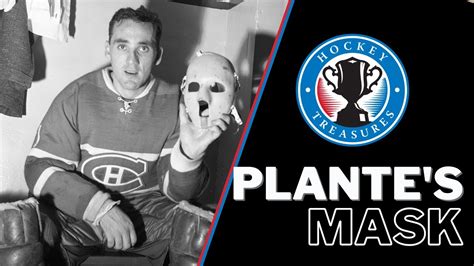
Jacques Plante popularized the use of goalie masks in hockey.
Early 1900s
In the early ages of hockey, goalies were very restricted in the gear they wore. Not only were masks not required, but coaches were generally dismissive of masks being used in games and often prohibited their team’s goalies from wearing them. Elizabeth Graham is credited with being the first goalie to wear a mask in a game, where she wore a wire fencing mask in a game for the Queens University hockey team.
In the NHL, Clint Benedict began wearing a leather face guard to protect a broken nose in the 1930s, but eventually stopped wearing it as it obstructed his vision.
Birth of the First Mask
In 1959, Jacques Plante became the first NHL goalie to don a full mask in an NHL game after being struck by a shot in the first period. This mask, made of fiberglass, was snugly fitted to Jacques’ face and was effective in protecting against shots in this age. Within 10 years, most NHL goalies adopted a similar style mask and few goalies were without a mask by 1970. In 1974, Andy Brown of the Pittsburgh Penguins was the last to play in the NHL without a mask.
Over the years, the fiberglass mask evolved to be more protective and more comfortable. Padding was added internally and companies experimented with new styles to suit goalie’s preferences of the age. A top manufacturer of early masks, FibroSport, found that adding ridges into the forehead of the mask help increase structural rigidity of the mask and improve protection for the goalie, a design feature that is still in use today. This style of mask evolved and eventually led to the modern combo style mask.
Read also: The story of Craig Needham
Evolution to the Modern Age
In the 1970’s manufacturers began experimenting with a wire cage in front of the fiberglass shell. This marked the beginning of the modern combo style cage; a combination of a fiberglass shell and a wire cage. This provided substantially better impact dispersion, where the wire cage absorbed the full impact of the puck and dispersed it to the outer edges of the mask and away from the goalie’s head.
Memorable Masks of the Quebec Nordiques
As subjective as it may be, there are undeniably some great goalie masks of the Nordiques era, starting with the all-time classic Igloo theme of Stephane Fiset. Fiset played parts of six seasons in Quebec and one as a member of the Avalanche. A quality goaltender, he’ll forever be remembered for his Nordique logo bursting through the ice cubes.
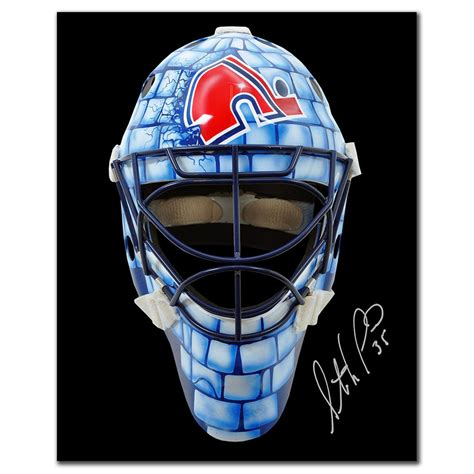
Stephane Fiset’s iconic Igloo-themed mask.
Ron Hextall had a few different mask designs while playing his one season in Quebec, including a plain white mask and then a creative one featuring a snarling polar bear. Hextall, known for his ornery ways, was well represented by a snarling polar bear, as he amassed 56 penalty minutes in 54 games in Quebec.
Another journeyman goalie with a mask to remember was Garth Snow during his time in Quebec. He sported a mask painted blue with yetis on each side of the mask and the Nordiques logo on the chin area. Although he only played seven games with the team, his mask made an impact all its own.
Read also: Inside Aaron Ness's Career
Memorable Masks of the Avalanche
This list has to begin with the mask adorned by Patrick Roy. His Montreal mask was an all-time classic, and the Colorado one did have some memorable mountains with avalanches rolling down to the chin area. He also had his customary “33” on there.
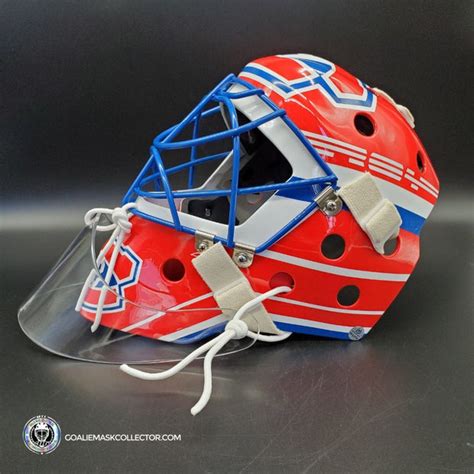
Patrick Roy's Avalanche mask, featuring mountains and avalanches.
Roy helped win the franchise’s First Stanley Cup as well. Darcy Keumper, another Stanley Cup winning goalie for the Avs, also had Avalanches rolling down to the side of his mask down to his number on the chin area. Possibly an ode to Roy, possibly a key to lifting the Cup.
Swiss goaltender David Aebischer had a memorable mountain man, abominable snowman with gritted teeth on his mask along with some rolling snow down the jawline of the mask into the Avalanche logo at the chin. Aebischer was a quality goaltender for the team in the early 2000’s, playing 174 games with 2.35 goals against average and .915 save percentage.
Recency bias says Scott Wedgewood’s new design is a creative one, with his mask picturing his kids and dogs sledding down snowy slopes on one side of it, the Avalanche A logo on the other side.
Curtis Joseph ("Cujo") and His Iconic Mask
St. Curtis Shayne Joseph (né Munro; born April 29, 1967) is a Canadian ice hockey coach and former professional player. Throughout his NHL career, Joseph played for a number of franchises, rising to prominence during the playoffs with the St. Louis Blues, Edmonton Oilers, and Toronto Maple Leafs. He also played for the Detroit Red Wings, Phoenix Coyotes and Calgary Flames. Nicknamed "Cujo," Joseph has worn the number 31 for the St. Louis Blues, Edmonton Oilers, Toronto Maple Leafs, Detroit Red Wings, Phoenix Coyotes, and the Calgary Flames.
Fitting then that Cujo's helmet nodded to the crazed Stephen King canine of the same name. No doubt that wrapping his helmet with the teeth-baring beast made for an unforgettable image in a breakaway situation.
Curtis Joseph's iconic "Cujo" mask.
This goalie mask was practice worn by Curtis Joseph during the 2002 Winter Olympics games of Salt Lake for Team Canada. The mask was commissioned by Bauer Corporation. The Pro's Choice shell is crafted by Dominic Malerba in 2002, who signed his name inside the shell. The Mad Dog artwork was painted by Ron Slater, who also signed his name inside the shell.
Two distinct goalie masks were made by Bauer for Curtis Joseph for the Olympics, a red one and a blue one. Cujo opted to play with the blue version. Cujo played one game during the 2002 Olympics and Team Canada came out with a gold medal. This is truly historical piece of Curtis Joseph memorabilia and also of Hockey Canada history.
Other Memorable Masks
Here are a few other memorable masks in hockey history:
- Johnny Bower: Eventually sported a Hannibal Lecter-looking dupe that was about as frightening as his fearless style of play.
- Wayne Thomas: Opted for a graphic paint job, painting a Maple Leaf-flecked "X" across his eyes.
- Felix Potvin: Kept it sleek and simple with his '90s era lid.
- Ed Belfour: His reputation came thanks to a more menacing winged creature.
- Raycroft: His memorable helmet paid homage to iconic Leafs throughout history.
Goalie Mask Evolution Summary
| Era | Mask Type | Key Features | Notable Figures |
|---|---|---|---|
| Early 1900s | None/Leather Guards | Limited protection, often discouraged | Elizabeth Graham, Clint Benedict |
| 1959 | Fiberglass Mask | Full face coverage, snug fit | Jacques Plante |
| 1970s | Evolved Fiberglass | Padding added, improved comfort and protection | FibroSport manufacturers |
| 1970s Onward | Combo Mask | Fiberglass shell with wire cage, better impact dispersion | Modern NHL goalies |