The snowmobile has evolved from a vital means of transportation across frozen landscapes to a popular recreational hobby and competitive sport. The first mass-produced snowmobile was the Ski-Doo, developed by Joseph-Armand Bombardier in 1959. These machines have evolved since that time and continue to gain more intelligent engineering and increased horsepower.
There are several major brands, like Yamaha, Arctic Cat, Ski-Doo, and Polaris, producing a wide range of snowmobiles for sale. It must be mentioned that just because the following machines can easily exceed 100 miles per hour doesn't mean you should try it out personally. According to 9and10News.com, an average of 15 snowmobile fatalities take place each year. The world also recently lost a legend, with Hoonigan Rally star Ken Block suffering a devastating snowmobile crash. Safety is crucial when riding a snowmobile, as these can be exceptionally dangerous at high speeds.
Not only was this machine a vital means of traveling across the frozen landscape of the upper portion of North America and elsewhere, but it also developed into a recreational hobby and competitive sport. Believe it or not, the record for snowmobile speed was made by a vehicle called the G-Force One, which reached an astounding 320 miles per hour. However, an up-and-comer seeks to break that record using the HRC-4 engine that helped break speed records in 2024. These machines are highly modified, and not something you can just go and purchase.
The beautiful Coaticook region, in the Eastern Townships, is known for its ice cream and its Parc de la Gorge de Coaticook. However, did you also know that the designer of the fastest snowmobile in the world also lives there, and that his name is Gilles Gagné? In 2014, he and Sylvain Ouellet met to develop this project. Sylvain is also an enthusiast, and he will be the driver of the vehicle during qualifying. Sylvain is also involved in the design of the vehicle. He explained that the objective is to reach 400 km/h with this track propelled vehicle in Bonneville (Utah) on a salt desert in August 2021. This is where world speed records are made.
Let’s talk about mechanics and the partnerships that Gilles and Sylvain have been able to obtain. G-Force 2 will be powered by a 1-liter engine to reach the desired speed, which will be supercharged by an electric turbo … quite special, eh? The idea was submitted to the University of Sherbrooke, who was taken with the project, and a partnership was created with them. They developed this turbo, powered by a 120 HP electric engine, and it’s called the E-BOOST. The E-BOOST is unique in the world. It also has a six-speed gearbox that is computer-controlled.
Read also: Register Your Snowmobile in IL
Sylvain explained that the computer turns off the engine at a rate of 0.007 seconds for each gear change that takes place; it’s very technical… The track is made of carbon fiber developed by CAMSO and has been tested in the laboratory at over 400 km/h to ensure its resistance. The suspension was designed and calibrated by STAR SUSPENSION, an expert in this field. The first tests will soon begin on the Sherbrooke airport runway. They will then be able to make the necessary corrections to be ready to face the Bonneville desert.
Imagine the mechanics and logistics of G-Force 2, which will have to be pushed to the max for about 90 seconds to reach the 400 km/h target. In August 2021, in Bonneville, Utah, an outstanding Quebec team led by Gilles Gagné and Sylvain Ouellet will, I’m sure, blow the world away. The visibility and influence of your accomplishment will be felt throughout Quebec.
There is not one exact answer to how fast a snowmobile can go. While averages generally hover in a specific area for top speeds, so many factors are involved in the ride of a snowmobile, even a high speed for a particular machine will vary depending on conditions. However, if you’re looking to up the pace of these winter cruisers, read on to find out what makes the glide faster and what might be slowing you down.
Where the Snowmobile Began The snowmobile began in the early 20th century. Harold J. Kalenze had a patent for a machine called a vehicle propeller in Manitoba, Canada back in 1911. A few years later, in 1915, Ray H. Muscott, A man from Michigan, obtained a patent through Canada for a motor sleigh. A year later he was awarded the United States patent for a snowy weather vehicle with rear tracks and front skis. The general design was used for rule delivery and commonly known as “snowflyers.” Finally, in 1935, the first snowmobile (by Joseph Bombardier) underwent successful testing.
Your typical current-day snowmobile will most likely be powered by a four-stroke internal combustion engine or a two-stroke internal combustion engine. In the past, two-stroke engines were typically used to reduce the weight and cost of the machine. Four-stroke engines continue to gain relevance in the past couple of decades. Yamaha, for example, now produces only four-stroke engines in their snowmobiles.
Read also: Snowmobile Tunnel Bag Comparison
In the past, snowmobiles had as little as 5 horsepower from their engines. In the first part of the 1990s, the most significant engines you could get put out around 115 horsepower. Since around 2010, numerous models can be found with engines up to 1200 cc with over 150 hp. There are even turbocharged snowmobiles, which increase the power of a substantial amount. The variety to choose from grows more and more, with options such as touring, performance, mountain, utility, crossover, and even hybrid snowmobiles available.
The speed capabilities of a snowmobile are partially a result of its design and propulsion. However, other factors can affect your speed in the snow as well. Some of these include the snowmobiles weight, engine size, aerodynamics of the snowmobile’s design, the depth of snow or ice you are driving through or over, wind, and the person riding it.
There is no exact number of how fast snowmobiles go because so many elements affect these machines, and there is such a variety to select from. Even averages will change in certain conditions or with different riders. For example, if you are riding in strong winds, your speed can be increased if it is at your back as opposed to driving into the wind head-on. If you’ve ever held on umbrella or panel of wood up in heavy winds, you know how much a non-aerodynamic design can create pull in these conditions. The same goes for snowmobiles.
If your windshield is very upright and the design of the snowmobile is not exceptionally aerodynamic, and you are out in wintery winds with high speeds, your ride can be noticeably slower. The terrain is another component that will affect speed. If a snowmobile runs on grass, it will have a far lower pace than on ice because of the resistance. Riding uphill will also slow you down as opposed to downhill. Interestingly, the temperature is also a factor with snowmobiles.
Cooler air is denser when entering an engine. This can increase the power and cause the engine to run better than in warm weather. Generally, a heavier machine will be slowed down, as the engine has to work harder to propel a snowmobile forward. A lightweight snowmobile and smaller, lighter rider will typically go faster than a more substantial machine with the same engine. Again, even in this comparison, other factors will apply, such as the snow being ridden on, the wind, the temperature, and so on.
Read also: Snowmobile Rentals in the Black Hills
The average highest speed for snowmobiles depends on the model but ranges around 95 miles per hour to 120 mph. Some of the higher speed snowmobiles can reach up to 150 miles per hour, but these are high power models. There are also snowmobiles used for drag-racing, and those machines can top out at around 200 miles per hour and up. These, of course, are used for racing in particular and not for general touring and standard use.
The current top brands for snowmobiles are BRP (made by Ski-Doo), Arctic Cat, Polaris, and Yamaha. The Yamaha Sidewinder retails for around $16,000 to $17,000 depending on location and has 180 horsepower. The Ski-Doo Gen4, as well as their Rotax 850cc E-TEC, are notable competition, and the Gen4 only has an 850-cc engine option. For some models, even if the odometer goes up to a certain number, it does not necessarily mean that machine will ever be able to hit it.
To give you a better idea of some popular snowmobile speeds, these are some ratings for standard models. Generally speaking, the initial cost of a snowmobile can be as low as $2,000 to $2,500 for a used model. Decent quality, new snowmobiles can have a price tag ranging from $9,000 to $13,000 depending on the brand. Some are even higher, such as a few Arctic Cat models that run in the $15,000 range. If you want a used snowmobile
It’s also worth noting that in different states snowmobiles have different set speed limits. These can be dependent on both the state itself and the trail you are on. Even if your snowmobile can reach higher speeds, do not exceed the limit as these have been set for specific reasons and conditions for the given trail.
Speaking of safety; you’ll want to be sure you insure your snowmobile before you hit the trails. More than a dozen fatalities were recorded from snowmobile accidents in Michigan alone during the winter of 2017 and 2018. Some of these accidents involved alcohol, while others were collisions with solid objects. Always take the time to be safe on your snowmobile.
Remember, your snowmobile’s top speed is not necessarily a pace you should push it to unless you are in an area designated for racing.
Top Snowmobile Models and Their Specifications
Let's examine some of the leading snowmobile models and their specifications.
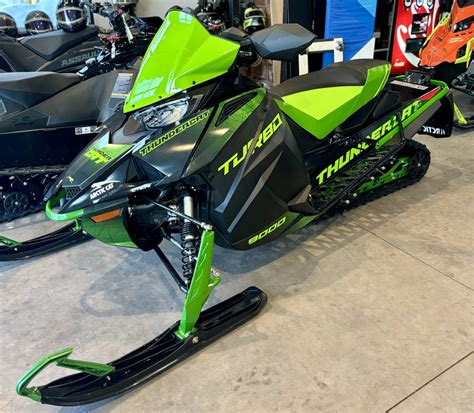
Arctic Cat Thundercat
With a 9000-series C-TEC4 turbocharged engine, the 4-stroke three-cylinder on the Thundercat generates around 200 horsepower. The hefty 998cc of this machine is made perfectly manageable through its clutch system, the Adapt CVT. Arctic Cat claims it's made the fastest snow machine, but official top speed figures aren't available from the manufacturer. Fortunately, with its electronic power steering system and innovative slide-action rear suspension, you'll be able to maintain control at speed while minimizing any bumps on the trail.
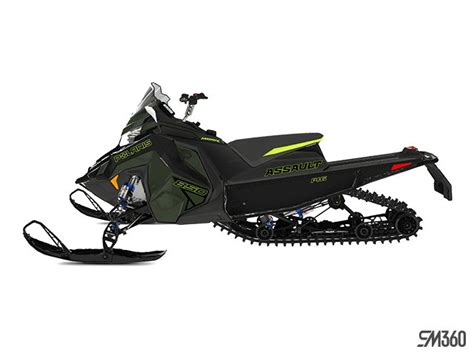
Polaris Switchback Assault
Built upon the Matryx platform, which is described as highly driver-centric in design, the Switchback Assault is a crossover-style machine with some distinct advantages. Made for an active style of riding, the cornering ability, stability, and rider ergonomics make this machine feel intuitive to control. With the turbocharged Patriot Boost engine (the most robust Polaris has to offer) the Switchback Assault is one of the most adrenaline-fueled experiences you can have on snow. One of the secrets to the Patriot Boost Switchback Assault is its use of a Smartboost technology that incorporates short airflow pathways, and sophisticated software to improve the efficiency and capability of the turbo system.
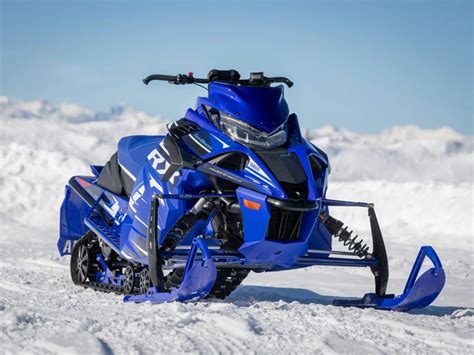
Yamaha Sidewinder SRX LE EPS
When you compare Yamaha's first snowmobile design to today's potent Sidewinder SRX LE EPS, it's night and day. This machine includes a 998cc 4-stroke turbo engine that produces 200 horsepower for monstrous performance. While not officially clocked for top speed, OnSnowMag.com reported easily reaching speeds of 117 miles per hour on previous iterations of the Sidewinder with less robust performance specifications. In addition, reviews of the SRX LE stated the machine is capable of 120 miles per hour (at sea level), which makes it one of the fastest stock snowmobiles you can buy.
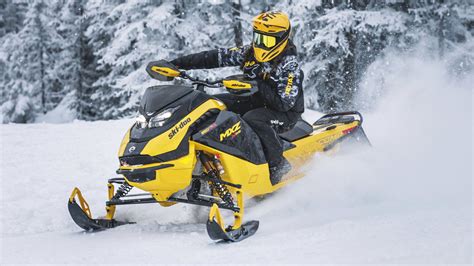
Ski-Doo MXZ
It's doubtful Ski-Doo founder Joseph-Armand Bombardier ever imagined the performance heights his brand would reach today. Of course, you don't need to travel flat-out at a top speed of 128 miles per hour to get your pulse rate going, the MXZ features remarkable responsiveness, with reviews stating that 0 to 60 miles per hour feels like it happens in less than three seconds. One of the advantages of this machine lies in its unique airbox design, which all but eliminates turbo lag. Naturally, this amount of power doesn't come cheap. The 2025 MXZ models featuring the 850 E-TEC Turbo R engines, like the top-of-the-line Competition Package, start at $22,549.
Snowmobile Speed: Factors and Considerations
Several factors influence the speed of a snowmobile, including:
- Weight: Lighter machines generally achieve higher speeds.
- Engine Size: More powerful engines contribute to greater speed potential.
- Aerodynamics: Streamlined designs reduce wind resistance, enhancing speed.
- Terrain: Ice and smooth surfaces allow for faster travel compared to grass or rough terrain.
- Weather Conditions: Wind direction and temperature can impact performance.
Estimated Costs of Snowmobiles
The cost of a snowmobile can vary significantly based on its condition and features:
- Used Snowmobile: $2,000 - $2,500
- New Snowmobile: $9,000 - $13,000
- High-End Arctic Cat Models: Up to $15,000+
Here is a table summarizing the specifications of the snowmobiles discussed:
| Snowmobile Model | Engine | Horsepower | Estimated Top Speed |
|---|---|---|---|
| Arctic Cat Thundercat | 9000-series C-TEC4 turbocharged | 200 HP | Not officially available |
| Polaris Switchback Assault | Patriot Boost turbocharged | N/A | N/A |
| Yamaha Sidewinder SRX LE EPS | 998cc 4-stroke turbo | 200 HP | 120 mph (at sea level) |
| Ski-Doo MXZ | 850 E-TEC Turbo R | N/A | 128 mph |
Remember, always prioritize safety when operating a snowmobile and adhere to local speed limits and regulations.
1000HP HRC 4 Turbocharged Snowmobiles
tags: #g #force #one #snowmobile