As someone who was basically born with a hockey stick in my hand and now plays Division 1 hockey for UMass-Amherst, I’ve always had a passion for the gear and equipment that has shaped the game. This blog is my attempt to lay out Easton’s journey, from its roots in archery, to revolutionizing stick design, to eventually fading from the spotlight, through both research and the lens of someone who grew up living and breathing hockey.
Looking back, Easton wasn’t just a brand, it was a rite of passage. Every player I knew growing up had their own “Easton era,” whether it was the original Synergy, the Stealth, or the RS, like me. The designs were bold, the feel was unmatched, and the name just carried weight. It was the kind of gear that made you feel like a better player before you even stepped on the ice.
As I got older and more into the world of elite hockey, I noticed something strange, Easton gear started to fade. Bauer and CCM were everywhere, and suddenly that once-dominant Easton logo became rare to see. It made me curious: How did a brand that once dominated NHL locker rooms and youth hockey culture all but disappear?
That curiosity is what led me to dig deeper into Easton’s story. What I found was a brand that completely changed the game, not just in terms of technology, but in how hockey gear was marketed, used, and remembered. Easton left a huge mark on the hockey industry, and I have to say, it’s always nice to see Travis Hamonic of the Ottawa Senators still rocking the Easton E400 helmet, keeping the brand’s story alive every time he steps on the ice.
Old School Mission/Easton Hockey Sticks - Terry's Twig Talks Episode 1 [4K]
Read also: Staying Safe While Snowmobiling
From Archery to Hockey: The Early Years
Long before the Easton Synergy or the RS lit up the ice, Easton was focused on hitting bullseyes, not backbars. Easton was founded in 1922 by Doug Easton, who was a pioneer in archery. The original company name was Easton Archery. He began by crafting his own bows and arrows out of cedar and pine.
Doug was a perfectionist, and he hated how inconsistent wooden arrows were, so he started experimenting with new materials, like aluminum…(ironic). In 1941, Doug developed the first-ever aluminum arrow, which completely changed the sport of archery. I find it kind of funny that if another hockey company had done a little research into archery in the 1940s, they might’ve beaten Easton to the punch on this genius idea.
Fast forward a few decades, and in the 1980s, Easton began producing aluminum hockey shafts, borrowing from the success they had in archery. As a hockey player who used to love Easton, I would’ve never guessed this all started with a guy making bows and arrows.
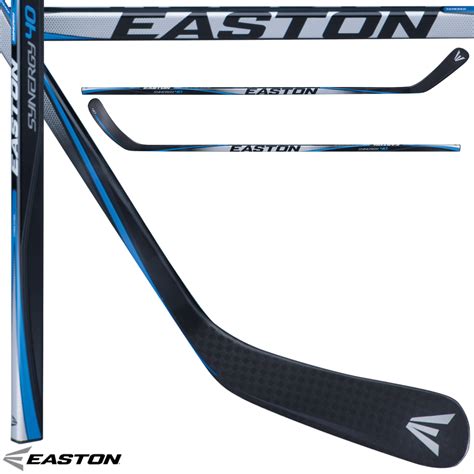
Easton’s first major hockey product was the aluminum shaft, which was stronger, lighter, and more responsive than anything else available at the time. This stick became legal in the 1980s. NHL players were slow to jump on board because they were used to the feel of wood and found the aluminum too stiff. In my time playing hockey, I’ve never once used a two-piece stick, so it’s funny to me how big of a deal it was back then. If I picked up a two-piece stick right now, I’d probably throw it straight in the trash, unless it was used and signed by Wayne Gretzky.
The Aluminum Revolution
One of the early breakthroughs came when NHL players started using Easton’s aluminum stick. A lot of people say Wayne Gretzky used Easton’s first aluminum shaft, but that’s not true. The real pioneers were Brad Park of the Boston Bruins and Dave Christian of the Winnipeg Jets. When they first gave Easton’s aluminum shaft a try in the 80s, it turned heads, and other players later began to follow their lead.
Read also: Is Eddie Bauer Ski Gear Worth It?
Easton completely changed the game of hockey with that aluminum shaft. Looking back on my own younger years, I remember how eye-opening the Bauer 1X Lite was when it dropped. My old teammate and great friend Jack Phelan, who now plays at the University of Wisconsin, was the first person I saw use that stick. He walked into the locker room, and I remember picking it up. It felt like a pencil. That stick marked the jump from heavy to light, and it seriously changed how we looked at gear. I wasn’t around when the Easton aluminum came out, but I imagine that same feeling is what NHL players felt in the late 80s when they first got their hands on it. Just like the 1X Lite changed the game for my generation, the Easton aluminum shaft changed it for theirs.
By the 1990s, Easton had fully arrived. Wooden sticks began fading away, and the aluminum shaft was winning over NHL players. Even Wayne Gretzky, who had stuck with the wooden stick longer than most, made the switch to Easton. There is no better hockey player to be using your brand than Wayne Gretzky. I can relate this to how I felt growing up just outside of Chicago, watching Patrick Kane and Jonathan Toews dominate with Bauer sticks. When you see your favorite players using a certain brand, you want to use it too and be just like them. Seeing Wayne Gretzky make the switch from a wooden stick to the aluminum shaft gave Easton all the credibility in the world.
If the best hockey player of all time is using an Easton stick, then every kid on the planet suddenly wants one in their hands, too. The floodgates opened; players like Brett Hull, Mike Modano, Paul Kariya, and Jeremy Roenick all became Easton guys. But Easton wasn’t done innovating; what came next would take hockey sticks to a whole new level and truly revolutionize the sport.
The Composite Revolution: The Easton Synergy
In 2001, Easton changed the game of hockey forever by releasing the Easton Synergy. The Synergy was one of the first one-piece composite sticks made primarily out of carbon fiber and fiberglass. Being born in 2004, this is up to my speed. I have no idea how players could use anything but a composite stick, and it amazes me how much the technology of hockey sticks has changed over time. Before the Synergy, most sticks were two-piece (aluminum shaft with wooden blade) or full wooden sticks. The Synergy combined lightweight design, strength, and enhanced puck feel, which was a major improvement over earlier materials. It wasn’t the first one-piece ever made, but it was the first one-piece stick to gain widespread adoption in the NHL. Scott Gomez was the first NHL player to use the Easton Synergy, and after that, the stick spread like wildfire.
Before the Synergy was released, Easton held about 40% of the NHL hockey stick market share. Within two years of the Synergy’s debut, Easton’s market share reportedly jumped to around 60% of the sticks used in the league. To put that into perspective, in the 2024-25 season, Bauer held the highest stick usage among NHL players, with approximately 39.89% of skaters using their sticks. Having 60% of NHL players using your stick is almost unheard of. It’s the kind of market dominance that not even Bauer or CCM, the current giants, have managed to reach in today’s game.
Read also: Nomad 3L Jacket and Cham Kit Review
I wasn’t around to see the Easton Synergy in its glory days, but I’ve heard a lot about it. For me, four sticks stand out as absolute favorites: the Easton RS, Easton V9, Warrior Alpha DX, and CCM Jetspeed FT3 Pro.
It’s interesting to wonder how players back then compared the Easton Synergy to the sticks they had before or after. I wasn’t a Bauer user until I played in the USHL, but I know plenty of players who would say Bauer’s Vapor APX2 and Vapor 1X Lite also rank among the best. The Synergy set a new standard for hockey sticks, but Easton’s impact did not stop there. What followed continued to push the boundaries of product innovation and shaped the entire hockey equipment industry.
Expanding the Brand: Gloves, Skates, and Helmets
Around the time the Synergy came out, Easton also started pushing into other gear like gloves, skates, and eventually helmets, but it wasn’t all smooth sailing. In 2002, Easton introduced the Z-Bubble shaft, a hollow shaft with a bubble-like structure inside to absorb vibrations and improve puck feel. The Z-Bubble’s technology was impressive, but it never matched the popularity of the Synergy. Easton kept releasing new sticks, including the Synergy 5000 and Synergy 6000, which were upgraded versions of the original Synergy.
Around this time, Easton was also trying to become a full-gear brand. They had already released the Easton Z-Air Comp skates in 1999, which top NHL players like Peter Forsberg and Steve Yzerman used in the early 2000s. The Easton GX gloves were seen on guys like Mike Modano before the Synergy even dropped. Helmets were last to join the lineup. Easton came out with the S9 in the mid-2000s, followed by the S19. They were making a serious push to become a top brand in every part of the game.
The Easton Stealth Era
Easton’s Stealth sticks changed the game starting in 2004. They were super light, quick on puck release, and built tough. Easton dropped a new Stealth model every year, each one improving on the last and making the line a go-to for players. Easton was one of the first companies to use this rapid-fire release strategy. Releasing new stick models annually wasn’t really a thing before the 2000s, but Easton changed that.
Easton started a trend that’s still going strong today. I can barely keep track of all the new sticks that these companies keep releasing, each trying to one-up the others and stay ahead. Easton set the bar high and put themselves ahead of the pack. Companies like Bauer and CCM had no choice but to keep up if they wanted to compete with Easton in the 2000s.
Looking into the late 2000s and 2010s, Easton kept making big moves. The two sticks I mentioned earlier were the Easton RS, which dropped in 2011, and the Easton V9 in 2013. A few different versions of the Easton Mako were also in the mix at that time. Additionally, Easton kept building on their existing lines like the Synergy and Stealth, while also upgrading their helmets, gloves, and skates.
The RS, V9, and Mako were all a really big deal when I was growing up. I remember those sticks being the loud talk in the locker room. Like I said before, the RS and V9 were two of my favorites. I didn’t like the Mako as much, but that stick had one heck of a graphic. When I saw it in stores, it caught my eye right away. As a kid, seeing a white stick like that was enough to make you beg your parents to buy it for you.
The Fade from Dominance
It’s wild to think that when I was growing up playing hockey, Easton gear was everywhere. As a huge Chicago Blackhawks fan, I vividly remember when the team picked up Tomas Kopecky during their 2010 run. I was just six years old, but I clearly recall him rocking Easton sticks, gloves, and a helmet, most likely the Easton S19 stick at the time. Easton went from dominating the NHL with around 60 percent of players using their equipment to practically disappearing off the map in just a few years. Today, Easton’s presence in the NHL is nearly extinct, except for a tiny footprint in helmets with Travis Hamonic still keeping the brand alive on the ice. It’s a crazy rise and fall for a company that once ruled the game.
One thing that’s interesting to note about the time when Easton was so successful is that their popularity exploded without the help of social media or modern influencer marketing. Their products spoke for themselves, spreading through word of mouth, highlight reels, and sheer performance on the ice. But during the 2000s and early 2010s, Instagram was in its early days and wasn’t used by companies for marketing at all. Back then, Easton couldn’t rely on constant digital advertising like hockey brands do today. Instead, their reputation spread through locker rooms, local rinks, and firsthand buzz. When one kid on my team showed up with an Easton RS, suddenly everyone wanted one.
During Easton’s glory days, one of the most underrated parts of its dominance was how good its gear looked. It started with the Synergy line, which introduced bold, clean color schemes-silver, blue, yellow-that popped on TV and in arenas. The first thing someone notices when picking out a stick is the graphic. When I was younger, that was basically all I looked at. Now, of course, I focus more on the feel and performance. But even today, when I choose what sticks I’ll use for the season, I still want them to look sharp. Easton had a unique eye for design that made their gear jump off the shelf. Whether you liked white sticks or not, I still think the Easton Mako had one of the best-looking graphics ever. Some guys might disagree, but to me, it was a perfect blend of flash and simplicity.
Easton produced so many memorable and visually striking designs over the years, it was tough to narrow down, but here are my top five favorite Easton graphics that really stood out to me:
- Easton Synergy ST (Green Edition)
- Easton Mako (White and Orange)
- Easton V9E (Black and Orange)
- Easton S19 (Silver and Black)
- Easton RS (Black and Yellow)
The Downfall: Missed Opportunities and Market Shifts
Easton’s stick innovation was still strong, but issues emerged with their skates, helmets, and gloves. Easton was a little late in the game compared to Bauer and CCM, who were already dominating gear beyond the stick market. Easton’s helmets like the E700 had mixed reviews. It was a very light helmet, which some praised, but the protection aspect wasn’t great-and at the end of the day, the helmet is there to protect you. Warrior and Bauer were doing a stellar job in the glove game, while Easton’s gloves were known for being bulky and stiff. Easton skates never caught on at the NHL level, especially skates like the Easton Makos, which suffered durability issues and comfort complaints. Many NHL players who tried out the Mako skates quickly switched back to using brands like Bauer and CCM. This inability to compete effectively in the skate market was a significant blow to Easton’s overall brand strength and contributed to their decline.
In the late 2000s and early ... Keep tabs on the newest product releases from all of the top hockey brands!
Latest Hockey Equipment Releases
The hockey equipment market is constantly evolving, with new releases from top brands like Bauer, CCM, and Warrior. Here's a quick look at some of the latest gear:
| Brand | Product | Key Features |
|---|---|---|
| Bauer | Vapor FLYLITE Skates | Lightweight Fusion Curv composite quarter, Fusion Flex outsole, Five flex notches |
| CCM | JetSpeed FT8 Pro Skate | Single-piece FORS composite boot, Aggressive forward pitch, ADPT Comfort tongue |
| Warrior | Alpha LX3 Pro Hockey Gloves | Hybrid Taper Fit, Durable nylon, dual-density foams, and plastic inserts |
| True | HZRDUS Smoke Goalie Stick | Lightweight composite construction, RESFLO resin, Precision Laminate Design |
| Sherwood | Rekker Morph Pro Hockey Gloves | Anatomical fit, E-Lite Pro+ shields, PE inserts, Nitrex foam |
College Hockey Gear Updates for 2025-26
For college hockey fans and hockey equipment enthusiasts alike, this time of year always brings a special kind of excitement. As NCAA Division I programs return to campus and hit the ice for the first practices of a new season, the energy isn’t just about the players, the coaches, or the schedules. It’s also about the gear. For equipment watchers, late August and early fall represent the unveiling of each team’s new identity on the ice. Updated color schemes, new stick graphics, and sometimes even new equipment partners. These partnerships often define how a program looks and feels for years to come, and every season brings its share of surprises.
This year has already proven to be a fascinating one, with several programs unveiling new partnerships that change the look and feel of their gear setups.
For starters, the Clarkson Golden Knights gave the college hockey community its first major hint back in mid-August. In a photo shared from inside their equipment room, sharp-eyed fans spotted racks of new Bauer gloves and pads, a clear signal that Clarkson had switched suppliers. The move officially ended their run with CCM, marking a new chapter for the Golden Knights and providing their players with a different set of tools for the 2025-26 campaign.
Not long after Clarkson’s reveal, Northeastern University added another layer of intrigue. The Huskies posted a photo of their locker room, filled with new gear in anticipation of the players’ return. Observant fans quickly noticed Bauer equipment throughout the room, confirming that Northeastern, too, had parted ways with CCM. In their case, it was something of a return to familiar territory. Northeastern had been a Bauer program prior to their four-year deal with CCM, and with this being the final season at historic Matthews Arena, it seems fitting that the Huskies would come full circle, skating in Bauer once again.
On the flip side, the Merrimack Warriors did the opposite, making the leap from Bauer to CCM. For years, Merrimack was a staple Bauer program, with their gloves, helmets, and sticks consistently reflecting that partnership. But when players took to the ice this fall for their first practice, it was clear that change had arrived. With many players outfitted head-to-toe in CCM gear, Merrimack now boasts a new look, and their partnership signals a significant refresh in branding for a team that had been visually tied to Bauer for such a long stretch.
As significant as those changes were, perhaps the most historic move of the offseason came from the Bowling Green Falcons. The orange and brown program, long synonymous with Warrior, made headlines as the first NCAA Men’s Division I team to partner with TRUE as their official equipment supplier. The announcement was a surprise for many, given the program’s deep ties to Warrior, but it has already made waves. TRUE sticks, gloves, and pants are now in the possession of Falcon players, and perhaps most surprisingly, many have even opted for TRUE skates. Typically, regardless of a college program’s equipment supplier, Bauer skates dominate Division I rosters. But Bowling Green’s early practices have shown a remarkable level of buy-in to TRUE’s full lineup, a testament to the company’s growing influence in the sport.
Adding another twist to this year’s gear news, the Minnesota Golden Gophers didn’t switch partners, but they did expand their relationship with CCM in a major way. After a few years already with CCM on the equipment side, Minnesota announced that the company will also become their new official jersey supplier, replacing Nike. For one of the NCAA’s most storied programs, this move reinforces their commitment to CCM while giving the brand additional visibility on one of the sport’s biggest stages.
With all these developments, it’s clear that the 2025-26 season is shaping up to be one of the most exciting in recent memory for equipment enthusiasts. Every year brings small surprises, but this one has delivered an unusually high number of changes, highlighted by Bowling Green’s historic partnership with TRUE. While the season is just getting underway, there’s always the possibility that more unannounced deals will surface as additional teams take the ice and fans get their first glimpses of locker rooms across the country.
For now, though, this year’s wave of announcements has already set the bar high. From Clarkson’s move to Bauer, to Northeastern’s return to Bauer, to Merrimack’s jump to CCM, and Bowling Green’s groundbreaking partnership with TRUE, each shift tells its own story about the ever-changing world of college hockey gear. Combined with Minnesota’s expanded agreement with CCM, it’s safe to say that this has been a year to remember for those who care as much about what players are wearing as how they’re playing.
NHL Equipment Trends
If you’ve ever wanted to know which equipment brands/models NHL players use most, this is the list for you. By tracking what each player uses, we’ve compiled a list, by category, of the most popular NHL hockey equipment.
Skaters
- Stick: Bauer Vapor HyperLite - 38%
- Skates: Bauer Vapor HyperLite - 32.75%
- Gloves: Bauer Vapor 2X Pro - 10.68%
- Helmet: CCM Super Tacks X - 20.35%
- Pants: CCM (Nearly Half the League)
- Visor: Oakley 831 - 29.91%
Bauer is the most-used stick brand in the NHL, at nearly 39%, and at the top of that list is the Vapor HyperLite. High-profile players such as Artemi Panarin, Tyler Seguin, Nikita Kucherov, Andrei Svechnikov, and Aaron Ekblad use the Bauer Vapor HyperLite, a lightweight model that suits a lightning-quick release.
Bauer also tops the list of most popular skates, by a wide margin - 69% of NHL players wear Bauers.Vapor HyperLite leads the way (269 players). Arguably, it’s hard to find players who don’t wear Bauer skates.
Bauer owns the gloves game in the NHL, at a 38% clip. Its top model is the Vapor 2X Pro, which offers a tapered fit with increased mobility for quick hands and better stickhandling. It is lighter and offers more protection than other models.
While Bauer dominates the skates, stick and gloves game in the NHL, CCM makes its first appearance on our list with the most popular helmet - Super Tacks X. Users of this model include Auston Matthews, Matthew Tkachuk, Miro Heiskanen, and Clayton Keller.
While we don’t have a boatload of information about pants in the NHL, we can tell you that nearly half the league uses CCM.
It shouldn’t be terribly surprising to see a sunglasses/goggles manufacturer top the list of visors in the NHL. Oakley owns 51% of the action when it comes to visors, with 831 as its most popular model. While not every player in the NHL wears a visor, users of the Oakley 831 include Sidney Crosby, Kirill Kaprizov, Johnny Gaudreau, Brayden Point and Mikko Rantanen.
Goaltenders
- Stick: Bauer Vapor HyperLite - 29.03%
- Skates: TRUE Stock Two Piece (41.94%) and TRUE TF9 (33.33%)
- Pads: True Catalyst PX3
- Glove/Blocker: TRUE Catalyst PX3 and Bauer Supreme Mach - 19% each
- Helmet: Bauer 950
Much like NHL skaters, a majority of goalies also tab the Bauer Vapor HyperLite as their favorite stick. Users of this model include Phillipp Grubauer, Linus Ullmark, Carter Hart and Filip Gustavsson.
With TRUE dominating the NHL market of goalie skates, it makes sense to mention both of its models. TRUE Stock Two Piece (41.94%) is used by Carey Price, Connor Hellebuyck, Sergei Bobrovsky, Igor Shesterkin, Thatcher Demko, and Juuse Sarros. Among those wearing TRUE TF9 (33.33%) skates are Darcy Kuemper, Ilya Sorokin, Jake Oettinger and Adin Hill.
Pads might be where goalies are most finicky. So many details go into the perfect pads - the slide, tightness of the skate, knee protection, how the puck rebounds ... goalies want to have pads that are perfect for them. Users of the True Catalyst PX3 include John Gibson, Jordan Binnington, Juuse Saros, Ville Husso and Alexandar Georgiev.
Ties don’t exist in NHL games anymore, but they do on this list. Goalies equally prefer TRUE Catalyst PX3 and Bauer Supreme Mach gloves and blockers. John Gibson, Jordan Binnington, Ville Husso and Juuse Saros are among those who use TRUE Catalyst PX3. Goalies on board with the Bauer Supreme Mach glove and blocker include Elvis Merzlikins, Linus Ullmark, Ilya Sorokin and Jake Oettinger.
Most NHL goalies wear the Bauer 950, including Andrei Vasilevskiy, Igor Shesterkin, John Gibson and Linus Ullmark. We don’t have data on how many goalies in the NHL have Simpsons characters painted on those Bauer 950s, however.