In the world of professional hockey, certain moments transcend the game, leaving an indelible mark on the sport's history. The quest for the hardest shot is one such pursuit, captivating fans and players alike.
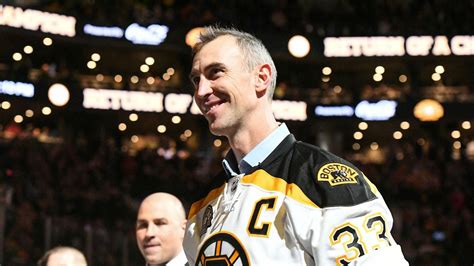
Zdeno Chára, known for his powerful slapshot
Zdeno Chára: The Slapshot Legend
One such moment occurred during the NHL All-Star Skills Competition in 2012 when Zdeno Chára, the towering defenseman from Slovakia, unleashed a slap shot that shattered records and forever etched his name in the record books of hockey greatness. Standing at a towering 6 feet 9 inches (206 cm), Zdeno Chara is not only one of the tallest players to ever grace the NHL but also one of the most fearsome. Known for his extraordinary reach and physical presence, Chara has long been a force to be reckoned with on the ice.
The year was 2012, and the NHL's finest were gathered in Ottawa for the annual All-Star Weekend. The hardest shot competition was always a crowd favorite, and Chara, representing the Boston Bruins, was no stranger to it. Chara, with his uniquely long stick and immense power, stepped up to the plate. The tension in the arena was palpable as he wound up for his shot. When the puck left his stick, it was like a cannon had been unleashed.
The radar gun registered an astonishing speed of 108.8 miles per hour (175.1 kilometers per hour). Chara's record-breaking slap shot shattered the previous record set by Al Iafrate in 1993. It showcased the evolution of the game, where players were becoming bigger, stronger, and faster.
Read also: Features of Custom Hockey Gloves
Using a Warrior stick with a flex rating of 155 (significantly stiffer than most players use), Chara first broke his own previous record with a 106.2 mph shot. What made Chara's shot special wasn't just the speed. It was the consistency. He would shoot in the back of his house, in his driveway, in his basement.
“We went from wood sticks to composite sticks,” Chara said. “I think that’s when goalies saw the puck the first time it was coming out of their nets when I was shooting slap shots. It was crazy."
“For me, having that wood stick was heavy. “The puck was just invisible for [goalies].
Later on, Chara said, “I was able to shoot close to 110 miles per hour,” “I wish I would be there, maybe toward the end of my career, with everything I was using, better sticks and all that.
While records are made to be broken, Zdeno Chara's monumental shot remains a testament to the extraordinary talent and determination that define the world of professional hockey. As we marvel at the incredible moments that unfold on the ice, we can't help but be grateful for players like Zdeno Chara, who push the boundaries of what is possible in the sport of hockey.
Read also: The story of Craig Needham
To unleash such a blistering slapshot, the stick has to withold an incredible force.
I used a Warrior stick , flex 155.
Your record breaking shots all flew very low, just a few inches off the ice. Was this a coincidence, or did you aim your shots low on purpose?
I didn’t focus to shoot to any specific area even though there is a certain probability that if you shoot into the lower part of the net you can get better results.
You were known to remove the tape from the bottom of your blade with a razor, in later stages you actually stopped using tape on your stick and switched to Rezztek®. Why did you prefer no tape on the bottom of your blade?
Read also: Inside Aaron Ness's Career
I just didn’t like any frictions on the bottom of my blade that was crested by taping.
The record slapshot stands at 108.8 miles per hour. Were you ever able to shoot even harder than that outside of the official all-star game?
Well I was shooting a commercial on the ice for something and I was shooting slap shots the same way as at the all-star game and someone brought a speed clock for fun.
If you were to give just one piece of advice for hockey players trying to shoot as hard as they can - what would it be?
Shoot , shoot , shoot ..
How to Increase Shooting Accuracy
Recent Developments and Contenders
Prior to this week’s record-breaking displays, the title of hardest shot belonged to Winnipeg Jets defenseman Colin Miller, whose slapshot clocked in at 102.59 mph against the Dallas Stars last season.
Thompson’s blast not only secured the new record, but also played a key role in the Sabres’ 5-3 victory. The shot, saved by Red Wings goalie Alex Lyon, resulted in a rebound goal by Jason Zucker, putting Buffalo on the scoreboard first.
Filip Hronek of the Vancouver Canucks is enjoying a great season 2023-2024. Well known for his great shot from the point, and especially for his rocket of a one-timer, he was looking for the first goal of the season.
The Vancouver Canucks later revealed that the NHL shot tracking technology measured the shot at a whopping 107.9 mph, making it the fastest goal shot ever recorded by the NHL tracking technology since its inception 3 years ago.
Unfortunately, Hronek's shot numbers, as reported by Sportsnet, were wrong. NHL EDGE technology lists his shot at 100.37 MPH.
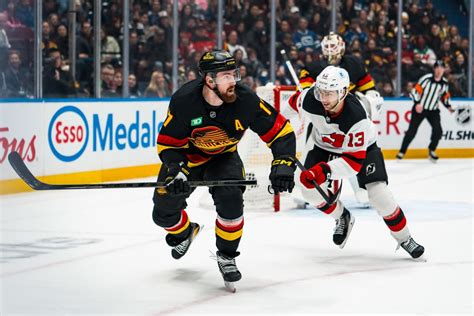
Filip Hronek
The Science Behind a Powerful Shot
Thompson’s scorching shot is a testament to the raw power present in the NHL today. Having a hard shot is a big advantage in ice hockey. If a player adds accuracy to shot speed goalies usually don't have a chance to react. Hockey legends such as Zdeno Chára, Shea Weber and the still active Victor Hedman are among the players with the hardest shot.
“The trick in hitting the puck with great speed boils down to the ability of the player to convert as much potential energy as they can into the kinetic energy of the puck,” wrote Dr.
When you slow it all down, the contact between the stick and the puck in a slap shot is so very brief, a tiny moment that produces a huge transfer of power.
“But for the slap shot itself, it’s a bit more complicated because if you see a slow-motion video, you’ll see that it’s not a direct hit on the puck,” Haché said.
With a slap shot, the blade hits the ice first, about a foot before the puck. That allows the momentum of the player, who is rotating at that moment, to be transferred to the stick in the form of potential energy.
“The magic of the slap shot involved deploying another source of potential energy -- the potential energy store in a bent stick,” Bansil wrote.
“The limit now is not twice the speed, the limit now is the energy that the player carries,” Haché said. “In principle, all that energy could be transferred to the puck. The physical limit now is the energy. And energy has two components, it has the speed, you need velocity, and you need mass.
“So, heavier, better. Stronger, better.
“If you hit the ice first, it’s the same as if you were to hit a wall, the player would hit a wall and it would compress the spring until almost the player is stopped,” Haché said. “Then, when the spring is compressed, you would put it in contact with the puck and then the spring would push on the puck and propel it. That’s what happening.
If the stick hits too late, too close to the puck? Not enough time to compress the spring. Hit the ice too early? It’s possible that a player could find a way to model the exact perfect moment to hit the puck, the spot on the ice that would transfer the maximum amount of energy into their stick and then into the puck. That kid is shooting. Shooting and shooting and shooting.
The Role of Technology
Currently, the NHL is using the EDGE technology, which measures various player indicators. One of them is shot speed. The NHL have been working with EDGE technology from the 2021-2022 season. That means that to this day, there are data available from three different seasons. The charts show speed achieved on any recorded shot attempt by an individual player during the chosen season.
According to NHL EDGE tracking data, the fastest in-game shot recorded in the NHL is Filip Hronek's 100.37 mph blast-nearly 9 mph slower than Chara's skills competition record.
Factors Influencing Shot Speed
You can influence the quality of your shot. Of course, you can practice shooting daily for a period of several years. There are hockey players that are predisposed to harder and faster shots. However, even the very best of them can improve their shots.
MacInnis was devoted to the wooden stick. Chara believed that once he transitioned to composite, that made all the difference. Chara used a 155-flex stick that could boggle the mind with its stiffness.
“The key elements that must work together involve the ability of the player to manipulate their arms, wrist, legs, feet, and the body weight, along with the extent to which the stick is bent and its timing before it hits the puck,” Bansil wrote.
“More a given stick is bent, the faster the speed with which it will snap back.
“My sticks, because they flex so much, I try to lean with my body into it,” Frk said. “That gives me more power behind because then the stick will do the job because the flex is obviously so low. So hopefully the stick doesn’t break when I’m taking the shot.
“I know when I’ve gotten stronger in recent years, I had to go up in flex because I want my stick to be fast,” Pettersson said. “I don’t want it to be like a long flex up, like a whip. I want to the whip to be fast, like very quick, responsive.
“It's getting force through the puck,” Pettersson said. “It's the sweeping of the whip, that's when you need to be your strongest or fastest. So, I think about the strong bottom hand.
“The basic physics is you have a rotating body, which is the player, and it collides with a stationary puck,” Haché said. “There’s basic physics there. So, math helps. If you have a bigger object colliding with a small object, the bigger the object, the faster the small object will go.
“That’s where the body strength and mass help,” he continued. “So you may have somebody who is bigger but not as fast, doesn’t have the muscle mass to accelerate to the speed that you would want to.
Chara is 6-foot-9, 250 pounds. Weber is 6-4, 230 pounds. So, sure, size matters.
“They’re usually tall, pretty muscular. Usually it’s a defenseman,” Haché said. “But then you’ll see other, smaller players who can shoot very fast.
One of the hardest things to get past, for a shorter player, is the stick length. Chara used a 67-inch stick. That could then bend more than average.
“It’s changed, it’s definitely changed,” Bruins defenseman Kevin Shattenkirk said. “I think it’s becoming less and less, especially with the way goalies play now. I think when they see a slap shot they’re smart enough to get out and cut off the angle.