Choosing the right lens can make or break your day on the hill. Ever been blinded by glare off snow or couldn’t see ahead because of snow flurries? Then you know the importance of having the right pair of ski or snowboard goggles for the conditions. Having the correct lens handy can make all the difference, and often dictate whether you're going to call it quits early, or be able to spend the day on the mountain without an issue.
Goggle lenses come in a wide variety of tints that filter color and light in different ways to enhance your vision. Some tints work best on bright, bluebird days. Which lens color is ideal for you? You’ll want to find a tint that is most suited for the light and weather conditions you’re skiing or riding.
This guide will cover the following:
- What is Visible Light Transmission?
- Lens Tint Offerings
- Filter Categories
- Anon's Lens Tint Categories
- Choosing between Sunny, Cloudy, and Variable lenses
- How is Visible Light Transmission measured?
- Perceive Polarized Sunglass Lenses
- Why is this important for skiing and snowboarding?
What is Visible Light Transmission (VLT)?
Visible light transmission - measured as a percentage - is affected by factors such as the color, thickness, coatings and material of the lenses. VLT is the amount of light that passes through your lenses and reaches your eyes. The amount of light a goggle lens allows to pass through is called Visible Light Transmission (VLT). VLT is expressed as a percentage of light allowed through the lens falling between 0% and 100%.
The lower the VLT percentage, the darker the lens will be. The higher the VLT percentage, the lighter (or more transparent) the lens will be. Manufacturers will often list a goggle’s VLT (or light transmission) with their products specs. Colors and light transmission can vary a lot from brand to brand, so be sure to consult manufacturer’s specs. The biggest takeaway from this, is to understand that a high VLT lens is great for low-light conditions, while a low VLT lens is better for sunny bluebird days.
Read also: Ski bag review: Find the perfect one for your needs
To get started, all of this information is specifically for polycarbonate goggle lenses used for skiing and snowboarding. While lenses come in various colors that may pose great style and looks, the colors are related to Visible Light Transmission (VLT), and are specifically designed to enhance visibility based on the varying weather patterns and outside lighting conditions.
Once you’ve decided your riding conditions and the corresponding VLT for those conditions, then choosing the color is largely a matter of personal preference. Goggle manufacturers give you many color options to express your individual style through your goggles while enhancing visibility for the specific conditions you want to ski.
If you can’t find a goggle’s VLT, don’t worry. Manufacturers like Smith, Oakley, Giro and others make it easy by calling out the conditions that certain lenses are best suited for.
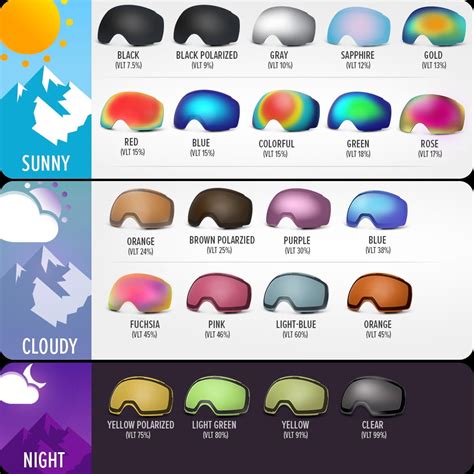
VLT Category Groupings
As you begin to look at VLT percentages, there are five categories that range from 4 to 0, which will often be accompanied by an S, indicating that this lens tint is for on-snow use. To make sense of these categories, 4 is the darkest lens tint rating, while 0 is the lightest. For example, a Sunny Onyx Perceive lens has a rating of 6% VLT, which is our darkest lens, falling in the S4 category.
To take it one step further, Anon's Perceive Lens Collection has simplified these VLT and filter categories, by simply grouping them as Sunny, Variable, or Cloudy lens tints. Fun Fact: All Anon Perceive Lenses have etched symbols on the lower right frame of the lens, indicating which lens tint is suited for sunny, variable, or cloudy lens tints for easy swaps on the fly.
Read also: Ancient Ice Skates
Here's a breakdown of VLT categories and corresponding conditions:
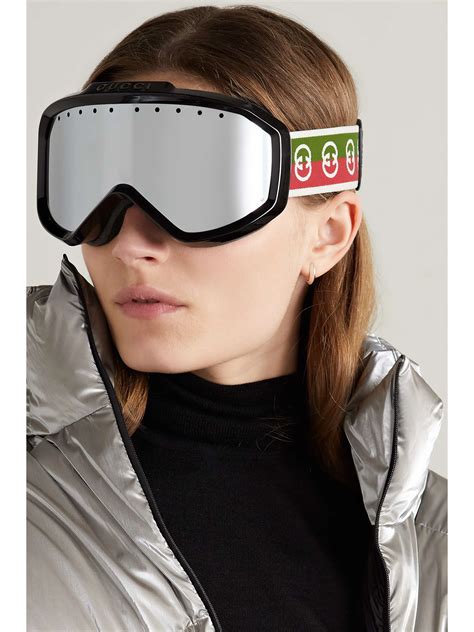
VLT for Sunny Conditions [5-20%]
A low VLT rating is best for bright and sunny days because it will allow the least amount of light to be transmitted through the lens, which helps your eyes adjust quickly, increases visibility, and turns down the brightness on snow in terms of how you see the terrain. For example, the Perceive Sunny Onyx lens has a VLT rating of 6%, making it very dark and great for being up on a glacier or in bright bluebird conditions.
Sunny Collection:
- Perceive Sunny Onyx (6% / S4)
- Perceive Sunny Red (14% / S3)
- Perceive Sunny Bronze (17% / S3)
VLT for Variable Conditions [20-60%]
On days when there are passing clouds, snow in the forecast, or a storm predicted to clear up, you need goggles that aren’t too dark or too light. These conditions are when a mid-range VLT lens is the best choice to ensure you’ll be set for whatever the weather throws at you. Anon’s Perceive Variable collection has a Variable green, blue, and purple lens with a VLT range rating of 21%-34%, which is perfect for a partially cloudy day.
Variable Collection:
Read also: The Evolution of Skiing in Aspen
- Perceive Variable Violet (34% / S2)
- Perceive Variable Green (22% / S2)
- PerceiveVariable Blue (21% / S2)
VLT for Low Conditions [60-90%]
On gray days on the hill or late in the day, when the sun goes behind the mountain and the snow gets covered in shadows, it can be hard to see the bumps and ruts in the snow. A high VLT lens will help increase the visibility contrast in these low light conditions so you can ski and ride more confidently and not feel like the lens tint limits your vision.
Cloudy Collection:
- Perceive Cloudy Pink (53% / S1)
- Perceive Cloudy Burst (59% / S1)
- Perceive Cloudy Night (72% / S1)
Как выбрать горнолыжную маску? Обзор очков для сноуборда и лыж разных ценовых сегментов.
Polarized Lenses
Polarized lenses are also an option, for bright light days and an enhanced version of blocking out unwanted glare.
Perceive Polarized Sunglass Lenses
Drawing from the success of our Perceive lens collection tailored for snowy conditions, these sunglasses deliver the same benefits, including high-grade optics, a hydrophobic lens coating and a polarized filter to combat glare for ample UV protection and unparalleled clarity. By filtering light effectively, these lenses enhance contrast and enrich real-world color in any given weather condition.
With five different models to choose from,Anon's Sunglass Collection features Perceive Polarized Lens Technology, offering maximized light filtration to optimize vision in outdoor environments. Each Anon sunglass including the Winderness, Opportunist, Advocate, Strategist and Promoter are apart of filter category S3, 14% VLT.
How is Lens Visible Light Transmission Measured?
VLT is measured by testing the amount of light that can pass through a lens. The testing uses a photometer, which measures the intensity of visible light before or after it passes through a lens.
Tips From The Pros
All in all, it's a game-changer to understand VLT and why having different lens tints available to accommodate the changing conditions on the mountain is essential. It's best to have at least two lenses on hand to swap them out as needed.
With Anon goggles, you'll receive an installed lens that suits sunny or variable conditions and a bonus lens for cloudy days with the purchase of a Magna-Tech goggle. We also recommend keeping a spare lens readily available for anything that may come.
For those who ski in different light conditions, it may make sense to get a second pair of goggles or one pair that has interchangeable lenses you can switch out depending on the conditions. Many brands make it quick and easy to change your goggle lens (even mid-run or while on the lift); the goggles use magnets, snaps or rails to swap out the lenses. Premium goggles that have interchangeable lenses also often come with a free “bonus” lens so you’ll typically have a dark lens for bright light conditions and another for low light conditions.
If you can’t be bothered to switch your lenses but you ski or ride in varying conditions, consider photochromic goggles for ever-changing conditions. Like sunglasses, the technology on these snow goggles automatically darkens in bright light or gets lighter when there isn’t much light out.
Dark or mirrored lenses like platinum, gray, black and red are suitable for days when the sun is blazing. They typically have a lower VLT (about 25 percent or less). Softer colors like rose, yellow and gold increase contrast in overcast, low-light situations. They typically have a higher VLT (about 50 percent or more). Clear lenses: Lenses with the highest VLT (up to 100%) block very little or no light.