Checking in ice hockey is a defensive technique aimed at disrupting an opponent with possession of the puck or separating them from the puck entirely. One of the more rarely seen, but visually impressive, forms of checking is the hip check. Let's delve into the details of the hip check, its risks and rewards, and how some players have mastered this technique.
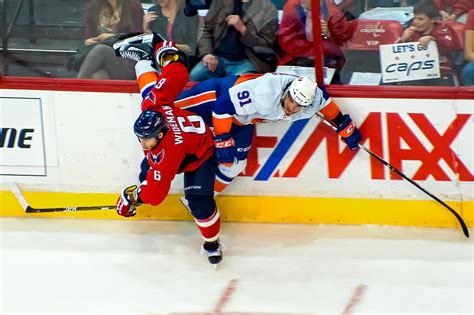
What is a Hip Check?
A hip check involves a player dropping to a near-crouching stance and swinging their hips toward an opposing player, sending the opponent off balance, often causing them to fall to the ice. This move is most commonly performed against the boards.
As Alex Pietrangelo said, it’s not a play you see often. So why don’t more players use the technique? Mostly because of the risk that comes with it.
The Best Technique for Delivering Huge Checks
The Risks and Rewards
Players and coaches have realized that most of the time a hip check is a low risk-reward play. The risk of either taking yourself out of the play if you miss the opposing player simply isn't worth the reward of the solid hit. A missed hip check almost always leads to an odd-man rush the other way.
According to Brayden McNabb, "It’s an all-in play, so you have to be good at it, and you have to time it well. If you miss, you know you’re going to look pretty dumb doing it. I think I’ve gotten better with it just because I’m not trying to do it so much, and taking myself out of the play."
Read also: Features of Custom Hockey Gloves
Despite the risks, a well-executed hip check can be a game-changer. “A big hit is like a goal for me,” McNabb said with a smile. “Anything to help the team get the momentum or energy. It’s a fun part for me, and I think it gets momentum for the team. Any time I can make a big hit to help the team.”
Brayden McNabb: A Master of the Hip Check
Golden Knights defenseman Brayden McNabb is known for his aggression and picture-perfect hip checks. His combination of positioning, timing, and pure brute strength separates opposing players from the puck. McNabb does have a team-high 88 body-check rating on EA Sports’ “NHL 22.”
“I don’t know how he does it,” teammate Alex Pietrangelo said. “It’s like a video game. You know, you press the button and just line the guy up. You don’t see that (move) a whole lot anymore, but it’s an art.”
Timing is Key
McNabb says that timing his route to close in on the puck carrier at precisely the right moment is crucial. “A lot of it is timing,” he said. “I’ve been doing it for a while now, so there are situations where you know you have the green light to do it, and times where you shouldn’t. Experience with it, and timing is the biggest part.”
He quickly noticed the puck carrier, Yanni Gourde, was being picked up by a backchecking Jonathan Marchessault and his defensive partner, Dylan Coghlan. Along with that read, McNabb also saw Seattle winger Branden Tanev curling to the right boards, presenting himself for an entry pass. Not only did it prevent a rush chance for the Kraken, it flipped the game’s momentum on its head.
Read also: The story of Craig Needham
“I think that was a huge moment for us,” coach Pete DeBoer said. “Nabber has that ability to kind of drag us into the fight with those types of plays. He’s done that continuously here. I thought Nabber kind of got the whole group’s attention. He wasn’t going to just quietly watch this game go by."
Experience and Adaptation
McNabb didn’t implement the hip check technique until he was in the NHL. “In junior, I always had big hits, but it was more open ice, not really against the walls,” he said. “It just kind of started when I got into the NHL. I knew I had to do something to stay, and being physical was part of it.”
McNabb has noticed wingers opting to take different routes into the zone as his hits have piled up over the seasons. “Yeah, as the years have gone on you notice it for sure,” he said. “Most skilled guys are smart guys, and they know. But you play against teams that you don’t play against very often, and can capitalize sometimes.”
Safety and Legality of Body Checking
It's essential to understand the rules and regulations surrounding body checking to ensure player safety. Checking or hitting is only permitted against an opponent with possession of the puck.
Charging, hitting from behind, and boarding are examples of illegal hits. "Charging shall mean the actions of a player who, as a result of distance traveled, shall violently check an opponent in any manner. A “charge” may be the result of a check into the boards, into the goal frame, or in open ice".
Read also: Inside Aaron Ness's Career
Beginning with the 2010-11 NHL season, any form of "lateral or blind side hit to an opponent, where the player's head is targeted and/or the principal point of contact" (which is known as an illegal check to the head) became prohibited. That hit is punishable with either a two-minute minor or a match penalty.
For the 2005-06 season, the NHL instituted stricter enforcement of many checking violations that in previous seasons would not have been penalized. The intent of the new standard of enforcement was to fundamentally alter the way ice hockey is played, rewarding speed and agility over brute strength, as well as increasing opportunities for scoring and minimizing stoppage of play.
Drills to Improve Checking Skills
Here are some drills to help players improve their checking skills:
- Hip Check Timing Drill: Players start without a puck on the goal line, take a smart angle, and make contact with a dummy being pushed by a coach.
- Loose Puck Contact Drill: Player 1 picks up a loose puck and passes to their teammate at the blue line. Player 1 comes down the center of the ice and forces the coach pushing the dummy up the wall with a good angle. The player will make proper body contact with the dummy and pick up the loose puck and pass it to the front of the line, Players 2.
- Defensive Zone Pressure Drill: Strong side defenseman will make a hip check or shoulder check on the dummy coming down the wall before picking up a loose puck and making a D-D pass.
Body Checking by League
The legality and rules surrounding body checking can vary significantly depending on the league and age group. Here's a breakdown of how body checking is treated in different contexts:
- Women's Ice Hockey: In women's IIHF ice hockey, body checking is generally considered an "illegal hit" and is punishable by penalties. Body checking was allowed at the first women's world ice hockey championship in 1990 but has been considered illegal since in almost all leagues.
- Youth Leagues: Any form of body checking is not allowed in leagues with young children. Beginning in the 2011-12 season, USA Hockey moved the age of legal body checking from 12U to 14U.
- Men's Amateur Leagues: Men's amateur leagues typically allow checking unless stipulated otherwise in league rules.
- Intramural University Leagues: Some intramural university leagues do not permit body checking to avoid injury and incidents of fighting.
Penalties
Several types of hits are illegal and can result in penalties. Here are some examples:
- Charging: Violently checking an opponent as a result of distance traveled.
- Hitting from Behind: Contacting an opponent from behind, which is particularly dangerous.
- Boarding: Checking an opponent in a way that causes them to be thrown violently into the boards.
- Illegal Check to the Head: Targeting the head of an opponent, which can result in a minor or match penalty.
Conclusion
The hip check is a high-risk, high-reward move that, when executed correctly, can shift the momentum of a game. While it's not as common as it once was, players like Brayden McNabb demonstrate that it can still be an effective tool in a defenseman's arsenal. However, it's crucial to prioritize player safety and adhere to the rules and regulations surrounding body checking.