Defensive zone coverage (DZC) is a critical aspect of hockey strategy. Many hockey fans hear terms like "man-on-man defense" and "zone defense" frequently, but a true understanding of these concepts is essential for appreciating the nuances of the game. This article aims to demystify the dichotomy between man and zone defensive strategies, explaining how they are implemented in the NHL and the advantages and disadvantages of each.
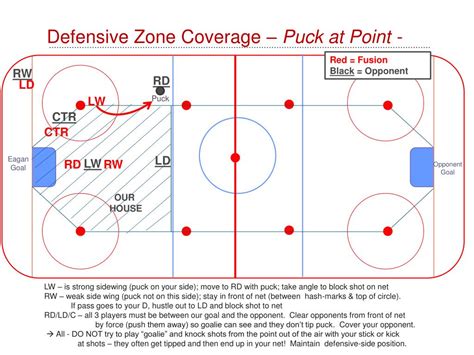
Man-on-Man Defense
Most NHL teams employ man-on-man defense when the puck is high in their defensive zone. This strategy allows defenders to closely match the speed and angles of their assigned attackers.
Example: The Colorado Avalanche often utilizes man-on-man DZC. In this formation, each defender is responsible for a specific opposing player, creating several 1v1 battles off the puck.
COL8 Cale Makar, a defenseman, has followed the puck carrier to the point to take away his time and space
Pros:
Read also: Features of Custom Hockey Gloves
- Simple and intuitive to teach.
- Allows for aggressive pressure and the potential to force turnovers anywhere in the defensive zone.
Cons:
- Difficult to implement effectively. Losing any 1v1 battle can quickly lead to odd-man situations near the net.
Vulnerabilities:
- Susceptible to bigger, stronger, and faster opponents who can win individual battles.
- Vulnerable to give-and-go plays and offensive picks.
Zone Coverage vs. Man-to-Man Defense
At its worst, a poorly executed man-on-man defense can appear chaotic. So, why not play zone defense instead?
Zone Defense
The fundamental difference between man and zone defense lies in their approach to the puck carrier:
- In man defense, you actively skate towards the puck carrier.
- In zone defense, you wait for the puck carrier to enter your designated zone.
A Neutral Zone Trap is an effective form of zone defense because the attacking team is obligated to transit the puck through the zone.
Read also: The story of Craig Needham
However, the calculus is quite different in the defensive end zone. A team employing exclusively a zone DZC would be completely unable to stop the possession unless the offensive team committed an unforced error (a missed pass, a blocked shot or a bobbled puck near a zone defender).
Example: Witness the Vancouver Canucks’ zone DZC against an extended Toronto Maple Leafs possession:
The five VAN skaters in white have collapsed to the slot in order to prevent high-danger passes and carries.
On the one hand they’ve formed a wall preventing the TOR puck carrier from attacking the middle. On the other, they’re actually defending very little space - just half of the “house.”
TOR18 Jordie Benn (right D), completely ignored by the VAN zone, sneaks down the back side and scores on a rebound moments later.
Read also: Inside Aaron Ness's Career
Pros:
- Less physically demanding than man defense.
- Can be played while standing around.
Cons:
- Does not proactively force offensive errors and turnovers.
Vulnerabilities:
- Susceptible to quick puck movement on the perimeter.
- Vulnerable to player movement between zone defenders (playing between checks).
Hybrid Approach: The Best of Both Worlds
Due to the contrasting strengths and weaknesses of man and zone defense, every high-level team employs a mix of both against high DZ possessions.
Example:
As the zone player, F3 can read the play and pressure the third player high, or stay back and cover the slot.
The four other TOR skaters apply moderate man-on-man pressure against perimeter carries as to force defensive stops, create turnovers and initiate breakouts.
Key Defensive Principles
Regardless of whether a team employs man-on-man or zone defense, several fundamental principles remain constant:
1. Protect the House
Protecting the house is a vital component of limiting scoring chances. The house is defined as the area from the left post out to the left dot to the top of the left circle then across to the top of the right circle down to the left dot and finally back down to the right post. This area is the highest scoring region on the ice and must be well protected. This includes clearing the front of the net in order let your goaltender see the puck and make the save. If the puck is in this area that means that all players should collapse down low in order to protect the house. Players must maintain an active stick and take away shooting and passing lanes in order to keep the puck away from our net and out of the house.
2. Limit Clean Shots on Goal
When the other team has control of the puck in your defensive zone, your first order of business as a defenseman is to stop them from getting a clean shot at goal. The more difficult you make it for the offense to pass or shoot, the less likely they are to score. This means that defenders must cover passing lanes and block direct access to the goal.
3. Proper Positioning
Proper positioning is vital to this process. If a you rush at the puck willy-nilly, you give the offensive player with the puck an advantage because he can beat you with a good head fake or quick move. Plus, you’ll invariably leave undefended space behind you, which the other team can exploit.
4. Stay Between Your Man and the Goal
This is sometimes called playing “on the defensive side” of the player or puck. It may seem obvious, but it’s an important consideration as you execute numbers 2 and 3 below. At all times, your body and/or your stick should prevent the puck-handler from skating in on goal or passing the puck to a teammate in the slot. If you are defending a player without the puck, your goal is to keep that player from getting to the ice in front of the goal unimpeded or receiving a pass in a position that provides a clear shooting lane to the goal. You don’t want to find yourself in a situation in which you’re trying to stop a play from behind your man-which often leads to bad mistakes or penalties. To maintain this defensive-side position, you’ll need to move as the player you’re covering moves.
5. Defend From the Middle Outward
The most dangerous part of the ice is the center of your defensive zone because the closer the shooter is to being directly in front of goal, the more net they have to shoot at. A goaltender has a much better chance of stopping shots that come in from sharp angles because the goalie can cover more of the net. Therefore, the defense as a whole should work to keep the puck out of the middle of the zone.
6. Maintain the Gap Between Defenders
Most defensive schemes involve two defensemen down low and two wingers covering the points. But to protect the center of the ice, it is vital that these pairs don’t allow the gaps between them to widen so much that an opposing player can split them. Therefore, when the puck is not on your side of the ice and your partner goes to the boards to make a check, you must skate to the center to maintain the gap between you. Conversely, if you go into the corner after the puck, your partner will fill in behind you. This dynamic formation keeps the defensive unit compact, which is more difficult for the opponent to break down. A good offensive player will recognize when defenders are leaving too much space between them and will exploit the extra space to create scoring opportunities.
7. Communication
Communication is vital to anticipating the play and reacting to what the opposition and your teammates are doing. Players need to keep their head on a swivel and anticipate the play in order to put themselves in the best position to transition from defense to offense effectively.
8. Transition to Offense
Once possession of the puck has been won, players must create outlets for the puck carrier, fill lanes, and put themselves in position to receive a pass.