Choosing the right field hockey stick is crucial for players of all levels. A well-fitted stick can improve your performance and prevent injuries. Here's a detailed guide to help you make the best choice.
Factors to Consider When Choosing a Field Hockey Stick
You may want to keep a few things in mind when choosing a field hockey stick. There is not an exact science when it comes to choosing the correct length of a field hockey stick. Players have different preferences based on their level of play and what feels best to them. Although a few options are left to preference, there are some simple guidelines to follow when buying a stick.
We also recommend taking into consideration your playing style and position when choosing a stick. We suggest buying a field hockey stick based on playing style, NOT position. Back in the day, certain sticks were better suited for certain positions. With all the modern technology in sticks today, this is no longer the case. It is best to find a stick that best matches your playing style.
Stick Levels
- BEGINNER STICKS: These entry level sticks are designed to help build basic skills. During the development of technical skills, power is not the focus. These sticks are usually constructed of 100% fiberglass or wood and have a low power level.
- COMPETITIVE STICKS: These sticks serve a wide range of skill levels. They are flexible allowing for more ball control.
- ADVANCED STICKS: This group of sticks is cutting edge for the progressive athlete. They are powerful, but more flexible and forgiving than the elite sticks. They typically contain less carbon than the elite sticks allowing for a softer touch and increased control.
- ELITE STICKS: At the elite level, innovation and technology combine to create the most advanced field hockey sticks in the world. They are on the cutting edge of development so they evolve each year with the game!
Materials
In the past, sticks were made from wood. Although wood sticks are still used by some, the majority of sticks made from some type of composite material.
If you’re new to the game or play casually, a stick made of fiberglass or a low-carbon composite is ideal. Competitive players need high-performance sticks with 70-100%carbon for maximum power, stiffness and responsiveness.
Read also: Snowboarding skill development
The beginning hockeyplayers mostly kids can starts off with a 100% fibre glass stick. They are light, flexible and not expensive and come in small sizes with thinner handles. Intermediate hockeyplayers will have a bit more power and will ask more of his/her stick therefore carbon is added which gives more stiffness and strength to the stick. Take a look at our 30-40% carbon sticks or our 55-70% carbon sticks.
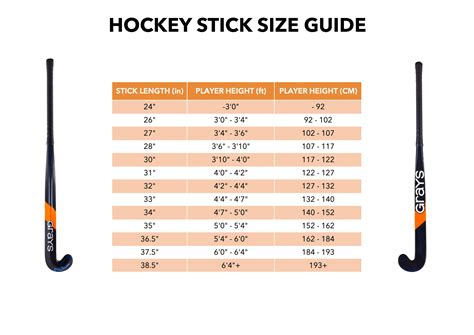
How to choose the right size hockey stick
Carbon Content
Increased carbon translates into greater stiffness in the stick. High carbon content contributes to high power in hits, but can also make receiving more challenging.
Weight
For each composite stick we offer, we include a targeted weight for a 36-36.5" stick. The superlight sticks are a delight to play with. 22 layers of 3K Japanese Carbon Fibre, laid down in alternating orientations for the optimal balance of stiffness and unique Osaka feel.
Try to balance your stick on your finger or on a pen. Measure from that point to the top of the curl and you know the balance point of your stick. Why is this an important factor? This significantly affects the overall 'feel' of the stick. The higher the balance point the more handleable the stick is because the curl is lighter.
Vibration
As a stick's carbon content increases, there is a tendency for greater vibration, or sting, in the handle. Vibration does not necessarily equate to the stick being broken. Manufacturers have added features within the stick handle to specifically address and ultimately absorb the vibration. Additionally, sticks need to warm up just like their owners.
Read also: Pure Hockey Long Island Guide
Bow Types
All composite field hockey sticks have a bow from the handle to the toe. The Bow of a hockey stick identifies the position of the arch in the stick shape. If you place the flat side of the stick on a plain/flat surface and the measurement of distance between the surface and the upper edge of the stick is know as the bow. Most sticks have a bow measuring at least 19mm, while the elite level sticks will have a bow closer to 25mm.
Low, Pro, or Show Bows support drag flicks, aerials, and fast, tactical play where every detail counts.
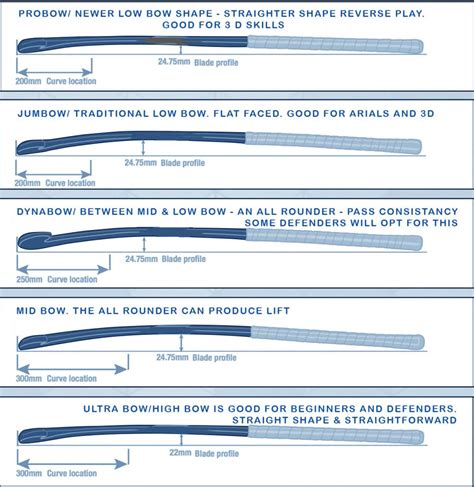
- THE REGULAR BOW: A regular bow has the highest point of the bow placed in the midsection or center of the shaft, assisting in every skill of the game.
- THE MEDIUM BOW: This gradual bow is versatile in all aspects of the game.
- THE LOW BOW: This low bow is typically about 25mm and the highest point is close to the toe of the stick.
- THE EXTREME LOW BOW: The Extreme Low Bow shape maximizes dynamic ball control, aerial pass skills and drag flick consistency.
Additional Technologies and Materials
- SCOOP: This technology refers to a 2mm groove in the toe of the stick which varies in length but runs up the shaft of the stick.
- Aramide: Lightweight and has excellent anti-abrasion properties and is used on the heel of the hockey stick to prevent quick wear down from use.
- Kevlar: The top of the OSAKA stick range is reinforced on the essential impact zones with Kevlar fiber.
- AC Range (Aerocore): Every element of the stick has been evaluated and optimized to provide the best performing sticks in Grays' history. Aerospace-grade foam is used within the core, providing exceptional feel and complete control of weight distribution.
- DB Range (Dynabow): More traditional composition offer a great all-around performance.
- JB Range (Jumbow): Featuring a traditional low-bow, the Jumbow is favoured by many top International Players.
- UB Range (Ultrabow): Offering the straightest, most traditional profile in the Grays Collection, the Ultrabow has been designed to offer great all-around performance.
Table of Key Features and Benefits
Here's a summary of key features and their benefits to help you choose the right field hockey stick:
| Feature | Description | Benefits |
|---|---|---|
| Carbon Content | Percentage of carbon fiber in the stick | Higher power and stiffness for hitting, but can reduce ball control |
| Bow Type | Shape of the curve from handle to toe | Different bow types support specific playing styles (e.g., drag flicks, aerials) |
| Weight | Overall weight of the stick | Lighter sticks for easier handling, heavier sticks for more power |
| Materials | Fiberglass, wood, composite | Fiberglass for beginners, composite for advanced players |
Read also: Comprehensive Jet Ski Guide