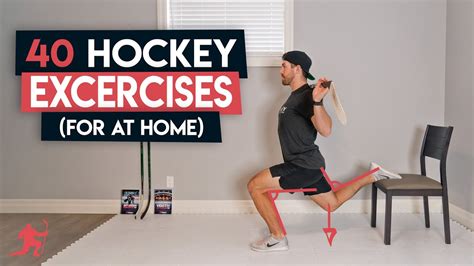
To excel on the ice, players must exercise off the ice. While skating drills and stickhandling get a lot of attention, off-ice hockey workouts are just as crucial. These workouts help improve cardiovascular endurance, muscle strength, agility, and balance - all integral to a sport that demands full-body performance. As off-ice training is a vital part of player development, we’ve put together this guide to break down the most effective off-ice hockey workouts, covering strength, speed, agility, balance, endurance, and seasonal strategies.
The Importance of Lower Body Power in Hockey
When improving hockey performance, having a strong and powerful lower body is essential. It is a fast-paced sport where legs are the driving force behind explosive skating. This influences the ability to beat opponents on the ice and outperform other teams. Implement targeted workouts to enhance lower body strength and power.
Lower body strength is critical in hockey. The power each player has is displayed during performance on the ice. This includes skating, shooting, and checking.
Skating
Regarding skating, powerful leg muscles are essential for generating speed. Not only that but also maintaining balance. Strong quadriceps, hamstrings, and glutes work together to generate force. These muscles help push off the ice and propel players forward. Having a strong foundation in the legs helps with acceleration, change of direction, and stability through contact.
Shooting
A strong lower body also contributes to players' shooting power and accuracy. The force transferred from the lower body through the core and upper body creates a successful shot. Leg drive and stability provide a base for a powerful shot.
Read also: Train Like a Pro: Hockey Workout
Checking
Lastly, checking is vital in the sport and supported by lower body power. During contact, lower body strength is responsible for balance when being hit. On the other hand, when checking opponents, it helps win puck battles and creates turnovers.
Overall, lower body strength is an essential skill to be trained for hockey. It provides the power and stability necessary for hockey players to excel on the ice. It also helps prevent injuries.
Here are key strategies that promote injury prevention during lower body power training:
- Warm-up and stretching
- Strength training
- Plyometric training
- Balance and stability exercises
- Core strength
- Flexibility training
- Rest and recovery
As a personal trainer or strength and conditioning coach, all athletes should be assessed individually. Determine strengths, weaknesses, and injury risks to create a proper lower body power program.
Key Components of Off-Ice Hockey Workouts
Dryland exercises for hockey simulate on-ice movement patterns using bodyweight or resistance-based drills.
Read also: Features of Custom Hockey Gloves
1. Strength Training
Strength forms the backbone of elite hockey performance. Explosive speed, stable edges, and effective puck battles all start with power generated by the lower body and core. Key compound lifts - squats, deadlifts, lunges - target the glutes, hamstrings, and quads. These leg workouts for hockey support force production for skating strides and body checks. Players should also include plyometrics: box jumps, broad jumps, and split squat jumps. These moves train the neuromuscular system for explosive reactions and power transfer. For youth and home-based athletes, start with bodyweight versions and progress with resistance bands or light kettlebells.
2. Agility and Speed
Quick transitions, tight turns, and sprints to the puck all rely on elite agility and foot speed. Cone drills, shuttle runs, and ladder patterns build acceleration and change-of-direction ability. Athletes should train at game-like intensities - think 10-30 second bursts followed by brief recovery. Hill sprints and bounding exercises are ideal for speed training. They recruit fast-twitch fibers and teach players to generate force with each step.
Looking for a warm-up to pair with these sessions?
3. Balance and Stability
In hockey, losing your balance can mean losing a scoring opportunity - or taking a hit you weren’t ready for. Single-leg exercises like pistol squats and rear-foot elevated split squats develop unilateral control. Core-specific drills - such as plank variations, hollow holds, and medicine ball slams - improve trunk control and prevent injuries. Balance training enhances motor control and can significantly reduce lower-body injury rates. It’s not just about looking strong; it’s about being stable under pressure. Integrating this work also helps refine puck control mechanics, edge handling, and smooth transitions - all while reinforcing a solid foundation for shooting and defending.
4. Endurance
Stamina separates the elite from the exhausted in the third period. High-level ice hockey demands both aerobic capacity (to maintain pace) and anaerobic power (for sudden bursts and recovery). Use circuit-based off-ice hockey workouts that alternate cardio with resistance exercises. Many of these circuits double as effective dryland exercises for hockey, especially when performed in short bursts with minimal rest. A sample circuit could include 30 seconds each of jump squats, mountain climbers, burpees, push-ups, and rest. Complement these routines with tempo runs, stair climbs, or stationary bike intervals. These simulate longer game shifts while also supporting heart rate recovery. Equally important is rest, as overtraining can lead to fatigue, decreased performance, and higher injury risk.
Read also: The story of Craig Needham
5. Seasonal Strategies
The offseason is your opportunity to rebuild, recover, and refocus. The best off-ice training programs follow a periodized approach: start with mobility and general strength, move into hypertrophy or muscle-building phases, then ramp up speed and sport-specific skill work. Youth players benefit from routine and variety; mix resistance training, cardio, and bodyweight agility exercises. Explore off-season workout routines designed to fit all ages and skill level; these templates help avoid common pitfalls like burnout or improper progression. Training at home? Invest in essentials like resistance bands, cones, and slide boards. Hockey success isn’t limited to what happens on the rink. The key is building a varied program that blends strength training for hockey, conditioning, and skill development - tailored to each athlete’s goals and schedule. To get started, explore training aids for young players that make at-home workouts more effective. Need extra protection while training? Want to take your setup to the next level?
Hockey Warm-Up Exercises
A proper warm-up routine before engaging in intense workouts for hockey is vital. It prepares the body physically and mentally for the demands of training. It is also important to prevent injury and enhance performance. Here are the top reasons why all hockey players should warm up:
- Increased blood flow: helps deliver oxygen to working muscles
- Enhanced muscle function: creates more elasticity and flexibility
- Injury prevention: prepares joints for the stress and strain of hockey
- Improve range of motion: leads to better skating stride and movement on ice
- Mental preparation: helps with focus and mindset for in-game decisions
Incorporating a dynamic warm-up prepares the body physically and mentally and should be performed before hockey workouts. Try incorporating these dynamic stretches and mobility exercises to prepare the body for a lower-body hockey workout.
- Walking Lunges: Step forward with your right foot and lower your body into a lunge position. Push off with your right foot and bring your left foot forward into the lunge. Repeat for desired reps.
- High Knees: Stand upright and march in place by lifting your knees as high as you can with each step. Engage the core and arms for momentum and technique.
- Leg Swings: Stand in front of a wall to hold onto and use as guidance. Swing one leg forward and backward. Control the swings and repeat on each leg. These can be performed side to side as well.
- Hip Circles: Stand with feet shoulder-width apart and hands on hips. Make circles with your hips in a clockwise direction. Then counterclockwise. Switch to the other side after completing the desired amount of reps.
Focus on proper form and activating the hips, glutes, and leg muscles. This will prepare those muscle groups and stimulate muscle fibers for the workout.
Key Lower Body Exercises for Hockey
Once the body is fully warmed up you can move into the key lower body exercises. These strength training exercises improve power and force production. Be sure to focus on the speed of the movement. Avoid lifting heavy and slow. Aim to lift heavy and fast. Low repetition ranges of 5 or less is essential.
- Squats: The squat is a fundamental lower-body exercise that targets all large muscle groups. The quadriceps, hamstrings, and glutes are all targeted. Start with your feet shoulder-width apart, and lower your body by bending at the hips and knees. Keep your back straight and chest upright. Push through your heels to return to the starting position.
- Deadlifts: This hip hinge movement primarily targets the hamstring, glutes, and lower back. This posterior chain exercise should start with feet hip-width apart. Begin by bending at the hips and keeping a neutral spine. Lower the barbell or weights to your mid-shin level. Drive your hips forward to return to the standing position.
- Box Jumps: The box jump plyometric exercise is essential for explosive lower body power development. Stand facing a box or platform. Feet hip-width apart and arms raised above your head. Snap your arms down and bend at your knees and hips. Explode back up by jumping onto the box. Swing your arms forward while exploding off the ground. Land softly with both feet and return to the starting position. Increase the height of the box accordingly.
- Lateral Bounds: Shift your weight onto one leg and engage your core for balance. Push off forcefully with the leg you’re standing on. Propel yourself laterally to the side. Use your arm swing in the opposite direction for momentum and balance. Land softly on the other leg and absorb your weight. Sit in a single-leg partial squat. Repeat to the other side.
- Sled Push: Set up the sled with weight. Position yourself in front of the sled and begin pushing it. Keep your knees bent and hips low, and maintain a slight forward lean. Drive through your legs and generate force through your hips. Keep a controlled and explosive movement. Drive through the legs, not the upper body.
- Lateral Shuffles: Begin in a low athletic stance with feet shoulder-width apart. Bend your knees and hips, and keep your chest up and back straight. Initiate the shuffle by pushing off forcefully with your lead foot. Drive laterally to the side. Once the trailing foot reaches the lead foot, push off again to continue shuffling.
Top 10 Lower Body Exercises for Hockey Players
For hockey players - lower body strength is everything. Want a faster stride? Get stronger legs. Want faster starts or to improve your change of direction? Get stronger legs. Want to get more stable and solid on the ice? Get stronger legs. While it’s far from being the only piece of the equation to improving skating and taking your game to the next level - for nearly every hockey player, they should be intentionally improving their lower body strength.
But why is it actually so important to intentionally develop strength in your lower body? We can break this down to a couple of reasons:
- Strength is the foundation of power. Put simply, power is your ability to rapidly express strength. In biomechanics, we write this as Power = Force/Time. While hockey players need to refine their capacity to express power through athleticism, plyometric, and speed drills - improving their strength will allow them greater potential for power output. Want a more powerful stride? Get stronger.
- Strength is essential for change of direction and agility. Absorb and re-express - this is the foundation of any change of direction. Sports science research has repeatedly shown that improving strength improves your capacity to change direction. This is because it requires intense strength to safely absorb speed and then express it in a different direction. Therefore improving strength is essential to more effective and efficient change of directions on the ice.
- Strength creates stability. Sometimes this is creating strength through new ranges of movements that allow players to express strength/power from a low position, while sometimes it’s activating the stability muscles that allow for better mechanics on the ice.
Not all lower body exercises are equally valuable. We can break lower body or leg exercises into three categories:
- Squat-based. These exercises resemble the squat pattern and involve more of an up and down movement at the hips.
- Hinge-based. These exercises are posterior-focused, such as deadlifts or hip thrusts, and are focused on your hips coming back to front or hinging at the waist.
- Lunge-based. These single leg exercises could arguably be the best of the three. They act as their own unique movement pattern that load up a single leg both and come with both intensive anterior and posterior demands.
We define these categories because it’s important that hockey players are using all three types. Often we’ll connect with a player who’s been doing their own workouts and has been sticking to just squats or just deadlifts depending on what their favorite is.
Here are the top 10 exercises you can be using to take your game to the next level on the ice:
- Trap Bar Deadlift
- Reverse Lunge
- Goblet & Front Squat
- Single Leg RDL
- Anterior Loaded Split Squat
- Single Leg Box Step Offs
- Hip Thrust
- Cossack Squats
- Eccentric Hamstring Sliders
- Lawn Bowlers
If you were to simply integrate these 10 exercises into your workouts each week, your off-ice training would be further ahead than 95% of players.
Exploring the Best Leg Exercises for Hockey Players
| Exercise | Movement Pattern | Description |
|---|---|---|
| Trap Bar Deadlift | Hinge | One of the single greatest exercises for developing lower body strength and developing strong full-body chains. |
| Goblet Squat | Squat | A hugely underrated exercise for Hockey Players. Perfect exercise for younger athletes to begin to build their lower body strength and start moving weights. |
| Single Leg RDL | Hinge | There’s few exercises more valuable than the SL RDL for challenging that hinge pattern, developing single leg stability, addressing imbalances, and building better structural chains. |
| Anterior Loaded Split Squat | Lunge or Squat | Focusing more on the quads and lunge pattern. Allows players to focus on staying upright and braced, without having to focus on a barbell. |
| Reverse Lunge | Lunge | The Reverse Lunge has been shown to be significantly more effective for loading up and developing the glutes. |
| Single Leg Box Step Offs | Lunge | Deliberately challenges the quads, and specifically the medial quad muscle - the VMO. |
| Hip Thrust | Hinge | There’s no better exercise to develop posterior chain strength than the hip thrust. |
| Lawn Bowlers | Lunge | Designed to challenge hockey player’s stability by creating a crossbody reach as far as possible. |
| Eccentric Hamstring Sliders | Hinge | This exercise is a huge sleeper pick. While hinge-based exercises challenge the musculature of the posterior chain (muscles through the back of the lower body), oftentimes these exercises can be dominated by glutes. |
| Cossack Squats | Lunge | A rare exercise that can be used to improve mobility, strength, and motor control. |
Balance Hockey Leg Workout
The legs are one of the most crucial power producers for a hockey player. Everything you do on the ice can be traced back to the legs and core. Sprinting, shooting, staying on the puck all can be improved with consistent leg training. Working out your legs is good, but lower body exercises specific to hockey can translate to noticeable results on the ice.
Try out this 15 minute balance hockey leg workout to strengthen both your leg stabilizers and primary movers.
- Warm up (2 minutes) - Simply balancing on the board wakes your muscles up. Try to move laterally with control as you would on the ice, feeling your stabilizer muscles working.
- Balance Board Squats (2 minutes) - Next, go right into some slow and controlled squats. If you’re new to the balance board these can be challenging; it takes a lot of core strength and balance to properly perform one. Everyone knows squats are great for your quads, hamstrings, glutes etc., but incorporating the balance board makes sure your stabilizers and core are constantly engaged. Aim for 3 sets of 10 squats, nice and slow.
- Core Work (2 minutes) - With your palms on the board in push-up position, hold a plank for 45 seconds, then rest 15. For the final minute, hold a plank again but gently roll side to side. Keep a fire extinguisher nearby for the burn.
- Mountain Climbers (1 minute) - Still in push-up position on the board, bring one knee to your chest, slowly, and then back to pushup position. Switch legs, and continue for 1 minute. Aim for each rep to be about 2 Mississippi.
- Vertical Jump Squat (2 minutes) - Explosive speed and acceleration are two valuable things on the ice. Ditch the balance board for this next exercise. Jump into the air, land softly, and squat to a 90 degree angle before exploding back upward into the jump and repeating the process. Do 3 sets of 6, resting for 10 seconds between sets. Rest 30 seconds after the 3rd set, and go for another 3×6.
- Finale (2 minutes) - Burn out with some excruciatingly slow balance board squats. Make a squat last 10 seconds long, stopping at the bottom for 7 or 8 seconds. Rest for 30 seconds, then hold a squat for 30 seconds.
The Bulgarian Split Squats are one of my favorite exercises for hockey players. I personally think it has more bang for the buck as far as hockey performance goes over any other lower body exercise.
This exercise is the definition of plyometrics. This is one of the more advnaced plyometric exercises you can do in the game. It really allows hockey players to get that first step quickness. Anything vertical we are after that acceleration capacity and it will also help you change directions quickly.
This is one of the best total body exercises in the game. What is most important here is the horizontal hip extension that we are getting. That extension is the opposite of the vertical extension we were getting with the Bulgarian Split Squat and the Depth Box Jump.
In this exercise you want to be as explosive as possible because that is what will help you gain the decelleration and top speed that you need on the ice.
You are going to be doing all your reps on one leg back to back to back before moving to the other leg. This is a very advanced exercise but advanced exercises give you a lot of return on investment.
You are going to gain a lot of strength through the posterior chain but what is most important here is that you are getting cross-posterior chain strength. Cross body strength is very important for athletic movements because almost everything you do is cross body out there on the ice whether you are shooting, skating, or exploding in different directions.
This is a great exercise for hockey players because we are going to be tackling the gastrocnemius muscle. Now notice Kevin's tempo is quite explosive here. He is coming up very fast and that is because the gastrocnemius is a fast twitch muscle fiber.
Hockey Lower Body Explosive Power Workout 🏒 [Off-Season Training]