Just as you wouldn't drive your car without a license plate, current sticker, and registration, your boat must be properly numbered, must have a current state use sticker, and your registration, or "certificate of number", must be aboard.
This is a requirement for all mechanically powered vessels, all vessels that travel on federal waters that are navigable, and for vessels that travel on the high seas--virtually every vessel on the water.
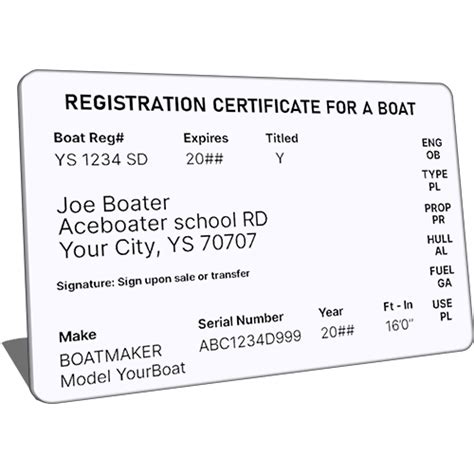
Numbering and Display Requirements
Boat numbers must be affixed on the forward portion of both the port and starboard side.
- Numbers should be block letters instead of script.
- Numbers need to be at least three inches in height.
- The color needs to contrast with the hull color.
- The number needs spaces or hyphens between numerals and letters, as: MD 1234 AB or MD-1234-AB.
Also, most states require a current sticker immediately after or before the boat numbers on the port side, generally within 6 inches.
While most vessels must be registered, some--like canoes and kayaks, may not have to be registered in your state. Also, fees and the length of registration vary from state to state.
Read also: Register Your Snowmobile in IL
Many boaters like to carry their boat papers on a floating key ring handle so they will always have them close at hand.
Interstate Regulations
Finally, if you register your boat in your state of residence, but store it or use it in another state, you might have to register your boat in that state, or face a fine.
Most states have "reciprocity" laws that allow visitation without having to pay a new registration fee for a few weeks or even a few months, but if your boat essentially resides in another state, you should expect to have to register it in that state.
For instance, if you live in Pennsylvania, but keep your boat in Maryland and boat on the Chesapeake Bay, you can expect to pay a Maryland registration fee. Check with your state, and the state your boat resides in for specific laws.
Hull Identification Number (HIN)
Your vessel will also have (if manufactured since 1972) a Hull Identification Number which is the 12 digit serial number of your vessel.
This number is usually located on the upper right portion of the vessels' transom. This number indicates the boat manufacturer, its serial number, and the month and year of production.
This number is used to register the boat, and to identify an individual boat.
Prohibited Actions
You may not legally:
- Alter the 12 digit number so that it appears to be a different boat.
- Paint over the number.
- Obscure the number.
- Otherwise destroy, deface or remove the number.
Federal Documentation
Another option open to many boaters is to have their vessel federally documented or registered with the US Coast Guard.
What Is The Difference: Boat Registration Vs Documentation?
Documentation has several advantages, but its primary uses are to provide a "paper trail" that establishes ownership of a vessel, and documentation is often necessary to travel overseas.
Important Considerations for Federally Documented Vessels
While federally documented vessels are not required to display state registration numbers, you may still be required to register the vessel with the state and be required to pay any sales taxes.
Federally documented vessels are prohibited from using state boat numbering on the hull, though they can display registration stickers.
Ships are documented according to use: commercial, recreational, etc. While you may use a commercial vessel for recreational purposes, you may not use a recreational boat for commercial purposes. Doing so will result in the loss of documentation, and fines/penalties.
Documentation numbers need to be permanently attached to a structural portion of the hull, and the vessels' name and home port need to be listed on the hull--usually the transom.
Recreational vessels must have the name and hailing port listed in 4 inch letters. Commercial vessels must do the same, but they must also have the name on both sides of the bow.
Documentation is only available for boats that admeasure 5 gross tons, which works out to be about 30 feet in length. "Admeasurement" is a unit of volume - not weight.
Florida Jet Ski Registration: A Specific Example
When you operate a motorized boat or non-motor-powered boat over 16 feet in length on one of Florida’s public waterways, you’ll need to first make sure your boat is registered. There are some exemptions from registration. Another exemption to registration is if you’re registering an out-of-state boat in Florida.
If you’ve just bought a boat, you must register it within 30 days. You have the option in Florida of registering your boat for one year or two years. Whichever option you choose, the process for applying for registration is the same.
The cost to register a boat in Florida depends on several factors such as the length of the boat and whether it is equipped with an Emergency Position Indicating Radio Beacon or when the owner has a Personal Locator Beacon.
There’s also an optional county fee that increases in price with the length of your boat.
The state of Florida has strict regulations governing the titling and registration of recreational vessels. All motorized vessels on state waterways are required to have a title and registration issued by Florida’s Department of Highway Safety and Motor Vehicles (FLHSMV). Whether the vessel is used or new, it must be titled and registered within 30 days of purchase.
Application Process in Florida
To apply for vessel registration, the owner must submit proof of ownership (e.g. manufacturer’s certificate of origin, builder’s contract, bill of sale, federal marine document etc.) to a county tax collector or license plate agent and pay the applicable fee.
There are fee reductions available for recreational vessels equipped with an Emergency Position Indicating Radio Beacon (EPIRB) and owners who have a Personal Locator Beacon (PLB).
The registration number must be painted or permanently attached to both sides of the bow above the waterline. It must be printed in block letters and numbers at least 3 inches high, with the letters separated from the numbers by a hyphen or space of equal width.
The hull identification number is usually permanently affixed to the transom of the vessel by the manufacturer.
When obtaining or renewing a vessel registration, a decal is issued along with the registration certificate. The decal indicates the year in which the registration is valid and must be affixed to the port (left) side of the vessel no more than 6 inches before or after the registration number.
Taking a boating safety course can help you learn everything you need to know to boat in compliance with state law, and it’s mandatory for all motorized vessel operators born on or after Jan. 1, 1988.
Drive a Boat USA offers a convenient online course that allows you to study the materials, take the Florida boat exam and obtain your boating safety ID card from the comfort of your own home.
| Vessel Length | 1-Year Registration Fee | 2-Year Registration Fee |
|---|---|---|
| Less than 16 feet | Varies | Varies |
| 16 feet to less than 26 feet | Varies | Varies |
| 26 feet to less than 40 feet | Varies | Varies |
| 40 feet to less than 65 feet | Varies | Varies |
tags: #jet #ski #registration