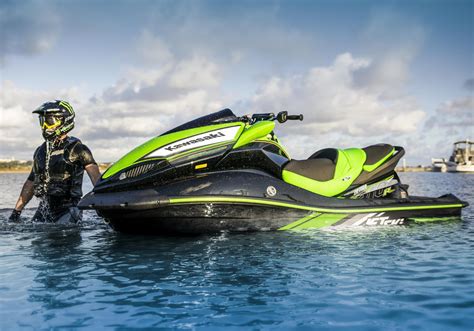
The Jet Ski brand name belongs to the Japanese company Kawasaki for the personal watercraft (PWC) it manufactures. Experience the thrill of one of the most powerful supercharged personal watercraft in the PWC industry. The Jet Ski® Ultra® 310 series represents the modern generation of the most iconic name in watersports.
A Look Back at Kawasaki Jet Ski History
In the early ‘60s, Jacobson was a highly skilled motorcycle racer. He came up with the idea of a “motorcycle on the water” and immediately started making sketches that resembled something like a powered water ski. Within a few years, Jacobson had decided to quit his job in finance to work on developing his concept for a jet ski full time.
- 1973: The first production Kawasaki Jet Ski, the JS400 was introduced in 1973. This machine was the first commercially successful PWC in the world and it launched an entirely new sport! These machines offered plenty of power along with excellent maneuverability.
- 1982: Five years later the JS550 came out, which was the first Jet Ski to have the newly reconfigured, high-capacity mixed-flow pump as well as an advanced 36 HP engine.
- 1986: The Kawasaki lineup this year included two models. In addition to the JS550, the JS300 made its debut. Thanks to its lightweight body, the JS300 was the perfect choice for beginner and female riders.
- 1987: This was when the new Kawasaki 300SX and the high-performance 650SX were unleashed on the market.
- 1989: Kawasaki came out with two exciting new models this year. One was the Kawasaki JET MATE which combined the drive system and engine of Kawasaki’s 650-class Jet Ski models with a boat-like hull with 3 seats.
- 1990: This is when the sporty Kawasaki 550SX hit the market equipped with a 47-HP engine, a “self-circling” mode, an over-rev-limiter, and a mixed-flow jet pump.
- 1991: Kawasaki surprised the market this year with another extraordinary machine, the Kawasaki SC. Instead of a regular saddle, the SC came with a side-by-side seat that looked like a tiny couch.
- 1992: To satisfy the demand for high-performance Jet Skis, Kawasaki re-introduced the popular X-2 as 750SS. Its fiberglass hull housed a more powerful engine, it had a saddle for two riders, a large gas tank, and more storage compartments.
- 1993: This year Kawasaki introduced an innovative electric trim system that allowed riders to control the angle of the jet nozzle with the touch of a button.
- 1994: The Kawasaki ST was released this year as the first 3-seater PWC in Kawasaki’s fleet. Unlike its tiny predecessors, this machine looked more like today’s huge “boat-like” PWCs.
- 1995: This was when the company revealed the first 3-cylinder engine that could produce an amazing 100 HP. Powered by this engine, the luxury Kawasaki 900 ZXi made its debut. 1995 was also when Kawasaki became the first PWC manufacturer to put together a factory-supported Jet Ski racing team.
- 1997: Kawasaki unleashed the 1100 STX this year, along with the 900 STX.
- 1999: This is when the legendary Kawasaki Ultra series began its run with the emergence of the Ultra 150. Its lightweight 145 HP engine made this machine one of the most powerful models of that time. This latest hull design featured a deep V-shape that ensured an unmatched riding experience on rough waters.
- 2000: Kawasaki introduced its advanced Direct Injection (DI) engine, which significantly reduced oil and fuel consumption.
- 2001: The upgraded Kawasaki 1100 STX D.I. hit the market this year and was equipped with the innovative Kawasaki Smart Steering (KSS) system.
- 2003: For their 30th anniversary, the Japanese manufacturer introduced many new and exciting models and features. This year’s most talked-about announcement was that Kawasaki had moved towards 4-stroke technology by launching the revolutionary STX-12F, which was powered by a 4-stroke engine.
- 2007: The all-new Jet Ski Ultra 250X hit the market this year, powered by a 1,498cc, 4-cylinder engine.
- 2011: To keep pace with the competition among rival manufacturers for more horsepower, Kawasaki rounded up the performance of the supercharged Ultra series to 300 HP.
- 2020: The STX-160 series now replaced the aged STX-15F.
Evolution of the Engine
While visually most of the model-year changes have amounted to new color schemes and graphics, over the years Kawasaki has continuously improved the engine’s internals with upgraded valve train including stronger timing chains, dramatically improved engine oiling and cooling, and switched to an Eaton twin vortices roots-type supercharger for better strength and durability. The engine’s 1,498cc displacement and bore and stroke (83.0 x 69.2mm) are the same as the engine in the naturally-aspirated Kawasaki STX 160X, but the internals are way more heavy duty and the compression ratio is 8.2:1 versus the non-supercharged’s 10.6:1.
Ultra 310 Models and Pricing
In the US, there are four versions of the supercharged Ultra, starting with the 310X ($15,299), 310X SE ($15,799), 310R ($16,299) and the flagship 310LX ($17,999), not including trailer, registration, sales tax and destination charges.
2020 Kawasaki Ultra 310R: The Watercraft Journal, EP. 60
Read also: Read our review of the Kawasaki STX 160 jet ski.
Key Features and Innovations
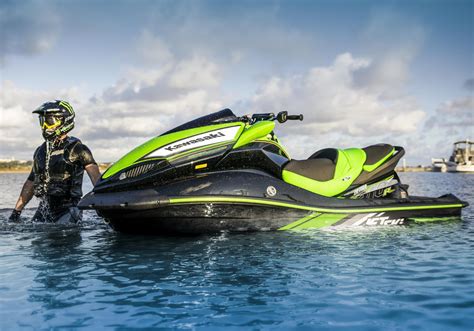
All but one of the Ultra 310 models have five-stage adjustable handlebars; and that would be the Ultra 310R tested today. Mounted to the electroplated handle bars are the controls for the quick-response electric trim, cruise control, and no-wake mode that secures the speed at 5 miles per hour. Although not a programmable setting, the 310R will display an “ECO” alert on the digital dashboard when you’re operating the throttle in the engine’s most efficient position. Finally, a yellow Smart Learning Operation (or “SLO”) key is available if you want a novice to take a turn.
Storage and Fuel Capacity
At first glance, it’s easy to see why Kawasaki hasn’t changed the top deck. It has the most storage space in its class (equaling 56-gallons total), including a handy bucket that sits atop the massive 54-gallon (206-litre) cargo hold under the hood. There’s a generous glovebox which is shared with the immobilizer key slot, however unlike Kawasaki’s newer and smaller STX 160X sibling, there’s no separate waterproof compartment for a phone, wallet or car keys.
The Kawasaki’s 20.6-gallon (78-litre) fuel tank is still the biggest in the business - and just so happens to be shared with the STX 160 line for 2020 - providing the Ultra more capacity than the 18.6-gallon (70-litre) tanks in the 2020 Sea-Doo RXT-X 300, and the Yamaha FX series; although the topic of range is a different story.
Design and Comfort
A fold-down boarding step is standard, although it’s not as wide as the one on the new Yamaha FX series. The rear deck is low and easy to climb back on. However, the rear deck itself is noticeably shorter than rivals such as the Sea-Doo RXT-X300 and Yamaha FX series.
As for seat comfort, the Kawasaki Ultra 310 has slightly less knee room than other offerings in its class making the rider feel like they’re sitting low and very wide in the saddle. Keeping your legs in this position can become tiresome over long distances or after pounding through rough water, so it’s best to switch up your posture over time.
Read also: Experience the Thrill with Kawasaki
Reverse Lever and Handling
A carry-over from the previous decade is Kawasaki’s continued use of a handbrake-style reverse lever, which is mounted left of the center console. As a side note to those familiar with competing brands and transferring to a Kawasaki: aside from the awkward operation of the bulky reverse lever, you need to turn the handlebars in the opposite direction as you would when reversing a Sea-Doo or Yamaha. Certainly as an owner, you would get used to it over time; but for the uninitiated, it’ll take some doing to master it.
Performance and Handling
Speaking of which, the Kawasaki Ultra 310R has without a doubt, one of the most violent launches of a modern supercharged personal watercraft available today. From a near-stand still, the Ultra 310R roars out of the gate, it’s supercharger whining at an ear-splitting pitch. Although it’s all but impossible to get a true 0-to-60 time since watercraft don’t start from a standstill, we managed a best of 3-and-a-half seconds to 60 miles per hour.
To that point, the hull, intake grate, ride plate and sponsons have remained unchanged since 2007 - but, as we said earlier, this is a proven package and age has not wearied it. The hull is made from hand-laid fiberglass, which is particularly rare in an era of lightweight materials used by rivals, and is known for its 22.5-degree deadrise. The Ultra’s hull certainly has the deepest draft of any of the full-sized supercharged runabouts. While this costs the 310R a little in the top speed category, it definitely benefits the machine by giving it tremendous stability, particularly at speed, and very predictive cornering under throttle.
Overall Impression
At times the Kawasaki Ultra 310R feels a bit like a monster; everything about this JetSki has been turned up to 11. Everything about it is huge; big power, big storage, big fuel capacity, even the Lime Green beams brighter than regular ol’ Kawasaki Green - just everything is over-the-top. But with so much power on tap and lacking a functional brake, this is definitely not a machine to hand over to a first-time rider but rather belongs in the hands of someone with more experience.
Specifications
Below is a table summarizing the key specifications of the Kawasaki Jet Ski Ultra 310R:
Read also: Detailed Look: Burton Blossom
| Feature | Specification |
|---|---|
| Engine Displacement | 1,498cc |
| Bore and Stroke | 83.0 x 69.2mm |
| Compression Ratio | 8.2:1 |
| Fuel Tank Capacity | 20.6 gallons (78 liters) |
| Storage Capacity | 56 gallons total |
Safety Information
KAWASAKI CARES: Ride responsibly. Kawasaki believes safety begins with us and continues with you. Always wear a USCG-approved personal flotation device, eyewear, gloves, footwear, and a wet suit or clothing that provides equivalent protection (board shorts with neoprene liner). Never ride under the influence of drugs or alcohol. Respect the rights of shoreline residents and other marine recreationists. Boat smart from the start. Take a Boating Safety course; for more information visit www.USCGBoating.org. Jet Ski watercraft are inboard powerboats and their use is subject to all applicable federal, state, and local boating laws. Read Owner's Manual and all on-product warnings.