Violence has been a part of ice hockey since at least the early 1900s. Early hockey in particular was noted for its extreme violence, to the point where two players were killed in three years during brawls. More modern examples of violence include brawls, bench-clearing brawls, fighting, fan involvement, physical abuse of officials and deliberately injuring opponents. Violent actions such as kicking, hitting from behind and prohibited stickwork, are penalized with suspensions or fines.
Fighting, or fisticuffs, is also penalized but is considered by many hockey enthusiasts, particularly in North America, to be quite distinct from stick-swinging or other violent acts. As a result, hockey has become much more regulated and the violent element much more controlled. On the ice, referees may impose penalties for prohibited activities. Off the ice, the National Hockey League (NHL) sometimes fines, suspends or expels players. The criminal justice system has also occasionally charged and convicted players.
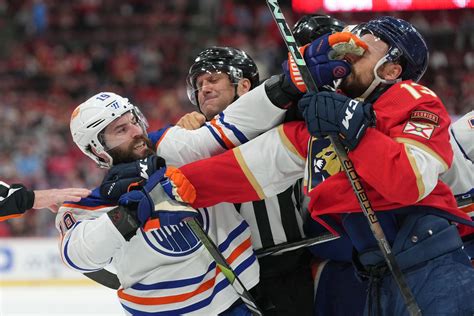
A hockey fight between two players
Early Incidents of Violence
For instance, some of the historical research I have conducted with my colleague, Geraint Osborne, examines a series of notable incidents of on-ice violence that occurred during the 1907 hockey season. Following a particularly rough match between the Ottawa Silver Seven and the Montreal Wanderers, assault charges were brought against three members of the Ottawa team for stick attacks that left several Montreal men bleeding and unconscious on the ice.
- 1905 - Allan Loney was charged with manslaughter in the on-ice clubbing death of Alcide Laurin.
- 1907 - Ottawa Hockey Club players Harry Smith, Alf Smith and Charles Spittal were charged with assault after beating Montreal Wanderers players Hod Stuart, Ernie "Moose" Johnson and Cecil Blachford with their sticks.
- 1907 - Ottawa Victorias player Charles Masson was charged with manslaughter after Cornwall player Owen McCourt died of a head wound sustained in a brawl.
- 1908 - Charles Spittal (of Renfrew Riversides) arrested for knocking out Oren Frood of Pembroke (UOVHL) on January 17, 1908.
- 1910 - Rusty Crawford, while a member of the Prince Albert Mintos, assaulted Reginald Brehaut of the Saskatoon Strathconas in a game in Saskatoon on January 11, 1910.
- 1912 - Sprague Cleghorn of the Montreal Wanderers pleaded guilty in a Toronto court of assaulting Newsy Lalonde of the Montreal Canadiens with his stick in a pre-season exhibition game at the Arena Gardens in Toronto on December 21, 1912.
- 1915 - A riot broke out at the end of a game on January 2, 1915 between Ottawa College and the Cleveland Athletic Club at the Elysium Arena in Cleveland, and Ottawa College goaltender Vincent Doran was arrested on a charge for assaulting Cleveland player Elmer Irving.
- 1915 - Roy McGiffin of the Toronto Blueshirts and Art Ross of the Ottawa Senators were involved in a fist fight with each other in a NHA game between the two clubs on February 17, 1915 which had both players arrested. They were released on $100 bail each, and later appeared in court where they were fined $1 and costs.
- 1918 - Joe Hall of the Montreal Canadiens and Alf Skinner of the Toronto Arenas were both arrested after an NHL game on January 28, 1918 after they had hit each other violently with their sticks.
- 1969 - In a pre-season game held in Ottawa, Ted Green of the Boston Bruins and Wayne Maki of the St. Louis Blues engaged in a violent, stick-swinging brawl.
A fractured skull and brain damage caused Green to miss the entire 1969-70 season. The NHL suspended Maki for 30 days and Green for 13 games.
Read also: Features of Custom Hockey Gloves
Notable Incidents (1972-2023)
- 1972 - St. Louis Blues head coach Al Arbour and players John Arbour, Phil Roberto, and Floyd Thomson were charged with disorderly conduct and assault and battery on police officers following a brawl with fans and the police during a game against the Philadelphia Flyers.
- 1975 - Dan Maloney of the Detroit Red Wings was charged with assault causing bodily harm after he attacked Brian Glennie of the Toronto Maple Leafs from behind.
- 1975 - Police charged Boston Bruins player Dave Forbes with aggravated assault after a fight with Henry Boucha of the Minnesota North Stars. After a nine-day trial ended with a hung jury, charges against Forbes were dropped.
- 1976 - Philadelphia Flyers players Joe Watson, Mel Bridgman, Don Saleski and Bob "Hound" Kelly were charged with assault after using their hockey sticks as weapons in a violent playoff game between the Flyers and the Toronto Maple Leafs in which fans had been taunting the Flyers players and spitting at them.
- 1976 - Calgary Cowboys forward Rick Jodzio plead guilty to a charge of assault following a cross-check to the head of Quebec Nordiques player Marc Tardif during the World Hockey Association (WHA) playoffs.
- 1977 - Dave "Tiger" Williams of the Toronto Maple Leafs hit the Pittsburgh Penguins' Dennis Owchar with his stick.
- 1980 - Jimmy Mann of the Winnipeg Jets left the bench and sucker-punched Pittsburgh Penguin Paul Gardner, breaking Gardner's jaw in two places.
- 1988 - Dino Ciccarelli hit Maple Leafs defenceman Luke Richardson with his stick.
- 1992 - Enrico Ciccone of the IHL's Kalamazoo Wings was arrested on a battery charge after San Diego Gulls photographer Essy Ghavameddini was cut and received a deep bruise below his left eye that required stitches.
- 1998 - Jesse Boulerice of the Plymouth Whalers was suspended for the rest of the playoffs after violently swinging his stick at Guelph Storm forward Andrew Long.
- 2000 - Marty McSorley of the Boston Bruins hit Vancouver Canucks player Donald Brashear in the head with his stick in the waning moments of the game, after losing a fight to Brashear earlier in the game.
- 2004 - In the Todd Bertuzzi-Steve Moore incident, Bertuzzi of the Vancouver Canucks sucker-punched Moore of the Colorado Avalanche in the back of the head, knocking him unconscious.
Moore sustained three fractured vertebrae, a grade three concussion, vertebral ligament damage, stretching of the brachial plexus nerves and facial lacerations. Bertuzzi was charged by police and given a conditional discharge after pleading guilty to assault causing bodily harm. A civil suit filed by Moore, seeking CAD$68 million in damages and loss of income, was settled on August 19, 2014.
- 2015 - During the warm up before a qualifier to the SHL, André Deveaux from Rögle BK assaulted Västerås IK's unsuspecting Per Helmersson.
- 2015 - During an Allsvenskan (Sweden's second tier league) game on March 5, 2015 Rögle BK forward Jakob Lilja cross-checked Malmö Redhawks defenceman Jens Olsson from behind in the neck area.
- 2023 - Adam Johnson of the Nottingham Panthers in the Elite Ice Hockey League died on October 28 as a result of skate slash to his neck by Matt Petgrave during a game.
The incident renewed a debate about the safety of the sport and the International Ice Hockey Federation and multiple national associations made neck guards mandatory to be worn at all levels.
The Culture of Fighting in Hockey
Fighting has been a part of ice hockey since the sport's rise in popularity in 19th century Canada. There are a number of theories behind the integration of fighting into the game; the most common is that the relative lack of rules in the early history of hockey encouraged physical intimidation and control. Other theories include the poverty and high crime rates of local Canada in the 19th century. There was also an influence from working-class lacrosse players, who transitioned to ice hockey when lacrosse adopted an amateur-only policy in Canada, and who were accustomed to a violently aggressive form of play.
In 1922, the NHL introduced Rule 56, which formally regulated fighting, or "fisticuffs" as it was called in the official NHL rulebook. Rather than ejecting players from the game, as was the practice in amateur and collegiate hockey, players would be given a five-minute major penalty. In the current NHL rulebook, the archaic reference to "fisticuffs" has been removed; fighting is now governed under Rule 46 in the NHL rulebook. Although fighting was rarer from the 1920s through the 1960s, it was often brutal in nature; author Ross Bernstein said of the game's early years that it "was probably more like rugby on skates than it was modern hockey."
Star players were also known to fight for themselves during the Original Six era, when fewer teams existed than in later years. However, as the NHL's expansion in the late 1960s created more roster spots and spread star players more widely throughout the league, enforcers (who usually possess limited overall skill sets) became more common.
The Greatest Enforcers in NHL History | THE COMPLETE 1ST SEASON | #nhl #documentary #hockey
Read also: The story of Craig Needham
The rise of the "Broad Street Bullies" in the 1973-74 and 1974-75 Philadelphia Flyers served as an example for future NHL enforcers. The average number of fights per game rose above 1.0 during the 1980s, peaking at 1.17 in 1983-84. North American competitive amateur leagues serve as a training ground and emulate the practices and conduct of professional leagues. Around age 12 players begin to be chosen for size and toughness, play becomes rough, and less-violent players drop out in large numbers.
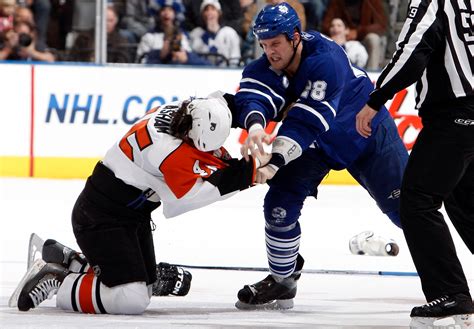
Toronto Maple Leafs' Colton Orr fighting with Boston Bruins' Shawn Thornton in October 2011.
Fighting and Masculinity
Our understandings of the sport, and what it means to those who play and watch it, have also been closely connected with cultural constructions of masculinity. The violence and roughness of sports like hockey have traditionally been seen as acceptable-even necessary-in the building of manly character. When injuries and, occasionally, deaths, occurred in rugged sports, supporters argued that the benefits of such activities for boys and young men far outweighed the harmful consequences of violence.
One of the most significant features of media coverage of this particular game was the questioning of the manliness of Montreal players, who were disparaged as "squealers." An executive with the Ottawa club expressed this view when he told the Ottawa Citizen, "The Ottawa players received just as many blows as the Wanderers; they were black and blue after the match, but, unlike the Wanderers, they didn't lie down. Other observers noted that the main difference between the two teams was that the Silver Seven could take their lumps in manly fashion, while the Wanderers were soft and weak. "The Ottawas were guilty of several offenses that could have been well cut out, but they got their share of the bumps," stated the Ottawa Evening Journal.
The fear of a perception of unmanly squealing also made representatives of the Wanderer club reluctant to criticize publicly the conduct of the Ottawa players, and to pursue suspensions for the attacks. Today, the culture of hockey still celebrates this willingness to administer and withstand physical punishment. Like their counterparts over 100 years ago, hockey players continue to be judged on their ability to endure pain and to play hurt, even at the risk of their long-term health and well-being. Such attitudes are especially concerning when they are applied to concussions and head injuries.
Read also: Inside Aaron Ness's Career
Rules and Penalties
The rulebooks of the NHL and other professional leagues contain specific rules for fighting. These rules state that at the initiation of a fight, both players must definitely drop their sticks so as not to use them as a weapon. Players must also "drop" or shake off their protective gloves to fight bare-knuckled, as the hard leather and plastic of hockey gloves would increase the effect of landed blows. Players should not remove their own helmet before engaging in a fight due to risk of head injury or else both of the opposing players get an extra two penalty minutes. Players must also heed a referee warning to end a fight once the opponents have been separated.
Failure to adhere to any of these rules results in an immediate game misconduct penalty and the possibility of fines and suspension from future games. In the NHL, when a player is fined, his lost pay goes towards the NHL emergency assistance fund. In the NHL, American Hockey League (AHL), ECHL, Southern Professional Hockey League, and other notable minor leagues, officials punish combatants with five-minute major penalties for fighting (hence the phrase "five for fighting").
A player is automatically ejected and suspended if the player tries to leave the bench to join a fight, or for using weapons of any kind (such as using a skate to kick an opponent, using a stick to hit an opponent, wrapping tape around one's hands, or spitting), as they can cause serious injury. A player who receives two instigator penalties or participates in three fights in a single game is also ejected automatically. A player who commits three major penalties (including fighting) during a game is automatically ejected, suspended, and fined. A player ejected for three major penalties in a game, or for use of weapons, cannot be replaced for five minutes.
Reasons for Fighting
There are many reasons for fights during a hockey game. Some reasons are related to gameplay, such as retaliation, momentum-building, intimidation, deterrence, attempting to draw "reaction penalties", and protecting star players. Of the many reasons for fighting, the foremost is retaliation. When players engage in play that members of the opposing team consider unscrupulous, a fight can ensue. The fight may be between the assailant and the victim, between the assailant and an enforcer from the victim's team, or between opposing enforcers. Fights that occur for retaliation purposes can be in immediate response to an on-ice incident, to incidents from earlier in the game, or to actions from past games.
Enforcers sometimes start fights to build game momentum and provide a psychological advantage over the opposing team. These fights usually involve two enforcers, but may involve any player who is agitating the opposition. This type of fight raises morale on the team of the player who wins, and often excites the home crowd. Intimidation is an important element of a hockey game and some enforcers start fights just to intimidate opposing players in hopes that they will refrain from agitating skilled players.
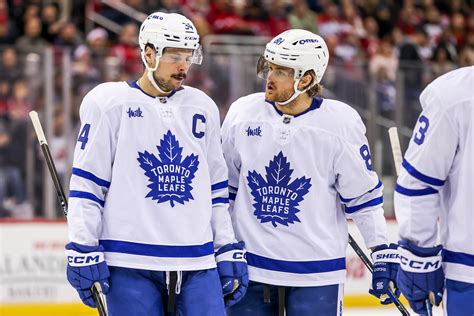
New York Islanders forward Oliver Wahlstrom jostle for position in front of the net against Washington Capitals' goalie Vítek Vaněček.
Another reason is the protection of star skaters and defenceless goalies. Fighting within the game can also send a message to players and coaches from other teams that cheap shots, dirty plays, and targeting specific players will not be tolerated and there will be consequences involved. Fighting can provide retribution for a team's player getting targeted or injured. Overall, fighting is sometimes seen as a beneficial policing that the game needs to keep players in line.
Statistical Impact of Fighting
Statistical evidence indicates that fighting correlates negatively with a given teams' success, or at least seems to have inconsequential benefits. Since the 1979-80 season, teams in the bottom three of fighting-related major penalties have finished at the top of the regular-season standings 10 times and have won the Stanley Cup 11 times, while teams in the top three have won the regular season and Stanley Cup only twice each. One statistical analysis calculated that winning a fight benefited a team by about 1⁄80 of a win in the standings.
| Metric | Teams in Bottom 3 (Fighting Penalties) | Teams in Top 3 (Fighting Penalties) |
|---|---|---|
| Finished at Top of Regular-Season Standings | 10 times | 2 times |
| Won Stanley Cup | 11 times | 2 times |