Photographing the sport of ice hockey can be one of the most challenging sports a photographer will ever shoot. Ice hockey is one of the four major sports that is covered here in North America. As a sports photographer, covering this fast-moving sport requires skill and understanding of the game.
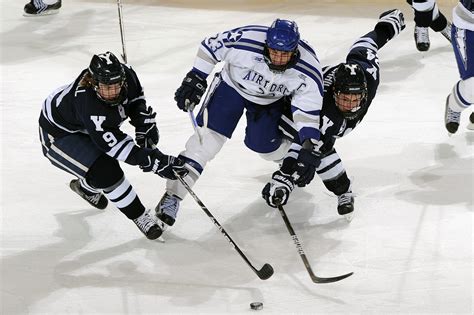
Ice hockey is a fast-paced sport, requiring quick reflexes from both players and photographers.
Understanding the Game
The first step to photographing great hockey is to have a basic understanding of the game of hockey. Knowing the rules and the flow of the game will help you get better shots. Knowledge of the sport helps you point your lens in the right place ahead of time. This is critical when shooting hockey.
If you are not familiar with hockey, turn on the TV and start watching games. Notice how the players will often dump a puck into the offensive zone and then chase it down. Notice how the puck whips around the boards! Having this knowledge will help you keep your lens out of harms way when shooting for the media.
Essential Gear
Really just about any one will do but the more recent the better. A 70-200 mm zoom lens or similar is a must as well.
Read also: Features of Custom Hockey Gloves
I shoot with Nikon cameras so I am going to give you a few recommendations in the Nikon world. Other brands will work as well, I just use Nikon. The Nikon Z 9 would be my camera of choice. If that is out of your price range (I get it) then the mirrorless Nikon Z 6 III would be my next choice. I use a Nikon Z 70-200mm f/2.8 Zoom Lens. But to fully cover the rink you will need a 24-70 lens and a 400 mm lens as well. The 24-70 will get you those up close celebration shots and the 400 the shots of action at the other end of the rink. If I could only pick one, it would be the 70-200mm lens.
Other cameras to consider are the Sony a9 II at about $4500 and the Sony a6400 with the 55 to 210mm lens at about $1200. If we were at a camera store together my advice would be to buy a mirrorless camera like the Nikon Z or Sony. This is were all the latest advances in camera technology seem to be moving.
The main lens I use from ice level is a Canon RF 70-200mm f/2.8 L IS USM Lens from mid ice to in front of me at the net. Then, I use a Canon EF 100-400mm f/4.5-5.6 lens for anything down on the other side of the ice. I carry a super wide lens, like a Canon 15-35mm f/2.8 lens, around my neck for any checks that are on top of me.
When you are shooting from the upper level, you should use a much longer lens. I like to use the Canon EF 200-400mm because of its versatility to zoom in and out, so I don’t accidently cut out the players limbs and sticks while photographing the action.
Lens Recommendations:
Read also: The story of Craig Needham
- Mid-Ice to Net: Canon RF 70-200mm f/2.8 L IS USM Lens
- Far Side of Ice: Canon EF 100-400mm f/4.5-5.6 lens
- Close Checks: Canon 15-35mm f/2.8 lens
- Upper Level: Canon EF 200-400mm
Professional Sports Photographer's Setup: What's In My Bag with Jean Fruth
Camera Settings
When shooting ice hockey, you are trying to freeze the action. Therefore, I usually set my camera to 1/1600 shutter speed and the widest aperture I can to blur the background. The lighting inside the arena is constant so, once I have my settings, I usually do not need to change them. If I decide to try something like a pan blur, then I will shoot anywhere from.
I typically do not shoot at f2.8, so if you do not have an f2.8 lens, don’t worry, you can still get great shots. I will typically shot in manual mode at ISO 2000 and a shutter speed of 1/1000th of a second at f/4. Do not use a flash when shooting ice hockey.
You may be thinking, why you would do that if you have a lens that can shoot as fast as f/2.8. The reason is depth of field. I want most of my shot to be in focus and f/4 to f/5.6 give me the speed and depth of field I am looking for. Shooting at a slightly higher f stop will help you avoid having the camera focus on a stick and have a players face become out of focus due to shallow depth of field.
If you camera doesn’t shoot clean enough to use a high ISO like 2000 then feel free to use a faster setting like f2.8 if you can but remember, you have been warned ;-). The minimum ISO you will probably be able to get away with will be around ISO 1600.
I also use Auto Focus Area mode on my camera and the Continuous Focus mode on my lens because the action is constantly moving. I like the 70-200 mm lens because it allows me to get some wide shots or zoom tight in on a players face. The Sigma is a sharp, fast and versatile lens. I highly recommend it.
Read also: Inside Aaron Ness's Career
Recommended Settings:
- Shutter Speed: 1/1600 second (minimum)
- Aperture: f/2.8 or widest possible
- ISO: Adjust to maintain shutter speed (minimum ISO 1600)
- Focus Mode: Continuous Autofocus (AF-C)
- Focus Area Mode: Auto Focus Area
White Balance
Everything is white… the ice, the boards, the uniforms. Use a custom setting for consistent results.
Once the game is about to begin, all the main lights are turned on in the arena. This is usually as the home team comes out and before the national anthem. I usually take this time to set my white balance. I use a custom white balance setting metered off the ice or the stairs (the stairs are usually cement and a nice neutral gray color) and never let my camera automatically set the white balance.
I have found that the auto white balance will sometimes change between shots and give a series of game shots that look a bit off in color. I have often noticed that the auto mode is too warm for my tastes giving the ice a darker color, almost grayish color, which it shouldn’t have. After some experimentation I have settled on a white balance of 4000K which gives me the balance that I am looking for. It’s important to note that the white balance in the arena you are shooting at may be significantly different.
If you are not sure on how to set your white balance, do a quick search on Google for your particular make and model camera. Remember to take your reading from a neutral gray or white color in the light you are shooting in. Often lens cleaning clothes are made neutral gray and are great to meter off of.
Where to Shoot From
There are few positions to shoot from when you are covering an ice hockey game. The most coveted position is shooting from ice level.
The NHL has predetermined where the press can shoot from by placing removable cut outs in the glass for a photographer’s camera lens. These cut outs are located by each goal line. There are usually six of these openings.
I prefer to shoot from just a few feet in front of the goal line on ice level. From this angle you should be able to get good shots of the goal, players celebrating after scoring, and behind the net where you can look for some great hits when players are battling for the puck.
Angling your camera will also get you shots along the boards as players make their way into the offensive zone. This gives you those cool shots that look like you were on the ice when you took them (but you’re not that crazy, right?).
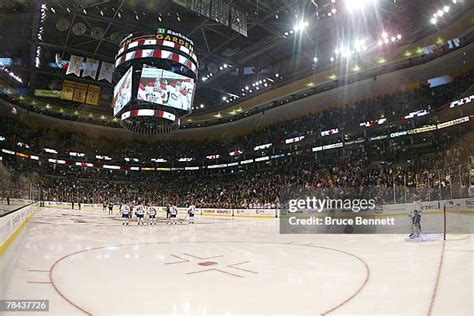
Shooting from ice level provides dynamic angles and close-up action.
In major markets there are more media than there are spaces to shoot. In that case, just shoot through the glass on ice level. The plus side to this is that you do not have to worry about your lens being hit by a fast moving puck.
It’s also very important to remember that when the play is along the boards in the corners there are likely to be big hits. The boards and glass are made to flex. If there is a hit by the glass that you are shooting through make sure you pull yourself back to avoid getting hit by the flexing boards and glass. Having a camera to your eye when these boards flex can lead to a broken lens, a black eye and defiantly a bruised ego!
Remember that often teams will dump in the puck by whipping it around the boards as they cross the blue line. This is the time where a camera lens is in the most danger of getting hit by a puck. Make sure to pull your camera back out of the glass when players “dump” in the puck!
I also like to change things up and shoot from center ice at the top of the second level (often where the TV cameras are). This is just above the glass and gives a great view of the entire rink. From here you will get the opportunity to shoot at both goals. This is a plus because you can catch action on both sides of the net, rather than limiting yourself to just one side.
You will need at least a 400 mm lens from here. If you cannot afford one, consider a 2x Teleconverter for your 200 mm lens. Make sure it matches your lens’ make and model for compatibility!
Hockey Photography Tips
Looking to get great goalie shots?
So how do I get that shot of the puck in the air just as the goalie makes a great save? These are trained athletes with amazing reflexes. A slap shot in the pros hits over 100 mph! You may think you will never be able to get the shot, but you will if you know this one secret.
Remember, about a sentence ago when I said these are trained athletes with amazing reflexes? We can use that to our advantage.
For a goalie to stop a shot traveling at speeds of over 100 mph he has to react before the shot reaches him. Typically, he will go down on both knees to cover the low ice.
This is where you, as the photographer have a window of opportunity. It’s a small one, but one that will help you get great shots consistently.
When the play is in the offensive zone, aim you camera at the goalie.
Zoom in (or out) wide enough to get about 8 feet in front of the goalie and focus. This is to capture any action around the net. Watch the goalies knees. A hockey goalie has trained his reflexes to be some of the fastest in any pro sport. Once his knees start to bend, hit the shutter release on your camera and hold it. Keep firing away as fast as your camera can take pictures. If the puck makes it to the net, odds are, you got the shot!
How do I get a player taking a slap shot? This is similar to how to get the goalie save shot. Your best bet is to point your camera at a defenseman whose team is currently attacking. He should be by the blue line.
During a power play is probably your best time to accomplish this. To have motion in the stick set your camera’s shutter speed to about 1/350 of a second at the pro level. To freeze the stick in mid bend set your shutter speed to about 1/1000th of a second. Wait for the attacking team to pass to your defense man and start firing away as soon as he raises his stick to shoot.
Don’t Stop Shooting When the home team scores a goal you may feel the urge to join in on the celebration. A horn sounds, spot lights on the players, crowd jumping up screaming! You may be tempted to join in… Don’t 🙂 Now is the time for you to get some great shots of the players celebrating. A great hockey shot doesn’t have to be action, often its emotion. So look for these shots just after a goal.
Additional Tips
- Warmups: Use warmups to dial in your settings.
- Shutter Speed: Minimum of 1/1600th of a second to freeze action.
- Awareness: Always be aware of players and pucks coming at you fast.
- Beyond Action: Photograph moments before face-offs, player portraits during breaks, and goalie details.
- Angles: Experiment with different shooting locations, including concourse areas.
- Continuous Mode: Set focus to continuous mode to follow players.
- Patience: The action is fast; be patient and practice.
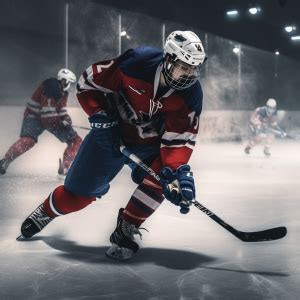
Key settings and focus points for capturing great hockey moments.
The best thing I can tell you when photographing hockey is to be patient. The action is fast. You can get overwhelmed very easily. This is a sport that takes years of practice. Get comfortable using one lens. Beware of players crashing into you at the boards.
The deadlines are quick, and you usually want to get photos transmitted between the three periods, during the game. I think the main thing to remember when shooting hockey is that you will not get portfolio pictures every time out of the gate. It is a very humbling sport to shoot. There will be nights where you come away with not many photographs.
At the same time, you are trying to tell the story of the game and you want to put out the best images you can give your editors.
When I am at a game, I also try to remember that it is not life and death. Hockey, like any sport, has a beginning, middle, and an end to it. Keep your expectations in perspective and try to enjoy yourself. Beware of your surroundings. You are with the fans in many situations, and you need to understand they pay tickets to watch the game.