Roller skiing is the cross country skier’s form of summer training, and it has been around for decades. Come May, competitive cross country ski racers swap their long skinny skis for short aluminum ones with wheels, switch out their pole tips, and switch from the trails to the streets. Until recently, it’s been a very niche sport.
However, the increased interest in cross country ski racing, sparked by the success of the US ski team in the last Olympics, coupled with popular interest in roller blading, has brought roller skiing to the attention of a much larger crowd. Recreational cross country skiers, outdoor enthusiasts, runners and cyclists looking for a form of cross training have all begun to look at roller skiing as their next hobby.
Sara at last year's Roller Skiing the 100m Rollerski Challenge event with Ludvig S├╕gnen Jensen. Photo Credit: Zach Walbridge
What is Rollerskiing?
Rollerskiing is essentially a training method for skilled cross-country skiers. The technique and motions used are identical to on-snow technique. Rollerskiing perfectly mimics the motions of cross-country skiing - whether it’s classic, skate, or double-poling, making rollerskiing the best way to prepare for the coming snow season.
Rollerskiing is an off-snow equivalent to cross-country skiing. First created as a summer training exercise, roller skiing grew into a competitive sport in its own right. Annual championships are held in various locations around the world. Most, if not all, national cross-country ski teams around the world roller ski during the off-season for specific physical training simulating winter skiing.
Read also: Snowmobile Conversion for Rollerskis
It began in the mid-1930s as a training method for Nordic skiers, helping athletes stay in shape year-round. If you love skiing, fitness, or just being outside, rollerskiing might become your new favorite sport. It’s fun, fast, and one of the best full-body workouts you can do - no snow required!
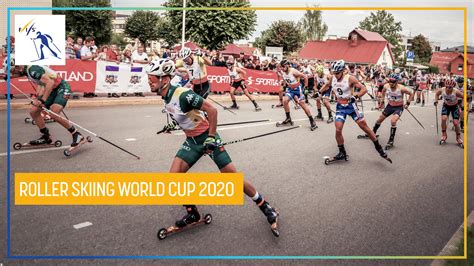
Rollerskiing is most popular in Europe, particularly France, Italy, Norway, Finland, Estonia, Sweden, and Russia, where there are many serious races and even a World Cup Circuit.
A Brief History of Roller Skiing
The first roller skis were built in the mid-1930s in Italy and North Europe. In the early 1950s, when cross-country skiing started to evolve to a serious competition sport, the necessity for good summer training grew. Starting in the 1950s people experimented with skis on wheels. In the 1970s, something of a standard emerged and the first races took place. At this time all roller skis had one wheel in front and two wheels at the back.
The growth of the roller ski sport attracted the notice of the International Ski Federation, or FIS (Federation Internationale de Ski). The first World Games were held in The Hague in 1993, and the first World Cup roller ski races later in the same year. In 1998, in Prague, the FIS granted roller skiing an official FIS World Championships.
Races have a variety of formats with different terrain. Formats include relays, sprints, team races, individual races and pursuit races. Terrain varies from relatively flat to hilly. On flat courses the speed can be as fast as 50 kilometres per hour (30 miles per hour). Average speed on flat tracks in World Cup races can easily be 30 kilometres per hour (20 miles per hour).
Read also: Roller Hockey Skates: A Nike Bauer Retrospective
Like their cross-country counterparts, the Italian, Russian, Norwegian, Swedish, German and French rollers have been very strong in competitions compared to other nations since the beginning of competitive roller skiing.
Health Benefits of Roller Skiing
There are certainly a number of health benefits to incorporating roller skiing into a workout plan. Just like cross country skiing on snow, roller skiing is a full body workout. Every push and glide strengthens your arms, legs, and core while improving your balance and endurance. It strengthens the legs, arms, upper body, glutes, and core, often targeting small balance muscles that are typically neglected in more traditional endurance sports. It offers the cardiovascular benefits of running, without the continuous impact that can bring up aches, pains, and overuse injuries.
Every stride works your legs, arms, back, and core while improving stability and posture. You strengthen your arms, stomach, back and legs while training endurance.
Additionally, it involves technical skill, balance, and speed, and can be practiced outdoors on the beautiful roads.
Inline skating is the best way in the off-season to recreate the unique muscle movements and carving motions found in skiing. Skiers at every ability level are discovering the amazing cross-training and fitness benefits of inline skating.
Read also: Grand Rapids Rinks and Spots
Like swimming and cross-country skiing, rollerskiing is a complete sport.
Getting Started with Roller Skiing
So how do you get into roller skiing? All you need is a pair of rollerskis, poles, a helmet, and a smooth path. PACCSA hosts regular group rollerski sessions and beginner clinics in or near Pittsburgh, perfect for learning safely, meeting fellow skiers, and enjoying the outdoors. Need rollerskis? Rental is also an option!
For the curious beginner, it’s helpful to have some prerequisite activity:
- Start with a base of on snow cross country skate skiing.
- Have a background of roller blading or ice skating.
This will give the skier some base skill set of the movements required to balance on one foot while rolling down a paved surface, and it’s easier to challenge balance on soft snow than on asphalt.
To begin, skiing on a flat surface with little traffic is ideal, like a bike path or a neighborhood cul de sac.
Once skiers feel comfortable navigating intermediate terrain such as climbs, descents, and corners, their are a number of workouts available to them.
Roller ski intervals, similar to training for running, can be done on a nice neighborhood loop: 3-4 minutes of hard effort (net uphill) with 3-4 minutes of easy skiing recovery (net downhill). Roller skiers can use the same scenic roads cyclists frequent for a moderate paced distance workout.
If you have a friend with whom to carpool, you can choose a sustained uphill, like the Bolton Access Road, leave a car at the top, and do a climbing workout.
It's important that you have the right skis for the right activity. Whether you’re going classic or want to try skating roller skis.
As a beginner on roller skis, it is important to start on asphalt surfaces without car traffic.
After buying or borrowing the correct roller skis and poles with asphalt spikes, you are ready to find the right place to start roller ski training. There are special ski poles for roller skiing or the option to fit roller ski spikes on the winter poles. Winter ski baskets are not suitable for roller skis.
Keep the weather out Whether you choose classic skiing or skating, it’s important to keep the center of gravity in the front part of your ski boot when starting up. We call it 'sharpening the knee', i.e. you push the knee forward and don't stand hard on the heel. This is especially important when you have chosen classic skis.
Double poling or poling is the most commonly used technique on roller skis. Here, it's important that you put the spikes on the poles into the asphalt in front of the ski shoes and that you tighten your upper body at the start of the poling, a bit like a sit-up movement.
A double pole with kick is a great exercise on roller skis and is used when it is too steep to pole and too flat to move diagonally.
If you choose skating and skate skiing, the same basic principles apply with “sharpened” knees, bent arms and full gravity transfer. When skating, your nose and knee should always be directly above the ski you are on at all times. Also make sure that your hips don't tilt up and down and are as stable as possible.
Rollerski fail
Equipment for Roller Skiing
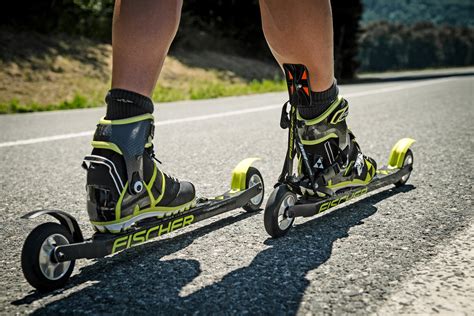
Much of the equipment required is the same as that used in nordic skate skiing. Roller skiers can use the same boots and poles they used for skate skiing in the winter. The tips of the poles need to be changed out from baskets to ferrules, so they won’t wear down on the pavement.
Rollerskis are mounted with standard cross country ski bindings using standard boots as well. The poles are also the same as what is used on snow, yet they are equipped with a rollerski ferrule. Rollerski ferrules are tips made of harder carbide (a metal alloy), which is reinforced by stronger plastic to prevent the tip from breaking off. Skiers will use the same pole lengths as well.
Roller skis can be purchased either in aluminum or fiberglass. Aluminum is lighter in weight and slightly less expensive, while fiberglass has a little more give and absorb some of the noise from rough pavement, making for a smoother ride. Skis can be mounted with either SNS or NNN bindings.
Although both skate and classic roller skis are available, typically skiers start with skate. The movement pattern is more similar to that of skiing on snow, and easier to navigate downhill than the classic variety.
It is customary for roller skiers to use neon reflective clothing every time they are skiing on the road so they are visible to oncoming traffic.
Extra protective clothing is recommended: full-finger gloves, helmet, eyewear, and knee and elbow pads.
Winter ski baskets are not suitable for roller skis. Poles are the same length as snow, but a special hardened metal spike is used to withstand the wear and tear of asphalt. These spikes can be sharpened with a diamond file.
Normal cross-country ski bindings and ski boots can be used with most roller skis, though some manufacturers produce special roller ski versions for the warmer weather use including Alpina, Botas, and Fischer.
Types of Roller Skis
There are differences in the design of skis intended for skating and classic style. One variant is designed as a hybrid and can be used for both styles.
Classic skis have a mechanism that prevents the ski from rolling backward, eliminating the problem of poor grip. Skate skis usually have thinner wheels with a larger wheel diameter to best suit skating technique and are usually shorter than classic skis.
Roller skis for classic and skate style skiing are used, as well as "combi" skis which may be used for either technique.
Wheels are available with different rolling resistances to suit different needs. Some are interested in competition skis where low rolling resistance is important, while others want a higher rolling resistance for a better training effect.
Newer models of roller skis include technological advances such as frames with built-in suspension to reduce vibrations from asphalt, resulting in less stress on joints and a more snow-like experience.
Classic style rollerskis usually have wide wheels to improve balance and better simulate classic ski technique. The wheel diameter is often less than 75mm to reduce the overall weight of the rollerskis. A ratchet mechanism is installed in either the front or rear wheel of each classic rollerski to allow uni-directional travel and simulate propulsion from classic ski strides on snow.
Skate rollerski wheels are usually 24 millimetres (0.94 in) wide (similar to those used on inline skates) with a wheel diameter of 100mm. 105mm skate rollerski wheels are a less common standard. Pneumatic rollerski wheels are also available but are especially rare and require pneumatic specific rollerskis. Pneumatic roller ski wheels have significantly greater diameter than non-pneumatic rollerski wheels.
Rollerski shafts may be composed of many different materials depending on the manufacturer and model. Wood was originally used, though this has mostly been replaced by aluminum, fiberglass, kevlar, carbon fiber or a combination of these materials. The wheelbase of skate rollerskis is typically around 610mm while classic rollerskis generally have a wheelbase of at least 700mm. The longer shafts of classic rollerskis help provide a better simulation of snow skiing.
Choosing the Right Roller Ski Model
There is no one perfect rollerski. Most top skiers have at least 2-3 pairs of rollerskis and most serious Master skiers have two pairs - one classic, one skate.
We recommend that people who have never rollerskied before start with a classic model. These skis are safer because they roll slower and have the option of a speed reducer. They also keep you further to the side of the road and out of traffic. They are also ideal for building upper body strength and endurance, which is the primary focus when starting to rollerski.
Here's a general guide to help you choose:
| AGE/LEVEL | Classic Model | Skate Model |
|---|---|---|
| YOUNG JUNIORS Age 14-16 (Below 110 lb, and < 5’5”) | C2S7 Junior | |
| YOUNG JUNIORS 14 and up (Above 130 lb, and > 5’5”) | C2S2 | |
| ADVANCED LEVEL OLDER JUNIORS Age 17-20 | C2 and C3, Roadline Tech | S5e |
| INTERMEDIATE & ADVANCED JUNIORS | C2 | S5e or S2 |
| BEGINNER & INTERMEDIATE MASTERS | C2 | S2 |
Roller Skiing Techniques
Roller skiing techniques are very similar to regular skiing; the same physical and skill requirements apply.