For hockey fans in Utah, the dream of having an NHL team has finally come true. With the arrival of the Utah Hockey Club, now known as the Utah Mammoth, Salt Lake City has entered a new era of professional hockey. But the story of hockey in Salt Lake City goes back much further, with a rich history that includes the beloved Salt Lake Golden Eagles and the Utah Grizzlies.

The Salt Lake Golden Eagles: A Legacy Begins
The Salt Lake Golden Eagles’ first season was in the Salt Palace in 1969. The Golden Eagles played in Salt Lake City from 1969-94, competing in the Western Hockey League (1969-74), the Central Hockey League (1974-84) and the International Hockey League (1984-94). Their first home was the Salt Palace (1969-1991).
Dave Soutter reflects on the Eagles and the impact the team had on his life, “Me and my family were huge Golden Eagles fans my dad took my older brother and me to the very first Golden Eagles home game in October of 1969. I was 11 and I was hooked on hockey from then on. The Golden Eagles encouraged me to begin playing organized hockey which also led to coaching hockey and serving on various hockey boards of directors and local amateur hockey associations my wife and I met at the Salt Palace at a hockey game we both had part time jobs as ushers.
The Golden Eagles’ first two seasons were rough. In 1972, the team became the farm club for the California Golden Seals of the NHL. With that new affiliation came the kelly green and yellow uniforms, legendary copperall pants, and white skates.
Mark Woodmansee told KSL Sports, “My dad took us to a game in January of 1972,”. “The Eagles played the Seattle Totems, and we were hooked. We bought season tickets the next year. The crowds were always full and full of energy.”
Read also: Winter Fun in Utah
“My first memory of the Golden Eagles is my oldest brother and his girlfriend took me and her little brother to a game in 1969. I had two coupons for Dee’s Hamburgers souvenir sticks. The lady giving us the sticks said, ‘Do you want to give one to your little brother?’ I said no, I’ll keep both.
Memories from the Ice: Players and Fans
Former Golden Eagle, St. Louis Blue and Boston College standout Paul Skidmore appeared on the Utah Puck Report last year and talked about his memories of playing for the Eagles, “My most vivid memories of playing with the Eagles were when I was in the groove and I was playing well, and gosh everything felt so good, the fans were into it, the players were into it. There was one time I had a streak of 18 games unbeaten … Still, the best times were when we played against the real top teams, having the close games that we did back then. We were selling out the Salt Palace, and it was phenomenal. I remember the crowds were into the game. I mean, they were there early, and they celebrated early. The Jazz had just barely gotten there.
“There was a really cool part about sharing the arena with the Utah Jazz. Frank Layden and Mark Eaton were hockey fans.
Many other recognizable names would play for the Golden Eagles.
Larry H. Miller sold The Golden Eagles franchise to Detroit in 1994.
Read also: Ski Resorts Map
Notable Players and Their Experiences
Several players who skated for the Golden Eagles went on to have successful NHL careers. Paul MacLean and Joe Mullen, along with Dallas Stars general manager Jim Nill, all played for the Golden Eagles in the early 1980s.
Mullen arrived in 1979-80. After four years at Boston College, the forward signed with the St. He remembers playing in the first 10 games or so before coach Jack Evans sat him out for a while. He didn’t understand it. Linda -- then his girlfriend, now his wife -- came for a visit. When he got back in the lineup, he got a chance to play on the first line with veterans Rick Bowness -- yes, that Rick Bowness -- and Floyd Thomson. “They called me ‘Muggsy’ back then,” Mullen said. “He goes, ‘Muggs, I just love it when you tape your stick like that, because I just look for your stick and I just pass it there.’ It was fun playing with him. Every time somebody wanted to fight me, I’d turn around, and they’d be gone. Mullen finished with 72 points (40 goals, 32 assists) in 75 games and was named CHL rookie of the year. “We had a dinner, and the coach said, ‘Yeah, thank goodness that Linda came out,’” Mullen said with a laugh. “He said it kind of woke me up. Mullen had 117 points (59 goals, 58 assists) in 80 games in 1980-81. He was named CHL most valuable player, and the Golden Eagles won the Adams Cup again. “Oh, it was a great building,” Mullen said. “I was surprised at the size of it for a Central League team, and the people were great. We were getting, I guess, somewhere around five, six thousand every game, and that was good at that time back then to play in front of a crowd like that. In 1981-82, Mullen had 48 points (21 goals, 27 assists) in 27 games for Salt Lake and 59 points (25 goals, 34 assists) in 45 games for St. Louis. He would play 17 seasons in the NHL and win the Stanley Cup three times, with the Calgary Flames in 1989 and the Pittsburgh Penguins in 1991 and 1992.
MacLean and Nill were linemates for the Golden Eagles in 1980-81 after a season with Canada’s national team and the 1980 Lake Placid Olympics. The Blues had selected the forwards in the 1978 NHL Draft -- Nill in the sixth round (No. 89), MacLean in the seventh (No.
“The city itself was beautiful with the mountains right there,” MacLean said. “You’re like, ‘Wow, is this ever a nice place,’ and the people were just fabulous as far as neighbors and getting to know people. The hockey team was a great group of guys, the veteran guys that had won the championship before. We had some real classy people. MacLean had 78 points (36 goals, 42 assists) in 80 games for Salt Lake before playing the next 10 seasons in the NHL. “It was a very big crowd and a loud crowd, and they really appreciated the effort we put in,” MacLean said. “I think the fact that the team won the championship the year before, and we contended and won the championship the year we were there, really helped to draw the fan base in. It was a team that actually won something. The experience of the Salt Palace each and every night was a big thing.
Nill had 62 points (28 goals, 34 assists) in 79 games for Salt Lake before spending the most of the next nine seasons in the NHL. “It was probably the most fun I had in pro hockey,” Nill said. “You’re in the minors. Everybody’s in the same position. We’re all a bunch of young guys with some older veterans for guidance. We won the championship, which was exciting, but just turning pro there, great city. I love Salt Lake City. It reminds me of Calgary, with the mountains closer. It’s a great city.
Read also: Buckeye Lake Jet Ski Information
The Salt Lake City market also has had two versions of the Utah Grizzlies, who played at the Delta Center (1995-97) for two seasons before moving to the suburb of West Valley City, Utah. The first version played in the International Hockey League (1995-2001) and the American Hockey League (2001-05).
The Utah Grizzlies: Continuing the Hockey Tradition
After just one season out of ice hockey, Salt Lake City received another IHL franchise in 1995, as the reigning Turner Cup champion Denver Grizzlies, having been replaced by the newly relocated Colorado Avalanche of the NHL, relocated to the Delta Center for the 1995-96 season as the Utah Grizzlies. The Grizzlies spent two seasons in Salt Lake City proper, including a second consecutive Turner Cup championship in 1996; notably, the Cup-clinching game 4 of the Turner Cup Finals saw an attendance of 17,381, at the time the largest single-game attendance in minor-league ice hockey history.
The Grizzlies later moved to the newly constructed E Center (since renamed the Maverik Center) in the suburb of West Valley City for the 1997-98 IHL season, and joined the American Hockey League (AHL) in 2001 alongside five other surviving IHL franchises upon the latter's collapse. The AHL iteration of the Grizzlies were subsequently replaced by a relocated ECHL franchise of the same name; the franchise had most recently played in Lexington, Kentucky, as the Lexington Men O' War but had become dormant after the 2002-03 ECHL season. The new Grizzlies began play out of the E Center in 2005, immediately after their AHL predecessor had gone dormant, and have played 19 seasons in the ECHL since. However, the franchise has been comparatively unsuccessful; although they have missed the playoffs only four times, they have won just one division championship and no conference championships, only having reached the conference finals twice.
According to Whiting, at the time, the IHL was just a step below the NHL. The Denver Grizzlies were successful. Their success motivated an NHL team to move to Denver. The team moved to Salt Lake and became the Utah Grizzlies. Until 2005, the Grizzlies played in Salt Lake City. Then, they were sold to a group in Cleveland, and became known as the Cleveland Monsters. However, Whiting said that a group led by Dave Elmore bought a team in the ECHL. The team still plays in the ECHL, which was previously known as the East Coast Hockey League. Whiting added that the ECHL is the third-tier hockey league.
While Whiting said that “it seems like right now everybody’s kind of happy with where they are,” the Grizzlies could potentially move to the AHL. However, he said the problem right now is that there are already 32 teams in the league.
The Road to the NHL: Salt Lake City's Expansion Team
Salt Lake City initially emerged as a potential NHL destination in June 2023, with rumors regarding the Arizona Coyotes' potential relocation spreading after the failure of the New Tempe Arena referendum. Six months later, in January 2024, Ryan Smith, owner of the NBA's Utah Jazz and co-owner of Major League Soccer's Real Salt Lake, petitioned the NHL to begin the process of expansion to Salt Lake City.
On April 13, 2024, it was reported that, with the NHL's permission, the Coyotes were making efforts to relocate to Salt Lake City following concerns about an indefinite timeframe on a new arena and the effects of continued play at the 4,600-seat Mullett Arena. Under the terms of the agreement, the Coyotes franchise was essentially split in half. While the deal was reported in the media as a $1.2 billion "sale" of the Coyotes, it is in reality two separate transactions in which $1 billion is being paid by the NHL to Alex Meruelo for the Coyotes franchise while Smith is paying a $1.2 billion expansion fee to the NHL's other owners.
Delta Center, home of the Utah Jazz, will serve as the home ice for the Utah Hockey Club. The multipurpose arena can hold 16,200 in a hockey configuration, and has previously hosted games for the 2002 Winter Olympics and the NHL preseason, starting in 2021.
The Utah Hockey Club is a member of the National Hockey League (NHL). Utah plays in the Central Division of the Western Conference. The team’s official placement transitions directly from the Arizona Coyotes.
The team was created on April 18, 2024, with the NHL Board of Governors granting an expansion franchise to Jazz owner Ryan Smith.
The NHL’s board of governors approved the sale of the Coyotes and the creation of the Utah Hockey Club on April 18, leaving less than six months to get the team up and running before the regular-season opener on October 8.
The Utah Hockey Club will play at the Delta Center in Salt Lake City. The franchise turned to fans for its team name, beginning with 20 candidates before narrowing down to six finalists.
The Utah Hockey Club will play its first game on Tuesday, Oct. 8, when the team hosts the Chicago Blackhawks.
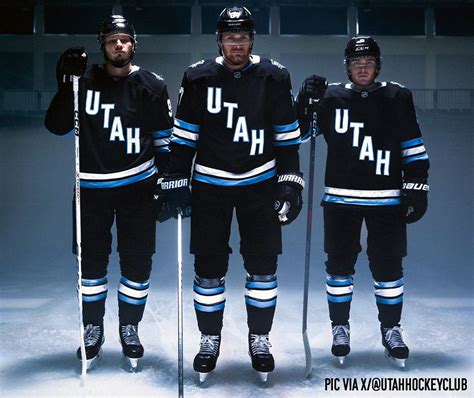
The Utah Hockey Club: A New Era Begins
For now, the NHL has temporarily designated its newest franchise as the Utah Hockey Club. However, the permanent team name is not yet decided. A selection process that has involved an initial pool of 20 options and two rounds of fan voting is still underway. The six finalists for the franchise’s permanent name are the Utah Blizzard, Utah Hockey Club (Utah HC), Utah Mammoth, Utah Outlaws, Utah Venom and Utah Yeti.
On January 29, the team announced that fans attending their following four home games in late January and early February could vote for a permanent identity for the club, with the final three options being the existing Utah Hockey Club, Utah Mammoth, and Utah Wasatch.
Utah’s team logo and designs for the 2024-25 regular season were revealed in June 2024. Spearheaded by the design firm Doubleday & Cartwright, the Utah Hockey Club’s debut look will feature team colors Rock Black, Salt White and Mountain Blue.
Utah Hockey Club Reveals Color Scheme, Jerseys for 2024 25 Season
On June 13, 2024, the same day that the temporary name was revealed, the team also released their logos, colors, and jerseys for the inaugural season; the primary logo depicts a roundel with a "Utah" wordmark in the center, ringed with "Hockey Club" and colored with mountain blue, rock black, and salt white.
The new team’s roster and coaching staff are largely unchanged from that of the Coyotes’ 2023-24 team. The head coach is André Tourigny, and the team captain is forward Clayton Keller. Nicknamed "The Bear," Tourigny joined the franchise as head coach in 2021. The Coyotes did not have a captain for two-plus seasons after Oliver Ekman-Larsson was traded during the 2020-21 campaign.
The Utah Hockey Club will play its first regular-season game on Oct. The team’s official placement transitions directly from the Arizona Coyotes.
Utah played their first preseason game on September 22, 2024, defeating the St.
The Utah Hockey Club will play its first game on Tuesday, Oct. 8, when the team hosts the Chicago Blackhawks.
On May 8, the Smith Entertainment Group confirmed the team would play their first season simply named "Utah", without an official logo, mascot, or team colors, and with "Utah" written across the jerseys. At the same time, SEG released a Qualtrics poll featuring the 20 name finalists.
Patent and Trademark Office due to its similarity to the company name Yeti Holdings. Prior to the rejection, it had been widely expected, even among Utah players, that the "Yeti" name would be chosen.
Utah Mammoth: The Permanent Name is Chosen
On May 7, 2025, on the day the permanent "Mammoth" name was unveiled, a new logo and uniform set were unveiled to accompany the name change. Using the same blue, black, and white color scheme, the logo features a "Mountain Mammoth" with the top of the mammoth's head showing a depiction of mountain peaks, a nod to Utah's Wasatch Mountains. One of the mountains also forms an outline resembling the borders of the state of Utah. For the home uniforms, the "UTAH" wordmark was replaced with the new primary logo. The road uniforms retained the diagonal "UTAH" wordmark, but all text on both uniforms were updated to the new "Mammoth Sans" font.
During the inaugural season, the team's fanbase started referring to themselves as the "Clubbers", a play on the team's temporary "Hockey Club" moniker.
The Mammoth began play as an expansion team in the 2024-25 season. It had a 38-31 record in its inaugural season. The Utah organization conducted several public polls to determine the team’s permanent name, and in May 2025 it announced that the franchise will be called the Utah Mammoth, after the extinct elephant species.
Broadcasting and Media Coverage
On April 18, 2024, shortly after the establishment of the team, it was announced that the team had reached an agreement with the E.W. Scripps Company to broadcast Utah NHL games on their Provo-based station KUPX-TV; KUPX had previously served as the Coyotes' affiliate in the market, and also broadcasts Vegas Golden Knights games. The telecasts are produced by Smith Entertainment Group's SEG Media division.
The team also launched a subscription streaming service known as UtahHC+ (now Mammoth+), which carries the games and other video content related to the team. On September 20, 2024, the team announced an agreement with Bonneville International to broadcast games on KZNS, branded as the KSL Sports Zone, with Mike Folta serving as the play-by-play announcer.
Affiliations and Development
The Utah Grizzlies are a minor league professional hockey team playing in the ECHL. Although the Grizzlies’ home ice at Maverik Center in West Valley City, Utah is just under 10 miles from Utah Hockey Club’s Delta Center, the two teams are not currently affiliated.
| Season | GP | W | L | OTL | Pts | GF | GA | Standing | Playoffs |
|---|---|---|---|---|---|---|---|---|---|
| 2024-25 | 82 | 38 | 31 | 13 | 89 | 252 | 257 | 5th in Central Division | Lost in First Round |
The Utah Hockey Club officially joined the NHL, and unveiled uniforms and logos.
The Utah Mammoth are a professional ice hockey team based in Salt Lake City. The Mammoth compete in the National Hockey League (NHL) as a member of the Central Division in the Western Conference. The franchise joined the league as an expansion team for the 2024-25 season.
Much has changed since the early 1980s. Mullen hasn’t been back to Salt Lake City since he left.
“I would think it would be good, only because, way back then, it was pretty good,” he said. “It’s a great place to live no matter where you go, with the scenery of the mountains that are so close,” he said. “It’s really going to be an endearing place, I think, for a lot of people and a lot of NHL players once they go there and visit. “It’s going to be a great market,” he said.
The Utah Hockey Club has come skating into Salt Lake City as the National Hockey League’s latest expansion team. The brand new tenants at downtown SLC’s Delta Center have the Beehive State buzzing as the city’s first major league professional hockey team prepares to hit the ice for their inaugural 2024-25 season.
The origin story of the Utah Hockey Club started in Phoenix, where the franchise’s NHL predecessor the Arizona Coyotes launched in 1996.
Meanwhile, Utah-based businessman and Smith Entertainment Group chairman Ryan Smith had been in discussions with the NHL to bring a team to Salt Lake City since 2022.