The evolution of skiing and snowboarding is a fascinating journey, marked by innovation, passion, and transformative leadership. From the snowy slopes of Michigan to the heights of the global ski industry, several key figures and events have shaped the sports we know and love today.
In the early days, skiing was more than just a sport; it was a way of life for many. Scott “Scooter” Stillings, for example, inspired skiers for over 50 years as a competitor, coach, ski school owner, sales representative, ski shop manager, ski writer, radio programmer and personality, a director of marketing, as a father and as a friend. His commitment was clear at the age of 13 when he mounted every single pair of bindings for Caberfae Peaks ski rental department. Scott learned to ski in the 5th grade on a pair of JC Higgins Sears Roebuck skis and there was no turning back.
A longtime friend recalled their first meeting, “I met him on a chairlift at Boyne Mountain during a pro event we both happened to be racing in. This was the tour of the early to mid ‘70s with the likes of Killy, Sabich, Penz, Duvillard, and others of that era. I think Scott skipped school that day to race, as he was only 17 or so. From 1972 to 1975 he continued amateur racing and became a full-time ski instructor. During this period, in 1974, Scott became the youngest member of the Ski Patrol at the age of 18. Between 1975 and 1984 he became a professional ski racer for Benson & Hedges, the Eastern Pro Ski Racing Tour, and the Peugeot Pro Tour. He was also the US Ski Team technician in the 1980 Olympics and the 1989 World Cup.
In 1976, Scott Stillings took the position of marketing director for Schuss Mountain, which later led to his position as a ski professional for Boyne USA and Dynastar. Between 1975 and 2019, Scott was a ski representative for Marker, Bolle, A&T, Kneissl, Salomon, Scott poles and boots, Maui & Sons, Rossignol, Dynastar, K2, Hexcell, Blizzard, Technica, Lange, Look Bindings, Kastle & Killer Loop, HaberVision and Berghaus. His clinics were the most informative and entertaining of all the road warriors of his era. As a skillful media man, Scott was broadcasting informative ski condition updates coupled with hilarious shtick. Skiers and snowboarders across the Great Lakes Region tuned in to hear what he’d come up with next.
On one such report, a longtime listener remembers “[Scott] pretended that his tongue was frozen to his truck’s door handle. It was a reminder of how cold it was that particular day, and a cautionary tale of what could happen if you’re not careful. Scott went on to own and direct the Nub’s Nob Winter Sports School, LLC where he provided best-in-class ski and snowboard instruction, in addition to building and running the Nub’s Nob Race Team, which produced hundreds of CUSSA racers, many Junior Olympians, and countless State and Regional champions. In 2020, Scott completed his ski industry career as the Manager of The Bahnhof Ski Shop in Petoskey, MI. The Bahnhof customers visited the shop to not only purchase the season’s new gear, but in the hopes that they’d get the chance to chat with Scott.
Read also: Sapient: Quality and Innovation in Snowboarding
Another notable figure, Dave Goode, founder and president of Goode Ski Technologies, was a gifted athlete and innovator. He graduated from Andover High School in Bloomfield, Michigan in 1973. At age 19, his career as a downhiller was cut short by an ankle injury, and the following year he founded Ski Accessories Co. to manufacture his own product designs. Over the years he took out 20 patents. He pioneered the use of carbon fiber, first for ski poles, which earned him a market-leading position in the rental business, and then in water skis, where his lightweight competition slalom ski revolutionized the sport.
For two decades, Goode was a leading sponsor of water skiing competitions, and athletes using Goode slalom skis held numerous world records. Goode relocated his business to Ogden, Utah in 2004. He was inducted into the Michigan Water Ski Hall of Fame in 2011, and in 2014 was presented the USA Water Ski Award of Distinction.
The Rise of Ski Resorts in Michigan
In the 1950s, Bloomfield Hills building contractor Morton Graddis suggested creating a ski area in northern Oakland County. The pair opened Mt. Holly in 1956 to earn some extra cash. But when their building business began to struggle a few years later, maintaining Mt. Holly became Hank's full-time job and his passion.
James "Grant" Hanks Sr., a long-time Holly resident and former co-owner of Mt. Holly Ski Area, played a crucial role in developing the sport in Michigan. "He absolutely loved the ski business," said his son James Hanks Jr. "He went from being a poor guy from Kentucky that never dreamed of skiing to owning a ski area." He helped build the small ski resort up from just four small slopes with tow ropes to 18 runs with chair-lift access -- one of which is named "Grant's Trail" for him, he said.
Mt. Holly also was one of the first ski areas in the Midwest to start making snow, he said. "It just changed the face of skiing," he said. "They used to pack this place during the week." Hanks also helped start an inexpensive learn-to-ski program at Mt. Holly that made the sport accessible to more people.
Read also: The Story of Vail Coffee
When the hills weren't covered with snow Hanks helped maintain Mt. Holly's own little "ghost town" complete with a mock saloon, general store and stage coach rides. He spent nearly every day at the ski area, but his children weren't far away and quickly became experts on the slopes, James Hanks Jr. said.
Bonnie Gillespie, a friend and former Mt. Holly employee, said Hanks loved talking to the skiers that frequented the slopes. "He liked people, so consequently they liked him," Gillespie, 80, of Waterford Township said. "He put so much time and effort into Mt. Holly. He's the one that made it go."
The evolution of skiing has been significantly influenced by the rise of major corporations. Vail Resorts, under the leadership of Rob Katz, transformed the ski industry by making skiing more accessible and affordable through the Epic Pass. Vail’s rise to the top of skiing has been unpredictable, surprising, rapid, and amazing to witness. For frequent skiers, the sport has never been more affordable, their choices more varied.
As Katz transitions to executive chairperson of the board and hands the keys to the CEO suite off to Vail veteran Kirsten Lynch, he has solidified his place as the most transformational figure in the history of lift-served skiing. "Rob changed a company, changed a business practice, added a product, he changed an entire business model, and an industry along with it," said Shaun Kelly, managing director and senior research analyst at Bank of America who specializes in gaming, lodging, and leisure equity research.
The Epic Pass spawned competitors. Vail’s consolidation of large resorts drove the consolidation of other large resorts. ski areas are on the Epic, Ikon, Indy, or Power passes. Just four companies own 67 of these mountains. Vail owns 33 (it will soon own 36 if regulators approve its sale of Seven Springs, Laurel, and Hidden Valley in Pennsylvania). Alterra - which did not exist in 2006 - owns 13. Powdr Corp owns 10, Boyne Resorts, nine; and Mountain Capital Partners, seven. But the combined might of three of those four conglomerates is on the Ikon Pass, matched against Vail and the Epic Pass.
Read also: Activities at Ski Run Marina
“Vail is the powerhouse of the industry,” said Alterra CEO Rusty Gregory in an interview with The Storm Skiing Journal. “There's no question about that. And Rob is the guy who led them to that success.”
However, this growth has not been without its challenges. Worker housing, long problematic, has reached crisis levels. Colorado’s Interstate 70, Utah’s Little Cottonwood Canyon (where Vail does not own a resort), and other mountain-transportation corridors have become synonymous with apocalyptic traffic. Resort consolidation has drawn charges of homogenization, mountain crowding, and day-ticket prices that make big-mountain skiing unaffordable for many Americans.
This season, Vail has suffered from Covid-related staffing shortages and other issues that have prevented the company from fully opening Stevens Pass, Wildcat, and Attitash. Several of Vail’s smaller ski areas have slashed operating hours from previous seasons. Warm temperatures throughout much of the country through the first half of December didn’t help.
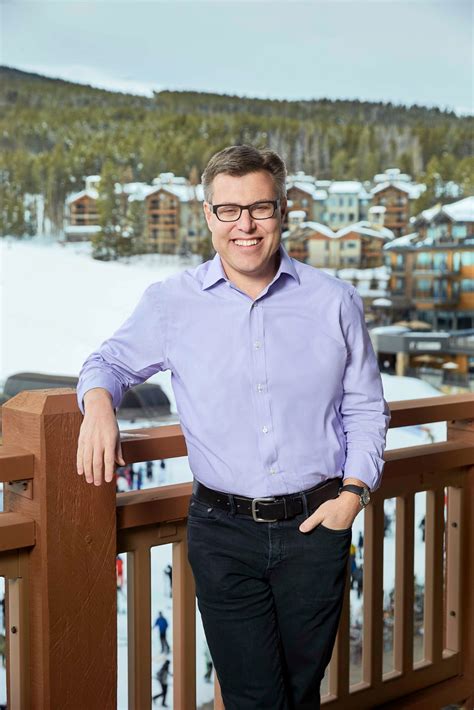
Rob Katz, Vail Resorts Executive Chairperson. Photo courtesy of Vail Resorts
The ski industry today resembles the ski industry of 2006 as much as shopping or entertainment in 2021 resembles its ancestors from that time. But unlike big-box shopping, disrupted by upstart Amazon, or carefully programmed linear television, undone by Netflix, skiing was disrupted from within, by an established player with a visionary CEO.
The Snurfer and the Birth of Snowboarding
A History Of Snowboarding Part 1.wmv
The history of snowboarding has deep roots in Michigan, thanks to Sherman Poppen, who invented the "Snurfer" in 1965. It's prompted by his pregnant wife's insistence to get the kids out of the house. they slide down the snow covered lake michigan dune in front of their home standing up and slightly sideways.
In 1966 - sherman files the "snurfer" with the us patent & trademark office. an excerpt reads "the present invention relates to a snow ski, particularly a surf-type snow ski which is adapted to support both feet of a skier and easily maneuvered therefore without foot bindings, thereby providing a new sport which incorporates features of certain summer pastimes, namely surfboarding, skateboarding, and slalom water skiing." -sherm also assigns the patent and licences the snurfer to brunswick corp, establishing a mass production source that eventually puts a snurfer within reach of millions of kids nationwide.
The first World Snurfing Championship was held at Blockhouse Hill, Muskegon State Park, MI on Feb 19, 1967 -1968. It was hosted by Muskegon Community College (MCC). Of the 300 participants Muskegon's Ted Slater and Sally Waite take 1st place in their divisions. Blockhouse Hill eventually becomes the mecca of snurfing. Poppen received patent approval on his snurfer from the US patent and trademark offices. In 1969 - poppen licenses snurfer patent to brunswick corp. manufacturing begins in muskegon, mi. By 1970 - stephens mfg. co., bridgman, mi introduces the fun-ski deck for "snow snurfing" lake michigan dunes.
Brunswick discontinues snurfer production in 1971 -1972. All snurfer rights revert back to poppen. He then licences it for a second time to three ex brunswick employees, each using an initial to form the name "jem" corp, which begins snurfer production in marion, va. By 1973 - the earliest documented case of the snurfers use as a "sandboard" on west michigan sand dunes. Jon Albaitis of Muskegon, MI wins Nat'l Snurf Championship at Blockhouse Hill, Muskegon St. Park in 1974.
The Snurfer's popularity grew, leading to the first national championships. The schlitz beer logo was added to the competition bibs as a supporting sponsor of the national snurfing championships in 1976. James Trim of Grand Haven, MI winds nat'l snurf championship at blockhouse hill in 1977. Jem Corp became an official sponsor of the national snurfer championships by offering a $1,000 in cash prizes to top finishers - possibly making for the first snowboard event to offer compensation. Jim Trim of Grand Haven, MI won the $400 1st place prize in 1978.
Jake Burton drove from Vermont to Muskegon, MI to compete in the national snurfing championship in 1979. His board with rubber bindings is not allowed to compete against bindingless snurfers until a new "open" category is created on the fly. The organizers had no idea that anything other than snurfers existed and mcc never thought to designate separate eligibility categories. Since jem sponsored the event, and burton snowboards was suddenly deemed a corporate competitor, jem was relieved when the best overall time in any class was run on a snurfer by ken campenia of north muskegon, mi. Burton eventually grows into the largest sb manufacturer in the world. This year marks the end of nat'l snurf championships at blockhouse hill. They move it to pando ski resort in 1980.
The first issue (vol. 1, no. 1) of snurfing news magazine is released. possibly becoming the first snowboard periodical ever. Labatts brewing airs a tv commercial in canada focused on snurfing. it features michiganders paul graves and mark & jane halseth. this is possibly the first tv commercial featuring snowboarding.
Burton attends the national snurfing championships again in 1980. The comp was moved to from blockhouse hill in muskegon, mi, to pando ski hill in rockford, mi with a 600' run and added slalom event in addition to the downhill of previous years. The move is made to the ski hill in attempt to ensure better snow conditions. Nat'l snurf champions are bill pushaw, grand haven, mi in the downhill, and doug bouton, bondville, vt in the slalom. In 1981 - tom pushaw (downhill) and bob novak (slalom) both of muskegon, mi, each take 1st at national snurfing championships.
The national snurfing event circut includes stops at marion, va; steamboat springs, co; mt hood, or; jackson hole, wy; and squaw valley, ca. Lenderink wood products, belmont, mi supplies wood cores to various snowbaord manufacturers in 1981. By 1982 - the national snurfing championship is held outside of michigan for the first time. Suicide six ski area in vermont borrows from the snurfer's competition success to host the event and changes the name to the national snow surfing championships with burton snowboards being a main sponsor. The event later becomes "the US open". Michigan's top seeds at the event are muskegon's kevin workman and bob novak.
Steve Link, midland mI native steve link founds summit snowboards in colorado. Saunzee snowboards begins production of hand made, hand painted fiberglass boards in spring lake, MI. Kevin workman (downhill) and bill pushaw (slalom) each take 1st at nat'l snurf championships (future well knowns steve link (3rd) and jake burton (5th) in 1982. A GROUP OF TEENS LED BY BROOKS MARCUS AND BOB NOVAK SUCESSFULLY TALKS MULLIGAN HOLLOW IN GRAND HAVEN, MI TO ALLOW SNOWBOARDING in 1983. THEY ARE GIVEN A SINGLE WEEKDAY EVENING TIME SLOT TO RIDE, BECOMING ONE OF THE FIRST RESORTS IN THE COUNTRY TO ALLOW SNOWBOARDING.
Steve link of midland michigan places 3rd at us nationals. Bob Novak is EMPLOYED by jake burton becoming one of the EARLY SHAPERS OF THE FAMOUS BURTON BACKHILL. Nat'l snurf championships are cancelled due to lack of snow. Bob Novak employed at burton and becomes an early shaper of the famous burton backhill in 1983. Bob novack, muskegon, mi, wins the national snurfing championship at pando ski area, rockford, mi in 1984. Novak beats some who would become legendary burton team riders... andy coghlan, mark heingartner, and chris karol. Andy "the dog" coghlan of manchester center, vt wins the slalom.
Steve link of midland, MI takes 2ed at world cup. Boyne allows snowboarding on their hills in 1984. The technical advances of snowboards at burton vs the snurfer staying about the same, coupled with the more national presence of the vt "surf" vs mi "snurf" contest, brought an end to the the national snurfing championships in michigan in 1985.
By 1986 - 1987 - 12 michigan resorts that allowed snowboarding as listed in the 87/88 burton catalog... alpine, caberfae, hanson hills, marquette mt, mt brighton, mulligan hollow, pando, riverview highlands, schuss mt, shanty creek, ski brule, the homestead. Caberfae is listed in the 87/88 burton catalog as the first resort to offer snowboard instruction, certification, rental/demo in helping to grow the sport in 1988.
Steve Link from Midland, MI begins Summit Snowboards in Colorado in 1989 - 1990. Sherman Poppen takes up modern day snowboarding at the age of 67 in 1991! By 1994 - joyride releases a board called the "edmund fitzgerald" depicting a mermaid on the base releasing stars of the lost souls to the surface of lake superior's whitefish bay. Sherman Poppen is inducted in the snowboarding hall of fame in banff, alberta, Canada in 1995. Century tool makes a limited run of boards out of flint, mi auto parts plant press.
Side note: snowboarding makes it debuts at the winter x-games and the olympics in 1998. Craig Fugate begins pressing boards under the name "Epic Snowboards" near Alpine Valley (?) in 1999 - 2000. Sherman Poppen is inducted into the muskegon mi area sports hall of fame in 2001. Michigander (arron) of draplin design co. is awarded project design for the iconic burton custom in 2002 -2003. Huck finn snowboard series begins.
Nubs Nob installs the first superpipe in the michigan and midwest in 2004. Michigan high school snowboard association begins in 2005. It's originally called "the bonehead boardercross series" with races taking place at mt. holly and alpine valley. mt. brighton took over for mt. holly later. what started as an "idea" for a snowboard club and beer league by greg flowers and joel bredowin 2004, changed completely and ended up taking root at the high school level. the current president greg flowers was instrumental in it's beginnings and development into what it is today.
Danny Davis finishes 5th overall on world snowboard tour in 2006. Novak snurfboards begin operations in muskegon, mi using plastic blanks heated in a pizza oven, shaped on a home made truck fender jig, and machine finished. Antix snowboards begins in 2007. Danny Davis wins euoropean open in 2008. Poppen's snurfer is acquired by the smithsonian institute in washington, DC to to display as the precurser to the snowboard in 2009.
Nick Baumgartner bronz world sbx championships, and ranked 3rd fis world cup standings. Marhar snowboards begins operations in grand rapids, mi. Transworld snowboard magazine votes the nubs nob superpipe one of the top 5 east coast pipes. Glss is created by merging the huck finn and middle earth snow series in 2009. Nick Baumgartner, competes at the turin, italy olympics in 2010. Sherman Poppen tribute statute is unveiled in downtown muskegon, mi.
Kyle Mack makes the us snowboard team in 2011. A 14' bronze statute commemorating the snurfer is unveiled dedicated in downtown muskegon, mi in 2012. It's called "the turning point" and depicts the evolution of snowboarding with a female snurfer on top, and a modern day snowboarder at the bottom. Antix snowboards begins manufacturing. Novak snurfboards beging marketing snurfer type boards.
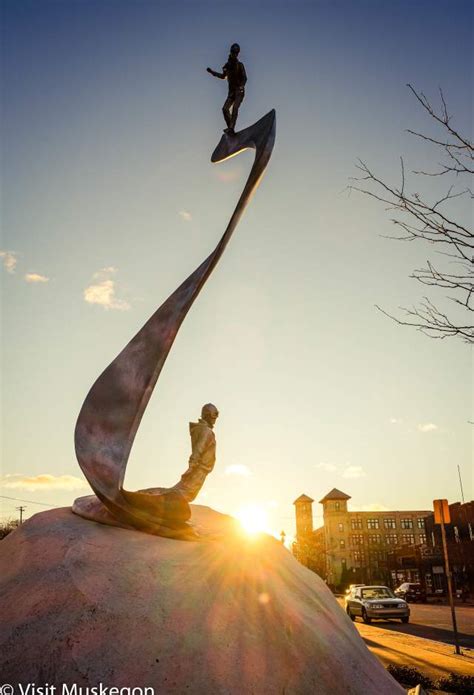
The Turning Point Statue in Muskegon, MI. Photo courtesy of Wikimedia Commons
Danny Davis 1st us grand prix in 2013. Shaggy's skis begins pressing snowboards for antix in boyne city, mi. Danny Davis, karly shorr, and nick buamgartner represent michigan in the sochi, russia olympics in 2014. Shorr places 6th slopestyle. Kyle Mack, world championships, bronze, big air & and slopestyle in 2015. Nick Baungartner bronz world sbx championships. Jake Vedder 3rd rev tour ski cooper.
Kyle Mack, born royal oak, mi/raised west bloomfield, mi, wins gold in slopestyle at us open in 2016. MHSSA state sbx championships "sportsmanship" controversy ignites when a brighton H.S. rider "spins" during state sbx race event in 2017. Rider deemed disqualified by opposing judge (also a competing coach). bhs team protests by flying jerseys as flags overhead on sticks, while turning the course into an impromptu park event. in doing so the entire brighton, MI team disqualifies itself voluntarily.
Michiganders kyle mack and nick baumgartner represent michigan at PyeongChang, olympics, south korea in 2018. Mack takes silver in the very first olympic big air comp, also competes in slopestyle. baumgartner makes the final sbx heat and just misses the podium taking 4th. Meanwhile on the amateur circuit michigan riders brent behm takes 1st, and drake warner 3rd, in finals at the burton NATIONALs at seven springs, PA.
Sherman Poppen inventor of the snurfer passes away at 89 in 2019. Jake Burton passes away at 65. During a 24 hour period beginning 9:00 PM January 11, 2019, michigan residents david zemens and sabato caputo broke the north american record of snowboarding the most resorts in a 24 hour period. The 430 mile journey within michigan began at boyne highlands, included nubs nob, boyne mt, treetops, otsego club, schuss mt, shanty creek, mt holiday, hickory hills, crystal mt, caberfae peaks, snowsnake, mt. holly, alpine valley, pine knob, ending at mt. brighton with 30 minuits to spare. In all they hit 16 resorts besting the prior record of 12 set in vermont, but shy of the world record 17 set in hokido japan.
| Year | Event | Details |
|---|---|---|
| 1965 | Invention of the Snurfer | Sherman Poppen invents the Snurfer in Muskegon, MI. |
| 1967-68 | First World Snurfing Championship | Held at Blockhouse Hill, Muskegon State Park, MI. |
| 1979 | Jake Burton's Participation | Jake Burton competes in the National Snurfing Championship. |
| 1982 | National Championship Moves | The championship is held outside Michigan for the first time. |
| 2019 | Death of Key Figures | Sherman Poppen and Jake Burton pass away. |
tags: #ski #company #bloomfield