A ski jumping hill is a sports venue used for ski jumping. They vary in size from temporary handmade snow structures to permanent competition venues. Understanding the design and construction of these hills is crucial for ensuring both the safety and performance of the athletes.
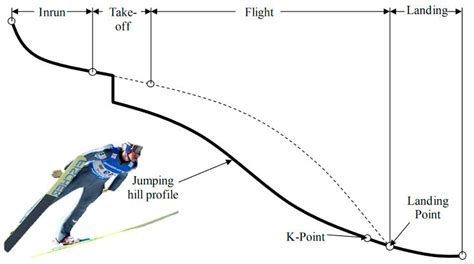
Let's delve into the key components and measurements that define a ski jumping hill.
Key Components of a Ski Jumping Hill
- In-run: At the top is an in-run where the jumper runs down to generate sufficient speed before reaching the jump. The platform has a bar across it, which the jumper sits on. By leaning forward, the jumper will naturally start to glide down the prepared tracks along the in-run. This allows the jury to regulate the speed of the jumpers in varying wind conditions by shortening or lengthening the distance along the in-run.
- Take-off: After gaining speed, the skier launches from the take-off.
- Landing Slope: The skier is then airborne until landing on the landing slope. The landing slope has a smooth curve which closely follows the profile of the ski jump; this means that the skier is never more than about 6 meters (20 ft) above the ground. The first part of the slope is known as the knoll. It is located between the take-off and the landing area; here the slope inclination increases. After the knoll, the nominal landing area begins at the norm point (also known as the P point), where the slope is the steepest. From there, the inclination slowly decreases as the landing area follows through the construction point (K point) down to the L point, beyond which a safe landing is no longer guaranteed.
- Out-run: The last part of the hill is the out-run, which may be either flat or even uphill, allowing the jumper to stop.
Critical Measurements
Several measurements are crucial in defining the size and characteristics of a ski jumping hill:
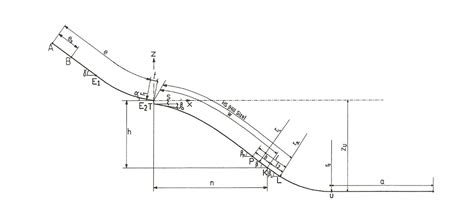
- Construction Point (K-Point): The construction point (K point) is used to determine the distance points for a particular length. For hills up to large, the scoring system grants 60 points to jumps which reach the critical point. For ski flying hills, 120 points are granted for the critical point length. Based on the hill's length, distance points are calculated, which are added for each meter beyond the critical point and subtracted for each point shorter than the critical point. A meter has more distance points in smaller hills. The calculation point or K-point is slightly further up in the hill, and is still used for the calculation of distance points, which along with style points determine the winner of an event.
- Hill Size (HS): The size of a hill is measured in the hill size. In 2004, the International Ski Federation replaced the calculation point as the measurement of the size of a hill with hill size. The hill size is the length from the takeoff in a straight line to the knoll and then along the level of the landing slope to the hill size point. The hill size point is calculated based on the technical data of a hill based on radius, angle of inclination and record distance. The distance from the take-off to the end of the landing area is called a hill size.
- Norm Point (P-Point): Another measurement that may be seen is called the Norm Point, which measures the distance to the P-point, or the beginning of the landing area, which is just above the K-point, usually approximately 80% of the distance to the K-point.
- L-Point: Hill Size is measured to the end of the landing area, or L-point, which is beyond the K-point. The area between the P-point and the L-point, which includes the K-point, is basically the flat part of the landing area, where it is safe for the jumpers to land.
Hill Classifications
Ski jumping hills are classified based on their K-point:
- Normal Hill: Currently, a normal hill has a K-point of about 90 metres.
- Large Hill: A large hill K-point is usually about 120 metres.
- Ski Flying Hill: These are termed ski flying hills, in which the K-point is at 180-185 metres, usually, although the largest hill is at Vikersund, Norway, with a K-point of 195 metres.
Olympic and World Championship Standards
The Fédération Internationale de Ski (FIS) uses Hill Size to define which events must be held at the Olympics and World Championships.
Read also: Highland Hills Winter Fun
“OWG [Olympic Winter Games] and WSC [World Ski Championships] jumping competitions shall be held on hills of two different sizes. A World or Olympic champion will be selected for each hill size. The smaller hill should have a Hill Size (HS) of at least 100 [m].
One thing to note is that the hills for Torino (2006), Vancouver (2010), and Sochi (2014) are exactly the same size, both in terms of K-point and Hill Size. Finally, note that the normal hill used at the 2002-10 Winter Olympics, at a hill size of 106.0 m, is approaching the maximum for a normal hill (109.0 m), as defined by FIS regulations.
Copper Peak: A Case Study
The Copper Peak ski jump is the world’s tallest artificial ski jump superstructure, towering 26 stories over the hilly forests of Michigan’s Upper Peninsula. Copper Peak is made with 300 tons of sturdy COR-TEN steel. It rises 26 stories above Chippewa Hill, with an upper observation platform that provides breathtaking panoramic views at 1,782 feet above sea level and 1,180 feet above Lake Superior. As the world’s tallest artificial ski jump, it boasts a 469-foot cantilevered inrun with a 35-degree slope.
Copper Peak hosted 10 international ski flying events from 1970 to 1994. The official record for the longest-ever ski jump at Copper Peak was set during the last competition in 1994. Two Austrian ski jumpers - Matthias Wallner and Werner Schuster-flew for a distance of 518 feet or 158 meters. Schuster also holds the unofficial longest flight record at Copper Peak when in 1989 he flew an amazing 522 feet.
Copper Peak is modernizing its facility to meet current International Ski Federation (FIS) standards. We’ve partnered with the board in this ambitious effort to bring this facility to the world stage of winter sports. Athletes will land on a synthetic skiing surface secured to a two-acre concrete slab. On this steep hillside, long-term geotechnical stability is vital and the focus of our design. The slab will be strengthened with reinforcement bars made of basalt-produced locally-to reduce the risk of corrosion compared with steel. We are currently overseeing the preparation of the landing hill for its new surface. Blasting and grading are complete, and placement of soil and rock anchors, drainage rock, and mesh has begun.
Read also: Luxurious Stay in Breckenridge
LIVE | Engelberg (SUI) - M - Large Hill - FIS Ski Jumping Continental Cup
They will pour a new concrete slab at a 37-degree angle, an amazing engineering feat, that Copper Peak will refrigerate in winter and cover with a plastic mat that becomes a water slide for summer ski-jumping competitions and training.
| Hill Feature | Description |
|---|---|
| In-run | The slope where the jumper gains speed. |
| Take-off | The point where the jumper launches into the air. |
| Landing Slope | The sloped area where the jumper lands. |
| K-Point | The construction point used for distance calculation. |
| Hill Size | The distance from the take-off to the end of the landing area. |
| Out-run | The area where the jumper slows down and stops. |
Ski jumping hill design and construction is a blend of engineering, physics, and athletic requirements. The ultimate goal is to create a venue that is both safe and conducive to high-performance competition.
Read also: A Vermont Skiing Legacy