Easton Hockey has a long-standing reputation in the hockey equipment industry, known for producing quality gloves. This article provides a detailed review of Easton hockey gloves, focusing on the Pro (2014) model and the Stealth S17 gloves. We'll delve into their fit, protection, durability, and overall performance, while also comparing them to other popular brands like Bauer, CCM, and Reebok.
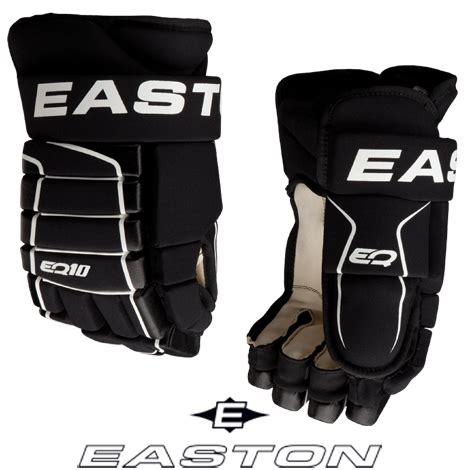
Easton Pro (2014) Hockey Glove Review
The Easton Pro (2014) Hockey Glove differs from Easton’s other flagship lines, the Mako and the Synergy lines, in terms of Aesthetics and Fit. The Easton Pro is a direct comparable to traditional-style 4-Roll gloves such as the Bauer Nexus 800/4-Roll Pro, the CCM 4-Roll Pro II/III, and the Reebok 9000/4-Roll Pro. The design is very classic, while the Fit is somewhat wider.
Easton Hockey has been around for a long time, and they know how to make a Hockey Glove. The Easton Pro comes highly recommended. The Easton Pro is a top-seller for most of the online Hockey retailers, and with good reason: it’s a top-of-the-class glove. It compares very favorably within the 4-Roll glove family and offers top-notch value compared to recent Easton releases.
Aesthetics and Fit
In the past Easton has offered up to a dozen color variations on a given glove, but for the 2014 Pro they opted for a very trimmed-down selection. The Easton Pro comes in a really sharp Royal, which I almost purchased to match our prior adult league team, P.T.’s Grille. However, Reboot Hockey ultimately sponsored our 2014 Fall League team, and we opted to go with the LA Kings Black/White/Silver scheme. When I made the purchase, I immediately pictured Marian Gaborik, who has worn Easton gloves for a number of years.
You can see obvious similarities in Fit and Design between the 2014 Pro and the mid-1990s Ultra Lite. Lastly, it’s worth mentioning that the 2014 Easton Pro is a quantum leap over recent Easton traditional-fit glove offerings, most notably the Easton EQ Pro (ugly shell, weak aesthetics) and the Easton Total Pro (Total Hockey exclusive, value-grade version of the EQ Pro), in terms of both Fit and Looks. I did not even consider purchasing the EQ Pro or the Total Pro, even at a steep discount.
Read also: The History of Easton Hockey
Comfort and Feel
As noted above, the first thing that came to mind when I tried out the Easton Pro was “memory foam”. The palms on the 2014 Easton Pro are luxurious black Nash. It’s a high-quality material that looks great aesthetically on all of the color schemes. I slightly prefer the beige Nash on the 2013 CCM Pro II, but both are extremely high-quality palms. The Easton Pros were quite soft right off the rack but did require a 2-3 skate break-in period. Having said that, the Easton Pro immediately reminds me of memory foam, in that the inside of the glove contours to the user’s hand.
The cuff on the Easton Pro is angled and slightly-wide, but not flared out as with some gloves.
Protection and Durability
In terms of injury protection, I put the Easton Pro right there with the Pro II and the Nexus 1000. The materials that comprise the gloves are naturally supple, and while 4-Rolls are quite thick across the back of the hand, I would consider a Pro-style modification if you’re a playing in a higher-level league.
The Durability on the Easton Pro seems to be very comparable to that of CCM 4-Roll Pro II, perhaps even a bit better. The black Nash on the Easton Pro seems to be slightly thicker and a bit more resistant to tearing than the beige Nash on the CCM Pro II. Like all contemporary nylon-shell gloves, I do not think the Easton Pro would be worth repalming at $25-$30 per palm, even if black Nash were more available.
Performance
Regarding Performance, personal preference comes into play to a great deal. As noted above, I prefer the Pro II to the Easton Pro because I like an extremely loose-fitting glove, but that’s like saying I prefer Angelina Jolie to Cougar Jen Aniston. The question for you is whether you prefer a loose-fitting, standard-fitting, or close-fitting glove. From there, you can go into details such as locked-thumb versus articulated thumb or whatever.
Read also: Features of Custom Hockey Gloves
Like the 2013 CCM Pro II, I think the 2014 Easton Pro is an excellent value at the current suggested retail of $80-$100. The new reality is that you are meant to get about one year of use from gloves. You can certainly go past that, but common issues like holes in the palms and frayed stitching are to be expected. As I noted above, I think it’s a better bet to get a high-quality glove like the Pro II or the Easton Pro for $80-$100 and love it than to get an economy-level glove for $40 and be annoyed all the time.
Something to be cautious about if you purchase gloves with dyed liners. As noted above, the liner on my Black/White Pro II gloves is a deep shade of red. This red dye wore onto the edges of my white elbow pads quite a bit. I don’t care because it’s only my elbow pads, but if the gloves had dyed one of my favorite white jerseys pink around the wrists, I would have been pretty aggravated.
Easton Stealth S17 Gloves Review
Easton Stealth S17 Gloves, 2008 Model. Size : 13". Time Used: 1 year (1 season of house league, various pickup, 1 season of Summer league)
It seems that Easton's stealth line has diverted from being a wider/traditional fit in 2007 to a more anatomical/tapered fit after, a combo of Bauer's Supreme and Vapour series. This top-of-the-line glove from Easton offers this new fit; tight in the fingers and gradually flaring out from the knuckles. When I first tried these gloves on at the store, I fell in love with the fit :)
Fit: 9/10
Read also: The story of Craig Needham
Weight and Mobility
Despite the leather palms and outer construction, these gloves are very light. Flared cuff again, offers a good range of motion. The key feature on this glove is the flex thumb, allowing one to bend their thumb slightly while not sacrificing protection. After using this glove, I don't think I'll be comfortable in a fixed thumb again. It offers better control and grip over the stick. The only problem I have about the flex thumb is that it takes some effort to bend it.
Weight & Mobility: 9/10
Protection
Being an anatomical glove, I didn't expect high-end protection similar to a Bauer 4-Roll or a Franchise. Despite not taking too many impacts to the glove, I can feel that the upper cuff and the pinkie area down to the palm are the most poorly protected areas. Be wary if you play higher level hockey.
Protection: 6/10
Durability
For the most part, these gloves are still looking like they are newly purchased. The synthetic leather palms show no sign of damage or heavy wear. The embroidery and chrome 'S17' decals are still shining and despite tiny loose stitching problems, these gloves are quite durable.
Durability: 10/10
Palm
I found that the palms are the worst feature on the S17. The synthetic leather Atacama Pittards palm is rather thick and offers poor feel for the stick. Being synth leather, they have also started to get crusty after games when they get wet, further spoiling the feel and it has even started to absorb odour.
Easton Talon vs. RS Gloves
Even if both are anatomical fits, they feel pretty different. Looking at the fingers, the Talons play a little long while I feel that the RS is more of a truer length proportional to other gloves. I wear 13" Talons and am somewhere between a 13" and a 14" in other gloves. As an example, I have to move to a 14" on the RSs.
In terms of comfort, the MSH2 palm edges out the RS palm imo, though overall the RS fingers are more comfortable because of the odd segmentation placement on the Talons. This could be just me but on the Talons, the segments don't line up well with my joints, especially on the pinky, which caused discomfort.
Looking at the palm and backrolls, I still prefer the MSH2 over the Ax Suede, both already ahve the broken in feel so I suppose it doesn't make too much of a difference. I feel that the RS offers more protection as the plastic inserts in them are more sturdily placed and the foams are denser.The wrist and cuff area is the key point when comapring the two imo. Traditional cuff and cuff extension placements on the Talons, nothing too significant and acceptable mobility. The RS angled cuff roll wasn't as noticeable when trying them on as when seeing them for the first time. The biggest problem I noticed relates to the sizing choice of the gloves too 13" gloves normally cover my inside wrists, but on the RSs, they were exposed. Moving to a 14" barely solved the problem. The biggest negative was wrist mobility. You can barely bend your wrist backwards without the cuff digging into your arm, side to side and downwards mobility was fine.
Durability is obviously still unknown with the RS but I've had some issues with the Talon.
Summary of Easton Glove Models
Here's a summary table comparing the key features of the Easton Pro (2014) and Easton Stealth S17 gloves:
| Feature | Easton Pro (2014) | Easton Stealth S17 |
|---|---|---|
| Fit | Wider, traditional 4-Roll | Anatomical, tapered |
| Palm Material | Black Nash | Synthetic Leather Atacama Pittards |
| Protection | High | Medium |
| Durability | High | High |
| Key Feature | Memory foam feel | Flex Thumb |