Finding the ideal pole length is crucial for various skiing disciplines, including Alpine Skiing, Cross-Country skiing, and Backcountry Skiing. The pole should support your technique, reduce potential falls, and enable an optimal transfer of power. These benefits are best achieved when poles are correctly sized - and this can vary a great deal according to the type of sport.
Correctly sized ski poles will help you ski better and keep you from getting stuck on those flat slopes. This is why it's important to understand how to select the right ski poles for your needs.
In this guide, we break down the key factors to consider when selecting ski poles, including finding the right length. While we'll cover some basics of ski poles for cross-country skiing, this article will focus mainly on poles for downhill or backcountry skiing.
How to Size Ski Poles | Tips for Choosing the Right Length
Types of Ski Poles
When choosing ski poles, start by considering the type of skiing you'll be doing. We'll cover three basic types of poles for downhill skiing, backcountry skiing and cross-country skiing.
Downhill ski poles: These ski poles help you maintain balance or initiate movements like turns while alpine skiing. The shafts are typically made of aluminum, though some skiers may prefer lighter (more expensive) carbon fiber options. Most downhill ski poles come in fixed lengths, but adjustable models are also available. Ski poles are also available in kids' sizes.
Read also: Is the Bauer TWITCH Worth It?
Backcountry ski poles: A standard pair of fixed-length downhill ski poles can work in the backcountry, but many backcountry skiers prefer telescoping poles that adjust using locking mechanisms. These allow you to extend your poles for uphill travel (skinning) or shorten them for the descent. Backcountry snowboarders often look for poles that collapse down short enough to be lashed securely to the outside of a backpack for their descent.
Cross-country ski poles: Cross-country ski poles are generally longer than downhill ski poles. For classic cross-country skiing, skiers typically size poles so they reach from the ground up to their armpits. For race and performance classic skiing, you may want to size them a few centimeters longer. For skate skiing, you can go longer even still-the poles should reach from the ground up to a point somewhere between your chin and lips.
Cross Country ski poles have different lengths depending on the technique (skate/classical) and style of skiing you intend to do (groomed trails/backcountry). Poles used in classic skiing are shorter than those used in skate skiing, and Poles used for racing or high-performance skiing are generally longer than those for recreational & backcountry skiing.
Cross-Country Ski Pole Sizing
Unfortunately, there are several ways to measure poles that makes it a little more confusing. The measurement system in place for a long time measured from the end of the pole tip to the top of the grip. Swix implemented a new measurement system for most of their poles that measures from the end of the pole tip to where the strap comes out of the pole. This makes sense as it is the functional length of the pole and makes it easier to comply with FIS rules on classical pole length (83% of height), but it is a new system that changes the pole length that we have all gotten used to. To convert from the old Swix length to new, subtract 4cm from the old length. For example, a 5'11" (180cm) tall skier would have an ideal (old system) length of 161cm. The new swix pole length would be 155cm.
- Skating poles should generally come up to the same height as your nose or bottom of your ears. Use this formula for a more specific fit: your height in cm x 0.89 (non-Swix length). For Swix poles, subtract 4cm from this length.
- For classic cross-country skiing they should come up to shoulder height (where the shoulder meets the arm) or you can use this formula: your height in cm x 0.83.
- Touring poles or poles for more recreational styles of skiing should be shorter. Target the armpit for touring/recreational poles, and go a bit shorter for backcountry if you like.
Adjustable poles for backcountry skiing are a nice option if you do a lot of steep terrain. Adjust the poles longer for flats and gradual uphills, a little shorter for steep climbs, and then shorten the poles to arms at 90-95 degree angle for descending.
Read also: In-depth review: Ritual field hockey sticks
Ski Pole Fit
To find the right length for downhill ski poles, start by wearing shoes or standing in your ski boots. Hold the poles upside down so the grips touch the floor. Grab the ski pole just underneath the basket so that the top of your thumb touches the basket. Your elbow should form a 90° angle.
If the angle is less than 90°, try a shorter pole. If the angle is greater, get a longer pole. Most poles are sized in 2" increments. If you're in between sizes, go with the shorter pole.
Ideally, when you flip a ski pole upside down and grab it below the basket, your elbow will bend to a 90-degree angle
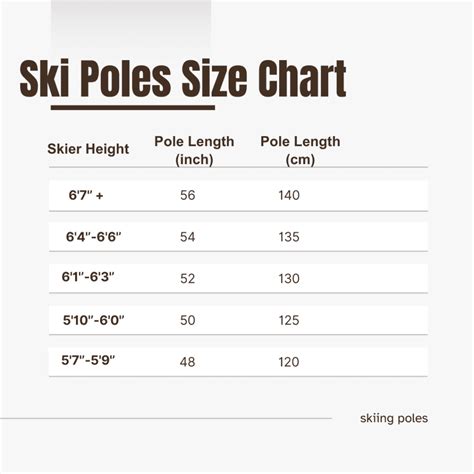
Consult the manufacturer's sizing charts or use this handy chart to help you find the right ski pole length:
Downhill Ski Poles Sizing
Here's a quick reference table for downhill ski pole sizing:
Read also: Guide to Miniature Field Hockey Sticks
| Skier Height | Pole Size (in.) | Pole Size (cm) |
|---|---|---|
| 3 ft. 6 in. and under | 30 in. | 75cm |
| 3 ft. 8 in. | 32 in. | 80cm |
| 3 ft. 10 in. | 32 in. | 80cm |
| 4 ft. | 34 in. | 85cm |
| 4 ft. 2 in. | 36 in. | 90cm |
| 4 ft. 4 in. | 36 in. | 90cm |
| 4 ft. 6 in. | 38 in. | 95cm |
| 4 ft. 8 in. | 40 in. | 100cm |
| 4 ft. 10 in. | 42 in. | 105cm |
| 5 ft. | 42 in. | 105cm |
| 5 ft. 2 in. | 44 in. | 110cm |
| 5 ft. 4 in. | 46 in. | 115cm |
| 5 ft. 6 in. | 46 in. | 115cm |
| 5 ft. 8 in. | 48 in. | 120cm |
| 5 ft. 10 in. | 50 in. | 125cm |
| 6 ft. | 50 in. | 125cm |
| 6 ft. 2 in. | 52 in. | 130cm |
| 6 ft. 4 in. | 54 in. | 135cm |
| 6 ft. 6 in. and over | 56 in. | 140cm |
Ski Pole Materials and Features
Ski poles come in various materials, each with its own set of advantages:
- Aluminum: Durable and more economical, poles made of aluminum shafts are typically heavier.
- Composite: These shafts are constructed from a mix of materials such as aluminum and carbon; they offer a balance between weight and durability.
- Carbon fiber: Lightweight and stiff, shafts made of carbon fiber are more expensive but great for skiers seeking high performance.
- Wood: Less common today, some ski poles are made of bamboo, considered a fast-growing renewable resource. They're lightweight, durable and flexible.
Pole Straps
Most ski poles feature a flexible nylon wrist strap that serves multiple purposes.
During turns, if you lose your grip, the strap helps keep the pole where you planted it. If you fall, the straps keep your poles with you and not buried in the snow far upslope.
To use wrist straps correctly, insert your hand up through the bottom of the strap loop, then your thumb and hand grip over the strap and around the pole.
Some downhill ski poles now have detachable straps-tearproof loops that click in and out of the grips for fast transitions.
Pole Baskets
The basket is the plastic disk (sometimes shaped like a snowflake) near the bottom of a ski pole. Its purpose is to keep your pole from sinking too far into the snow.
- In powder conditions, use a bigger basket.
- On groomed slopes or hardpack conditions, use a standard basket.
Some poles come with interchangeable baskets or additional pole snow baskets can be purchased separately.
Telescoping Poles
Telescoping poles are used by ski mountaineers or backcountry skiers. These can be lengthened for uphill climbs or shortened for alpine descents.