The Ski to Sea Race, often simply called Ski to Sea, is a beloved and challenging team relay race held annually in Whatcom County, Washington. This unique event combines seven different sports into a single, continuous race that spans 93 miles (150 km). It starts on the snowy slopes of Mount Baker Ski Area and culminates at Marine Park in Fairhaven, on the shore of Bellingham Bay.
The Ski to Sea Race is owned and operated by Whatcom Events, a volunteer-operated community 501(c)(4) non-profit organization.
The race is held annually on the Sunday of Memorial Day weekend in Whatcom County, Washington.
A Ski to Sea team consists of three - eight racers competing in seven different sports: Cross Country Ski, Downhill Ski/Snowboard, Running, Road Bike, Canoe (2 paddlers), Cyclocross Bike, and Sea Kayak.
The race course runs through the towns of Glacier, Maple Falls, Kendall, Everson, Lynden and Ferndale, finishing at Marine Park in the historic Fairhaven district of Bellingham.
The event has 900 volunteers that keep race weekend running smoothly (well, as smoothly as possible), and coordination and planning are a year-round task for Rankin and the Whatcom Events crew.
For those who come to experience this little slice of Pacific Northwest glory, the event puts all of the region’s natural wonders on display, and, just like in 1911, it proves love of adventure is one of the area’s defining attributes.
Whatcom Events aims to host and sustain environmentally mindful world-class events showcasing recreational opportunities in Whatcom County.
Just like in 1911, we want the race to be part of a healthy local lifestyle and highlight the recreational opportunities and geographical diversity of Whatcom County.
Competitors from across town - and across the world - ski, bike, paddle and pant their way through a Washington state race that follows in the footsteps of its pioneers and is under the watch of 900 volunteers.
From the summit of Mount Baker in Whatcom County, Washington, the Pacific Ocean looks surprisingly far away.
It's only 48 kilometres (30 miles) as the crow flies, but the terrain is heinous.
It’s not exactly beckoning for a race, but each year, participants of the team-relay race Sea to Ski break the route down into stages, each stage featuring a classic northwest sport.
The Ski to Sea embodies a community in a way that few events ever could.
Its ubiquity in Bellingham is surreal - everybody plays their part - even if they just happen to “have a truck with racks.”
It shows off every unique geographical feature of the county in which it takes place, has a rich history, and means an unfathomable amount to so many people.
It’s deep roots, and organic rise aren’t immediately replicable, and I don’t mean to suggest that they are.
What I mean to say is that I love the Ski to Sea because it represents the pinnacle of what running, and racing, can mean to a group of people.
You don’t have to win, or even compete, to understand how resplendent the day of Ski to Sea is in Bellingham - in fact, you might not even need to know your own last name.
Origins: The Mount Baker Marathon
The idea for the Ski to Sea Race came from much older races called the Mount Baker Marathons. These races took place between 1911 and 1913. The Ski to Sea has its origins in the Mount Baker Marathons of 1911-1913.
The race is held annually on the Sunday of Memorial Day weekend in Whatcom County, Washington.
The Ski to Sea race traces its history back to 1911 when the first Mount Baker Marathon was held.
The Mount Baker Club organized the early marathons to call attention to their scenic area.
The Mount Baker Club was looking to boost economic activity in Bellingham, Washington, and they decided running from Bellingham to the summit of Mount Baker might stimulate interest in the area.
They figured few people would race, but many would come to watch.
Those early races were super tough! People raced from the city of Bellingham all the way to the very top of Mount Baker and back.
Debuting in 1973, the team relay race from Mt.
Those competing on the Glacier route would leave Bellingham from the building that is now the Chuckanut Bay Distillery on Cornwall Avenue.
Competitors in the original Mount Baker Marathon left Bellingham from the Chamber of Commerce building on Cornwall Avenue.
The building is now the Chuckanut Bay Distillery.
“The runners would run out of that building, and if they were going on the Glacier route, they would get on a train on Railroad Avenue,” said Kolby LaBree, co-owner of the Good Time Girls.
Good Time Girls has been offering historical walking tours of Bellingham since 2011.
“It’s 1911, 1912 and 1913 when they had this race, so these are like old-school cars with no roof or anything,” LaBree said.
The Whatcom Museum celebrates both the 110th anniversary of the last Mount Baker Marathon race (1911-1913) and the 50th anniversary of the present Ski to Sea race (1973-2023).
Watch the movie The Mountain Runners, at the Pickford Film Center on Wed., May 24, 6pm.
The film tells the story of the Mount Baker Marathon, America’s first mountain endurance/adventure foot race.
Unlike most marathons, participants chose between taking a train to Glacier, Washington, 70 kilometres (44 miles) east on Highway 542, or an automobile to Heisler’s Ranch outside of Deming, Washington, 40 kilometres (26 miles) away.
From their drop-off points, racers would summit the 3,286-metre (10,780-foot) mountain before turning around and running back down to Bellingham.
Early sports enthusiasts could use any means of transportation available to get from Bellingham to the base of Mount Baker.
They then ran 11 miles to the summit and then back down.
Race officials huddled at the summit to make sure everyone made it to the turnaround.
Racers then raced back down the mountain and took their mode of transportation back to Bellingham.
fast approached, twenty-thousand spectators swarmed the streets of Bellingham to witness fourteen contestants embark on the first recorded mountain adventure race in American history.
Competitors raced from the bay city at outrageous speeds aboard stripped-down automobiles and an old Iron Horse toward two competing trailheads at the foot of Mount Baker.
Disembarking from their contrivances, they ran in darkness through dense forest, on snow and ice fields, over glaciers and crevasses, against savage storms and whiteout conditions to the 10,781-foot summit and back again.
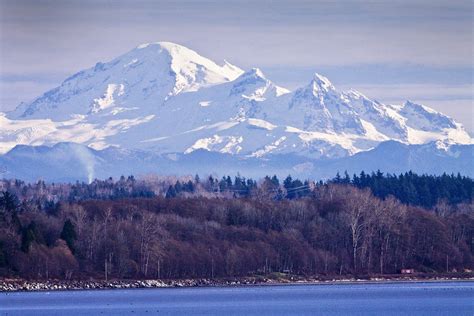
Mount Baker as seen from Bellingham, WA
Challenges and End of the Marathon
Mount Baker, while only the fifth-highest peak in the Cascade Range, is not an easy mountain, and its elevation, glacial hazards, and remoteness pose challenges.
Although Mount Baker is laced with deep crevasses, usually there was no new snow, so racers could see the dangerous fissures.
With the limited communication of the era, judges on the mountain attempted to postpone the race that year but were unable to connect with organizers in town, so it proceeded anyway.
As the day went on, officials were missing from their posts, multiple racers got lost, and one fell into a 12-metre crevasse, where he waited for five hours before being rescued.
With only a few hiccups in the first and second years, the marathon met its maker in 1913.
tags: #ski #to #sea #bellingham