It’s called “ski”ing for a reason. First principles are the ski manufacturer’s basic methods of crafting a ski for a specific purpose. A powder ski will have shapes and profiles that are radically different than a carving ski. Shape and profile determine ski performance characteristics. You need to know the details of these to help you understand what ski manufacturers have at their disposal. They make the candy, knowing how helps you make better selections.
Ski Shape
A ski’s shape is built around several key measurements:
- Tip and tail width: The width of the ski’s tip and tail.
- Waist width: The width at the ski’s waist.
- Sidecut (or radius): The curvature created by the tip and tail width.
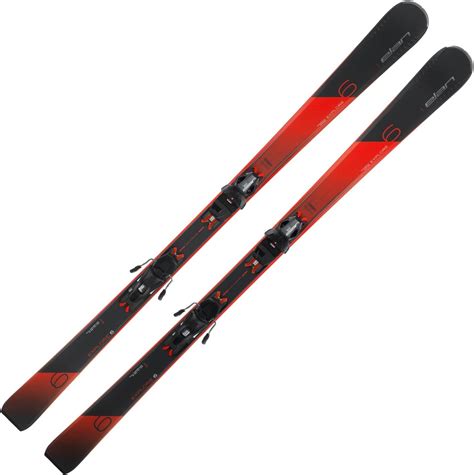
Almost all skis are now parabolic. In the ski industry, the term means an hourglass shape created with a tip and tail width larger than the waist. The sidecut or radius created by measuring the curvature of the ski is the sidecut.
Shaped skis create a very specific type of sidecut. The sidecut helps determine the skis turn radius (see Turn Radius for details). Skis can be the same length and have the same tip and tail width and ski very differently because of a different sidecut. In other words, a different shape can create a different sidecut, and that sidecut dramatically changes the characteristics of a ski.
Reverse sidecut is when the radius is convex, from above. This comes right out of the world of surfboards and water skis.
Read also: Maximize Savings on Mount Snow Skiing
Parabolic skis
Ski Profiles
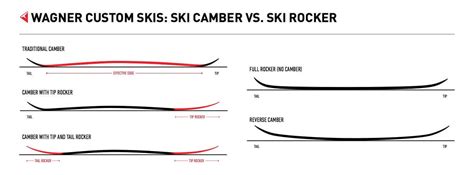
The pictures above show skis flat on a surface. The flex pattern between the ski and the surface is commonly called a profile. When the arc is convex, from the surface, the skis profile is described as camber. When the ski is concave and pushes against the surface, the ski’s profile is described as reverse camber. For GNASA purposes, we’ll refer to profiles as camber and rockers.
Camber
Camber is the upward bend in a ski between the snow touch points. The skiers weight presses down on the ski causing the ski to bend at the touch points. That creates a kind of pop or spring where the skiers weight and the camber act in opposite directions to create a quick responding ski.
On hard snow, cambered shaped skis create the best edge hold, stability and rebound.
Read also: MLine Pro Deck: Three-Season Performance
Rocker
Rocker is upside down camber and often referred to as reverse camber. It allows a ski or board to easily roll. Rocker shapes are common in water sports where turning is everything. Rockers were introduced as manufacturers found that they could create all kinds of edge, grip and torsional precision using design techniques and materials, but didn’t have a simple way to help skiers turn. The rocker solved this.
Camber vs Rocker
Rockers also address other issues with cambered skis. Whereas cambered skis are loaded, like a bent spring, rockers are not. On bumps, choppy hard pack or crud, cambered skis vibrate. Rockers are able to absorb the vibrations. They are easier on your body.
Today, full rockers are used for deep powder snow. Originally made famous by K2 Pontoons and Volant Spatulas, these rocker plus reverse sidecut skis allowed skiers to turn effortlessly in deep powder.
Read also: Summit County Ski Report
Rocker Camber Rocker
In an attempt to get the best of both worlds, quick turning skis and easy turning skis, the camber-rocker combination was created. This is one of the most common profile configuration used today. The rocker to rocker effective edge can be homed for edging. The added rocker allows skiers to quickly initiate turns by using the rockers easy roll characteristics. Many of the all mountain skis use this pattern. It help facilitate on piste and off-piste skiing. Head Kore, Volkl RTM, Elan’s Ripstick, and Kastle MX series use this profile.
There are other profiles manufactures can use for specific effects. Below are the most common profiles.
Camber + Tip (Front) Rocker
This profile uses a rocker configuration on the tip of the ski and camber behind. The tip rocker helps the ski to initiate turns.
Full Rocker No Camber
Full rockers with no camber skis are usually powder skis that can make turns on hard pack. The enhanced edge is created by flattening the rocket (zero camber).
Choosing The Right Skis: Rocker Vs Camber
Stiffness & Flex Pattern
All skis have a stiffness. A decade ago flex pattern conversations were common. Tip, tail and underfoot stiffness would vary a lot and had noticeable effect. Today industry folk generally refer to the stiffness of a ski on a continuum between soft and very stiff. Today manufacturers have so many techniques to address flex patterns that your best bet is to read up and test drive.
The stiffness determines how hard or easy it is to flex the ski. Stiffness is created over the entire surface of the ski. There is a bending stiffness, called longitudinal stiffness and torsional stiffness often called twisting stiffness. These two forces combined determine a skis flex pattern or stiffness.
Manufacturers will tell you about their skis flex pattern. They will generally explain how they create a skis stiffness. It is usually created by ski materials and design techniques.
When we talk about flex, we are referring to how the skis support your body weight when on a groomed snow surface. Ideally, we look for a ski that will support your body weight while maintaining the longest running surface as possible on the snow. When you push off, the ski should feel snappy and almost give a little back at the end of the stride. If a ski is too soft, you will flex right through the camber and form a pivot point under your foot. In soft snow, this is OK because it allows the ski to "float" more through the snow. In firm snow, this can be quite scary though. When the ski is too soft, the flex flattens out and edge control becomes a thing of the past. A good way to tell if your skis are too soft is, on a firm day, go out and balance on one foot. If you feel the ski moving below your foot to the point where it is tough to stay on top, the ski may be too soft.
If a ski is too stiff, the opposite is true. Instead of flexing through the ski camber, you will not be able to compress the ski at all. As a result, you will be riding on the tips and tails of the ski almost all the time. A stiff ski is good in hard pack conditions because the surface you are pushing against is so firm, the edges will not completely flatten and the ski will maintain some of its bite on the ice. But, when conditions soften to even well groomed standards, a stiff ski can slow you down quite a bit. They will feel very solid going downhill, but when climbing, the tips and tails will punch into the groomed surface or "plow" and slow your progress considerably. Therefore, it is important to find the happy medium between too stiff and too soft.
We want a good, solid running surface that a soft ski will offer, but we want the support and edge control that a stiff ski offers. Sounds tough to find. Not so much. Most ski companies build their skis with these criteria in mind. The key is that no two skis are alike and even though the tag says so, the shop needs to put in some time to make sure the skis are flexed the way they are supposed to be and then match that with what the customer wants.
Different ski makers have different flex patterns that effect how the ski feels under foot. Even though a Madshus and a Fischer are flexed for someone who weighs 160lbs, they will "feel" different because of the manufacturers design philosophy.
Ski Length
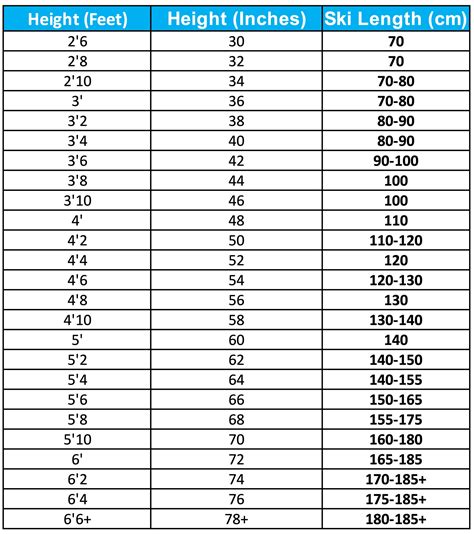
Shorter skis tend to be more maneuverable, whereas longer skis typically require a stronger steering effort, but add some stability at speed and float in deep snow.
Ski Size Chart
Other Design Factors
Athletes will trade these with other attributes, including their own style, physical characteristics, experience level, and coaching strategies.
The texture of this top layer dependent on the weather history. The texture and physical properties of snow can change over time.
The motion of a skier is determined by the physical principles of the conservation of energy and the frictional forces acting on the body. For example, in downhill skiing, as the skier is accelerated down the hill by the force of gravity, their gravitational potential energy is converted to kinetic energy, the energy of motion.
One type of friction acting on the skier is the kinetic friction between the skis and snow. The force of friction acts in the direction opposite to the direction of motion, resulting in a lower velocity and hence less kinetic energy. The kinetic friction can be reduced by applying wax to the bottom of the skis which reduces the coefficient of friction. Different types of wax are manufactured for different temperature ranges because the snow quality changes depending on the current weather conditions and thermal history of the snow.
An illustration of how snow quality can be different follows. In an area which experiences fluctuation in temperatures around 0°C - freezing temperature of water, both rain and snowfall are possible. Wet snow or the wet ground can freeze into a slippery sheet of ice. In an area which consistently experiences temperatures below 0°C, snowfall leads to accumulation of snow on the ground. When fresh, this snow is fluffy and powder-like. This type of snow has a lot of air space. Over time, this snow will become more compact, and the lower layers of snow will become more dense than the top layer. Skiers can use this type of information to improve their skiing experience by choosing the appropriate skis, wax, or by choosing to stay home.
The second type of frictional force acting on a skier is drag. This is typically referred to as "air resistance". The drag force is proportional to the cross-sectional area of a body (e.g. the skier) and the square of its velocity and density relative to the fluid in which the body is traveling through (e.g. air). To go faster, a skier can try to reduce the cross-sectional area of their body. Downhill skiers can adopt more aerodynamic positions such as tucking. Alpine ski racers wear skin tight race suits.