Toy Machine is a must for anyone who loves skateboarding because the historic brand was born from the genius of legendary American skateboarder Ed Templeton. Founded in 1993 by the innovative Ed Templeton, Toy Machine has become a cornerstone of skateboarding culture, known for its bold graphics and unforgettable characters like the Toy Machine Sect and the iconic monster face logo.
Ed Templeton was born on July 28, 1972, in Garden Grove, California. He began skateboarding in 1985 in Huntington Beach, with friend, Jason Lee. Templeton also identified his teenage skateboarding area, Huntington Beach, as an influence on the progression of street-based skateboarding, stating, "I can say that for certain, that there was, something happened here ... in Huntington Beach, that advanced street skating.
Templeton was influenced by Mark Gonzales, recalling:
"By luck, [professional skateboarder and company owner] Mark Gonzales lived here in 1987, so, ah, one of my first, probably the first pro I ever saw, or realized was a pro skateboarder, was Mark Gonzales. I was in Sidewalk Surfer, the skate shop down here, and, that was on Main St., in Huntington Beach; we went in there to look at stickers, and there was a Skull Skates sticker which I fell in love with-I thought that was the coolest sticker ever ... so we followed him [Gonzales], ahh, back to his house, like stalkers, and, uh, and started skating the quarter-pipe [ramp] and he had disappeared, but then he came back down, did, like, a three, four-foot high "judo air" ... It wasn't until later that I realized he [Gonzales] did his own graphics. And that's, that's the one thing that I would cite as one of my biggest influences, was learning about the pros that did their own skateboard graphics-that to me was a really ... cool idea, and kind of meant a lot to me as a kid, 'cause I thought ... the board I am potentially buying ... was made by the guy whose name's on that board. He put his own artistic touch, or, or, his effort into that board."
In a January 2013 article, by Andrew Reilly for The Huffington Post, the ethos behind Toy Machine (or, the company's full name: "Toy Machine Bloodsucking Skateboard Co."), is described as, "an adverse reaction to the misrepresented and highly corporate images of skateboarding in popular culture", with Templeton sardonically referring to fans of the brand as "loyal pawns".
Read also: Behind the Scenes at the Rink
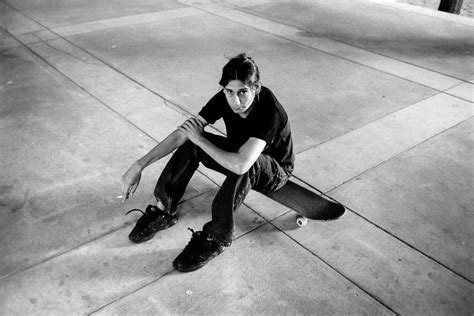
Ed Templeton
The Rise of Toy Machine
Toy Machine Skateboards was started in 1993 by Ed Templeton. It was very successful thanks mainly to its founder Ed Templeton who personally designed all the graphics of the brand. From epic videos such as Welcome to Hell, Toy Machine has a storied history within skateboarding.
Previous riders include legends such as Chad Muska, Jamie Thomas, Bam Margera, Kerry Getz, Brian Anderson. The toy machine skateboard decks and products has been distributed by one of the American giants that is Tum Yeto distribution for over 20 years. The company distributes Toy Machine, Foundation, Pig wheels and other major brands such as Habitat. Tum Yeto is a cornerstone of the American skateboard industry. Ed Templeton continues to contribute to skateboarding in a positive and genuine way as only a real skate brand can.
Beyond their eye-catching designs, the brand stands out for its commitment to creativity, showcasing a talented team of riders and producing groundbreaking skate videos that inspire the next generation. With a passion for community, Toy Machine actively supports skate events and builds skateparks, ensuring the spirit of skateboarding continues to thrive. Each Toy Machine deck is more than just a board; it’s a celebration of skateboarding’s rich history and the relentless pursuit of artistic expression.
Toy Machine's Impact on Skateboarding
From 1990 to 1991 Templeton had a great sponsor called New Deal Skateboards. One of them was the World Championships in Münster, Germany. So he became world champion at age eighteen, his first year being a pro. He had a little cultural capital in the skateboard world, and that’s probably why he thought he might be able to strike out on his own.
Read also: Using Sports Ice Machines in Recovery
The year 1992 was hard for him. He had no job and no prospects. He was calling everybody in the industry trying to find a place to start his own company. The fallback would be to just get sponsored by another company as a pro skater. But for him, once he got the taste of doing it himself, he wanted to do his own brand. He liked the idea of calling the shots. But he didn’t have any money.
Finally, that worked. The guy who had done Vision Skateboards, Brad Dorfman, listened to his pitch and said, “Okay, let’s do it.” So he started Toy Machine, and he was the financial backer. After a year, he was approached by Tod Swank, a former pro skater and owner of Foundation Skateboards. He wanted Toy Machine to join his skateboard distribution hub. They made a hand- shake deal. That was nearly thirty years ago now.
Toy Machine's main thing is making skateboards. And traditionally it was videos, too, although that aspect has changed now with Instagram, YouTube, and everything like that. In the early days, videos were a big part of their yearly sales. They would make a video and sell that video.
What Is Toy Machine Skateboarding? - Action Sports Arena
The Art and Marketing of Toy Machine
Essentially, Toy Machine is a marketing company. Because for the most part all skateboards are exactly the same. They’re all seven-ply hard rock Canadian maple decks with different marketing applied to them. What makes Toy Machine different is our style, graphics, team, and brand identity. That’s what I do. I do the graphics, and set the tone, language, and ethos for the company. That style is reflected in our videos and advertisements.
Read also: The Ice Rink's Unsung Hero
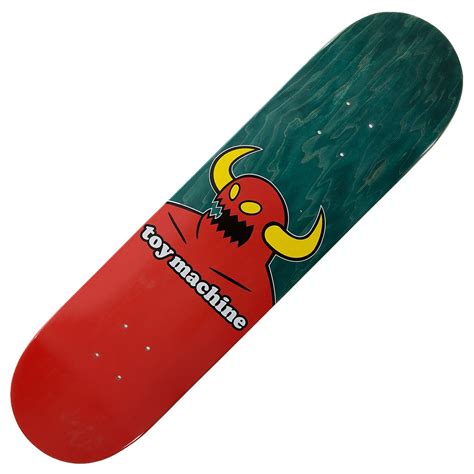
Example of a Toy Machine Skateboard Deck
Templeton came to the realization that he’s responsible for marketing and selling the very thing he love, skateboarding, which gave him some cognitive dissonance. He hates the concept of advertising and the psychological gymnastics that go into selling and advertising something. His solution to this was that everything should be a joke and that he should dial up the crass commercialism to eleven. He asked himself, “What would the marketers at Nike or Big Pharma wish they could say or do to sell their product but can’t?”
The central concept for him has always been mind control, brainwashing, and indoctrination. Toy Machine has a thing called the Consumer Control Center-our full name for it is Toy Machine: A Bloodsucking Skateboard Company. It’s something right out of Orwell’s 1984. They call the fans of Toy Machine our Loyal Pawns. Even using the word “Bloodsucking” was never meant to invoke vampires but a kind of money-grubbing corporation. And so all of our marketing language has always been stuff like, “We control your minds and your credit card, purchasing Toy Machine is not a choice, it’s mandatory.” And our fans get the joke, they know it’s all tongue in cheek.
Another part of Toy Machine’s identity is that skateboarding always comes first. So all the stuff I just talked about is just the window dressing, the decoration. The central principle is great skateboarding. Their ads and videos are filled with really great skaters. But we never sponsored skaters just because they were great, that would be like having a team of robots.
Toy Machine and the Beautiful Losers Movement
The minute I found skateboarding, I was immersed in a world of creative people-even as far back as middle school. Having a skateboard was the ticket into a new world. There were these two punk guys I had always steered clear of. I thought these guys wanted to kick my ass. But once I had a skateboard under my arm they were like, “Hey, come hang out with us.” They gave me a cassette tape with Dead Kennedys and other bands. My mind was blown.
The Beautiful Losers cluster-I think we are all loathe to call it a “movement”- was the same. I mean Thomas Campbell, who was also in the Beautiful Losers exhibition, is someone who I met because he was shooting photos for skateboard magazines. He was shooting me for my interview in Transworld Skateboarding magazine. Aaron Rose, who was the visionary mastermind behind it all, was running Alleged Gallery in New York. It was on Ludlow Street. And he was giving skateboarders the chance to show their artwork.
In 1994 I did my first show there called Waiting for the Earth to Explode. I’d been aware of the art world from early on. In 1990, the same year I turned pro for skating, I started painting. On that first trip to Europe, I went to see museums when I wasn’t skating because I really thought this might be my only chance to see Europe. I wanted to squeeze as much out of it as I could. I came back from that trip declaring, naively, “I’m gonna be a painter!” So my art life and my skateboard life have been on a parallel track from the beginning. Most people know me from skateboarding, but a lot of people from the art world were unaware that I was a skateboarder. Photography came four years later.
Ed Templeton's Photographic Journey
Templeton's photographic journey began with inspiration from Larry Clark and Nan Goldin. Seeing the photographs in those two books had a big impact on me-they changed my understanding of photography. These artists were not going out and shooting something happening in the outside world, they were shooting their own world, giving us all a glimpse into their slice of life and time and the particular way in which they saw it. So here I am traveling the world with these amazing people who get paid to skateboard for a living. They’re celebrities in their world. They skate hard every day and party hard every night, acting like rockstars with a “live fast, die young” sort of mentality, and I’m one of them. I came to the realization that I should be documenting this incredible life I get to live.
He also kept a spotty diary. He wasn’t as diligent as I should have been, but I do have notes from over the years. He always kept a sketchbook with me because I like to draw. It was mostly crappy sketches and little notes about what happened that day and where we were-nothing profound, no deep thoughts about life. But as time went on, these books got more elaborate and I started really keeping more of a diary. Now the diary part has almost squished out the drawings and a lot of the pages are all text.
tags: #toy #machine #snowboards