The Vail-Leavitt Music Hall, located on Peconic Avenue in the heart of downtown Riverhead, stands as a testament to the town's rich cultural history. Built in 1881, this historic building is listed on the National Register of Historic Places and holds the distinction of being the oldest performance venue in downstate New York. Its story is one of transformation, resilience, and community engagement.
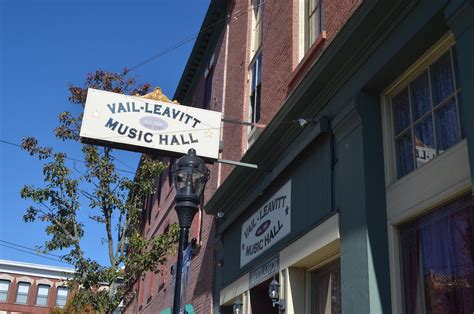
The Vail-Leavitt Music Hall in Riverhead, New York.
The Early Years and Construction
The Vail-Leavitt Music Hall was built by David F. Vail with the help of his son, George M. Vail. The theater opened its doors on October 11, 1881. According to local historians Harold Smith, Jean Hallock, Sylvia Shaffran and Robert Barta, the Music Hall’s inaugural show was a concert featuring both amateur and professional performers.
David Vail shared some interesting facts about the area, "Back then, Peconic Avenue was called Bridge Street. It was the main route to the South Fork. It was the center of carriage making trade, with several companies operating nearby. Also just down the street was the fire department’s old Washington Company. Matt Ammann’s handsome hardware store was on the other side of my building."
The main theater and its balcony are designed as a scale replica of the Ford Theater Opera House by J. W. Flack. The ground floor of the building housed commercial business storefronts, while the upstairs contained the opera house. Initially, the music hall was lit by candles, but the Vails later began operating a gas plant behind the theater.
Read also: Your Visit to the Gerald R. Ford Amphitheater
Transformations and Challenges
In 1908, George M. Vail, then the sole owner of the Music Hall, sold the building to Simon Leavitt, a tailor and clothier. Leavitt renamed the Music Hall as the Lyceum Theater and continued shows there for many years. Perhaps its most famous moment came in 1914 when it hosted a demonstration of Thomas Edison’s new “talking pictures.”
As more modern theaters were built in the area, the Music Hall was converted for use over the years as a restaurant, a roller skating rink and even a betting parlor. The upstairs hall became a Chinese restaurant in the 1920s but after a fire damaged the stage area they used the theater mostly for storage until it was “rediscovered” and acquired by the Council for the Vail-Leavitt Music Hall in 1982. However, the balcony and stage proscenium remained intact throughout the conversions.
The Music Hall’s heyday had long since come and gone. There hadn’t been a performance within its walls for approximately half a century.
Restoration and Revival
In 1982, the Town of Riverhead’s community development office, realizing the potential of the elegant upstairs theater, secured a HUD grant to create the Council for the Vail-Leavitt Music Hall, which assumed ownership and managerial control of the building. The council raised over $100,000 in cash and in-kind contributions to operate and restore the theater.
From the early eighties to the late nineties, old movies were shown on a small screen in its downstairs space, dubbed the "Mini-Cine". These movie showings helped the theater raise monies for the music hall's restoration.
Read also: Comprehensive Vail Resorts Overview
The Vail-Leavitt Music Hall had its grand re-opening on June 28, 2003.
According to Dawn Thomas, director of community development for Riverhead Town, “The objective of the board was to create a performing arts center that earns enough money to manage and take care of the building, which is also a historic resource.”
In early November, the Vail was awarded a $250,000 grant through the Suffolk County Jump Start program.
Recent Developments and The Jazz Loft
Riverhead took the title back in May of 2024, and around that time began talking with Mr. to sell the historic theater to the organization for $150,000. Thomas Manuel, founder, curator and artistic director of The Jazz Loft led the organization’s presentation to the Town Board at Thursday afternoon’s hearing.
Read also: Vail Ski Club Benefits
Manuel said The Jazz Loft has been working on the “acquisition, renewal and revitalization of the Vail Levitt theater” for more than two years.
“When I first got there, there were less than successful relationships in our community, and we really worked hard to develop much stronger relationships,” said Ms. Greiman. “And one of them was with Tom and …the Loft. And they really are key community partners for developing, for joint programming, for performances, and frankly, we use the Loft to help hire and retain employees,” she said.
The proposed schedule for opening The Jazz Loft calls for a soft opening in January, followed by about six months of renovations and a grand opening in July.
Financial Capabilities of The Jazz Loft
Chris Paradysz, a Jazz Loft board member on its finance committee, spoke to the financial capabilities of the organization. “We have a 10-year success story of year over year growth, both financially, from a revenue point of view and from a profit point of view. The last five years, we’ve continued to grow on that. And in fact, ticket revenues have exceeded $3 million in the last five years,” Paradysz said.
“The Jazz Loft today has $256,000 in cash and $850,000 in equity,” he said.
Manuel submitted to the Town Board a restoration plan prepared by Joel Snodgrass, who Manuel sad is “without question, the authority for restoration of historic buildings in New York State.”
“The main work is really the roof and the exterior. The building is not watertight. There’s leakage.
Community Impact and Future Prospects
“It’s going to be a destination,” said Brian Stark of Jamesport. “So if they have the financial ability, which they clearly do, the product is something that I believe people will come to Riverhead for, because it’s a great organization,” Stark said, pointing to how the organization works with schools, too.
Alan Fishbein of Riverhead said he loves jazz and spoke of how much he has enjoyed The Jazz Loft’s Southampton series this year. “They’ve done a great job down in Southampton … and the stuff is well attended. And in fact, I’ve seen people from the North Fork there,” Fishbein said.
Bryan DeLuca, executive director of the company that owns the Long Island Aquarium, the Hyatt Place Hotel and the future hotel on the town square, said that he is on the board of Discover Long Island. “Anytime that we can get a point of interest, an attraction or something for the East End is just another feather in our cap and another thing for us to market and take advantage of,” said DeLuca, who is also president of the East End Tourism Alliance.
“I think it’s another great point of interest for Riverhead, and I think it’s something that should be well supported by this board,” he said.
Today, it is a busy place that hosts many cultural, community, and charity events throughout the year. It has about 300 seats, including the balcony, and is known for its beautiful Beaux-Arts style.
| Fact | Details |
|---|---|
| Built | 1881 by David F. Vail and his son George M. Vail |
| First Show | October 11, 1881 |
| Original Name | Vail-Leavitt Music Hall |
| Renamed | Lyceum Theatre in 1909 by Simon Leavitt |
| Current Owner | The Jazz Loft (as of 2024) |
| Capacity | Approximately 300 seats |
| Architectural Style | Beaux-Arts |