Long before snowboarding became an Olympic phenomenon, people were experimenting with ways to glide down snow-covered hills like surfers. The evolution of the snowboard is a story of rebellious youth, innovative minds, and the pursuit of winter fun.
Early Innovations
The first known instance of snow riding came in 1917. 13-year-old Vern Wicklund stood on a modified sled that he rode down his parents’ backyard in Cloquet, Minnesota. Wicklund patented the idea nearly two decades later but produced only a handful of models.
The sport picked up speed in 1965. Sherman Poppen from Muskegon, Michigan came up with what most consider the direct predecessor of the snowboard in 1965 called the Snurfer (a blend of "snow" and "surfer"). On Christmas Day 1965, he braced two children’s skis together for his kids’ amusement, and then had the business acumen to immediately realize he was onto something.
Poppen’s first prototype of the Snurfer resulted from bracing children’s skis together and removing the bindings, 1965. He found that his invention worked regardless of the snow conditions. In 1966, Poppen patented the Snurfer and partnered with Brunswick Corp in Muskegon to manufacture it using laminated wood from bowling lanes.
Commercially available Snurfers in the late 1960s and early 1970s had no bindings. The rider held onto a looped nylon lanyard attached to the front of the Snurfer, and stood upon several rows of square U-shaped staples that were partially driven into the board but protruded about 1 cm above the board's surface to provide traction even when packed with snow. Later Snurfer models replaced the staples with ridged rubber grips running longitudinally along the length of the board (originally) or, subsequently, as rectangular footpads.
Read also: A guide to snowboard components
Poppen met with Brunswick executives, inviting them to try his invention as well as providing them with a promotional film of one of his daughters enjoying snurfing. Being first to commercialize an invention is not without its pitfalls. While both Poppen and Brunswick saw the potential of the Snurfer as a piece of sports equipment, the company decided to market the product as the “hoola-hoop of wintertime,” as one executive put it.
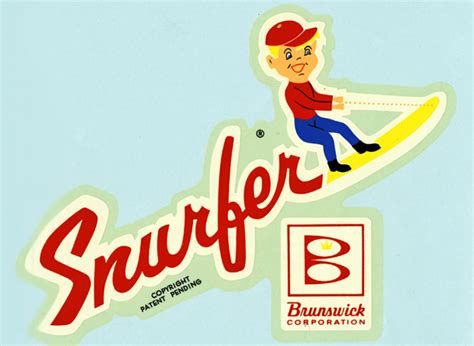
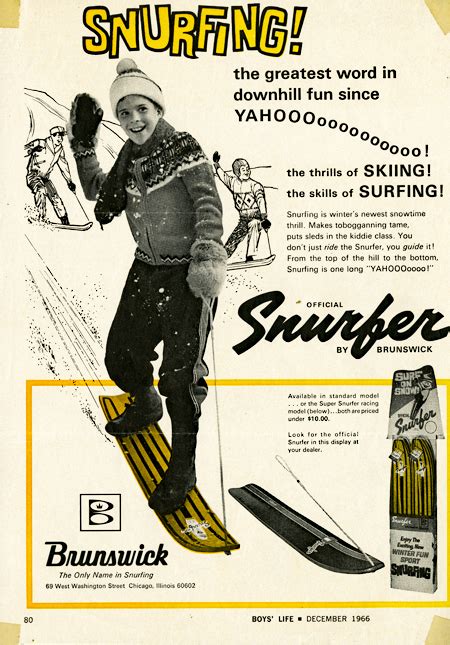
Brunswick advertisement for the Snurfer that appeared in Boy’s Life, December 1966
At first, the company’s strategy seemed to pay off. By 1970, approximately one million Snurfers had been sold in the US, Canada, and Europe. But when sales thereafter began to decline, Brunswick did not revamp its marketing and distribution strategy.
Production soon resumed under the JEM Corporation and it would seem the company more fully embraced Poppen’s dual vision of the Snurfer, promoting the snow surfer not only for recreational use but also for competition. JEM revamped their product literature in acknowledgement that the Snurfer was being used not only by kids like me as a novelty toy, but also by thrill-seeking teens and those in their twenties who raced the snow surfer in downhill and slalom competitions.
In 1978, JEM applied for a patent for improved non-skid foot treads and an adjustable length lanyard, features to enhance competitive performance. At the annual snurfing competition held near where Poppen lived in Michigan, the company awarded $1,000 in prize money and planned to promote snurfing as a sport through an expansion of local and regional competitions and the establishment of a National Snurfers Association.
Read also: Is the Gnu Antigravity Snowboard Worth It?
However, JEM did not follow through with these plans. Moreover, the general public continued to view the Snurfer as a toy.
While things were not looking good for the future of snow surfing, there were athletes who had been inspired by Poppen’s invention. Paul Graves was one such innovator. Graves, a self-described “crazy kid who could do some interesting things” with the Snurfer, was sponsored by Brunswick and later JEM, giving demonstrations and promoting snurfing.
At the 1979 competition, Graves showcased his unconventional snurfing techniques, performing surface 360s while racng downhill and ending his run with a front flip dismount. Rather than rethink snurfing technique, Jake Burton Carpenter considered the Snurfer itself.
Sherman Poppen, shown here with his Snurfer prototypes
The Rise of Modern Snowboarding
But the real breakthrough happened when Dimitrije Milovich, a Cornell University dropout, founded Winterstick, the first modern snowboard company, in 1972. An east coast surfer named Dimitrije Milovich began developing snowboards based on the model of the newest evolution of surboards, the short-board. His design included steel edges, laminated fiberglass, gravel on the board for traction and nylon straps. His company was called "Winterstick,” considered to be the first snowboarding company.
Read also: Battle Bindings: Performance and Value
Snowboarding went mainstream soon thereafter amid a fierce rivalry between Jake Burton Carpenter and Tom Sims. Sims, a New Jersey-raised professional skateboarder more interested in aerial stunts than in speed, founded SIMS Snowboarding in 1976. Also during this same period, in 1977, Jake Burton Carpenter, a Vermont native who had enjoyed snurfing since the age of 14, impressed the crowd at a Michigan snurfing competition with bindings he had designed to secure his feet to the board. That same year, he founded Burton Snowboards in Londonderry, Vermont.
In 1977 he started the Burton Snowboards company in Vermont to make a product that would perform better than Poppen’s. The Backhill, the first he produced, was the result of prodigious experimentation and 100 prototypes. It was wider than the Snurfer and had heel straps to secure both feet. Thus began the influx of better designed boards that came quickly to supplant the Snurfer in competition.
Carpenter later commented, “I always felt there was an opportunity for it [the Snurfer] to be better marketed, for serious technology to be applied to it, so Snurfing could become a legitimate sport instead of a cheap toy. I knew there was an opportunity there.
As Poppen began to lose control of the technology he had first brought to market, he also lost his influence on the burgeoning sport of snow surfing. In addition to improving snow surfing technique and equipment, Graves and Carpenter evolved the sport by organizing and promoting competition.
While JEM continued to sponsor the National Snurfing Championship in Michigan, an event with primarily regional appeal, in 1982 Paul Graves and other competitive snurfers organized the National Snow Surfing Championships at Suicide Six ski resort in Vermont, with Burton Snowboards as a major sponsor. The more competitive racers attained speeds in excess of fifty miles per hour.
Carpenter took over from Graves organizing the major northeast snow surfing competition. Since Poppen enforced his trademark of “Snurfer” and variations of the word, Carpenter renamed the event the US Open Snowboarding Championship.
With the rise of rival board manufacturers, JEM discontinued production of the Snurfer in 1983. Graves, whose board of choice was the Snurfer, worked with Poppen to find another interested manufacturer.
Meanwhile, Carpenter actively worked to promote his snowboard manufacturing business and snowboarding not just as a sport but a lifestyle choice. In a coup, Carpenter allied with Stratton Mountain in 1985. Not only did the ski resort agree to allow snowboarding but also hosted the US Open Snowboarding Championship.
That same year, the National Snurfing Championship in Michigan was cancelled due to a lack of competitors. No future snurfing competitions were held.
Through the dogged advocacy of Carpenter and others, by 1990 most ski resorts in the US allowed snowboarders on the slopes. Terrain parks led to an increasing interest in technique. During the 1980s and 1990s, snowboarding went from a fledgling to a mainstream sport, making its debut at the Olympics in 1998.
In 1980, Aleksey Ostatnigrosh and Alexei Melnikov - two members of the only Snurfer club in the Soviet Union started changing the Snurfer design to allow jumping and to improve control on hard packed snow. Apparently unaware of developments in the Snurfer/snowboard world, they attached a bungee cord to the Snurfer tail which the rider could grab before jumping. Later, in 1982, they attached a foot binding to the Snurfer. The binding was only for the back foot, and had a release capability. In 1985, after several iterations of the Snurfer binding system, Aleksey Ostatnigrosh made the first Russian snowboard.
The first fibreglass snowboard with binding was made by Santa Cruz inventor Gary Tracy of GARSKI with the assistance of Bill Bourke in their factory in Santa Cruz in 1982. One of these original boards is still on display at Santa Cruz Skateboards in Capitola, CA.
In 1981, a couple of Winterstick team riders went to France at the invitation of Alain Gaimard, marketing director at Les Arcs. After seeing an early film of this event, French skiers/surfers Augustin Coppey, Olivier Lehaneur, Olivier Roland and Antoine Yarmola made their first successful attempts during the winter of 1983 in France (Val Thorens), using primitive, home-made clones of the Winterstick.
In 1985, James Bond popularized snowboarding in the movie A View to a Kill. The actual snowboard used for the stunt was a Sims snowboard ridden by founder Tom Sims.

James Bond popularized snowboarding in the movie A View to a Kill.
By the mid-80s, snowboarding had considerable commercial success with multiple competing companies. Burton had established a European Division by the mid-1980s. In Canada in 1983, a teenager named David Kemper began building his first snowboards in his garage in Ontario, Canada.
Acceptance and Growth
As snowboarding grew in popularity, so did its reputation as a pastime for screwballs-a counterculture to skiing’s establishment vibe. In the 1980s, most North American ski resorts banned snowboarding, citing insurance liability and the rudeness of too many riders. The sport was more accepted in Europe, particularly in France.
“Quite a lot of [snowboarders] are uncooperative,” one ski patrol worker lamented to the Canadian Broadcasting Corporation in 1985. “They’re smart alecks.
By the 1990s, though, almost every resort in North America allowed riding. The advent of the Pipe Dragon, a machine to cut halfpipes through snow, enabled new aerial stunts, and when snowboarding debuted at the 1998 Olympics, the halfpipe was the sport’s biggest draw.
The International Ski Federation (FIS) recognized snowboarding as a discipline in 1994. Snowboarding made its Olympic debut at the 1998 Nagano Winter Games. Men's and Women's halfpipe and giant slalom competitions were an instant success due to their overwhelming popularity with spectators.
In February 1968, Poppen organized the first snurfing competition at a Michigan ski resort that attracted enthusiasts from all over the country. The "snowboards" were made of wooden planks that were flexible and had water ski foot traps.
The first competitions to offer prize money were the National Snurfing Championship, held at Muskegon State Park in Muskegon, Michigan. In 1979, Jake Burton Carpenter came from Vermont to compete with a snowboard of his own design.
There were protests about Jake entering with a non-snurfer board. Paul Graves, and others, advocated that Jake be allowed to race. A "modified" "Open" division was created and won by Jake as the sole entrant. That race was considered the first competition for snowboarding and is the start of what became competitive snowboarding.
In 1982, the first USA National Snowboard race was held near Woodstock, Vermont, at Suicide Six. In 1983, the first World Championship halfpipe competition was held at Soda Springs, California.
Today, high-profile snowboarding events like the Winter X Games, Air & Style, US Open, Olympic Games and other events are broadcast worldwide.
Initially, ski areas adopted the sport at a much slower pace than the winter sports public. Early snowboards were banned from the slopes by park officials. For several years snowboarders would have to take a small skills assessment prior to being allowed to ride the chairlifts.
As equipment and skills improved, gradually snowboarding became more accepted. In 1990, most major ski areas had separate slopes for snowboarders. There were 8.2 million snowboarders in the US and Canada for the 2009-2010 season.
Snowboard Styles
Since snowboarding's inception as an established winter sport, it has developed various styles, each with its own specialized equipment and technique. The most common styles today are: freeride, freestyle, and freecarve/race. These styles are used for both recreational and professional snowboarding.
"Jibbing" is the term for technical riding on non-standard surfaces. As a noun: a jib includes metal rails, boxes, benches, concrete ledges, walls, vehicles, rocks and logs. As a verb: to jib is referring to the action of jumping, sliding, or riding on top of objects other than snow.
Freeriding is a style without a set of governing rules or set course, typically on natural, un-groomed terrain. Freestyle snowboarding is any riding that includes performing tricks.
Alpine snowboarding is a discipline within the sport of snowboarding. It is practiced on groomed pistes. Sometimes called freecarving or hardbooting (due to the equipment used), this discipline usually takes place on hard packed snow or groomed runs and focuses on carving linked turns, much like surfing or longboarding.
Alpine Snowboard equipment includes a ski-like hardshell boot and plate binding system with a true directional snowboard that is stiffer and narrower to manage linking turns with greater forces and speed.
A skilled alpine snowboarder can link numerous turns into a run placing their body very close to the ground each turn, similar to a motocross turn or waterski carve.
Competitors perform tricks while descending a course, moving around, over, across, up, or down terrain features. The course is full of obstacles including boxes, rails, jumps, jibs, or anything else the board or rider can slide across.
The half-pipe is a semi-circular ditch dug into the mountain or purpose-built ramp made up of snow, with walls between 8 and 23 feet (7.0 m). Snowboard cross, also known as "boardercross", "boarder X", or "snowboard X", and commonly abbreviated as "SBX", or just "BX", is a snowboarding discipline consisting of several (typically 4 to 6) riders racing head-to-head down a course with jumps, berms and other obstacles constructed out of snow.
Snowboard racing riders must complete a downhill course constructed of a series of turning color indicators (gates) placed in the snow at prescribed distances apart.