Downhill is a 2020 American black comedy-drama film directed by Nat Faxon and Jim Rash, who also co-wrote the script with Jesse Armstrong.
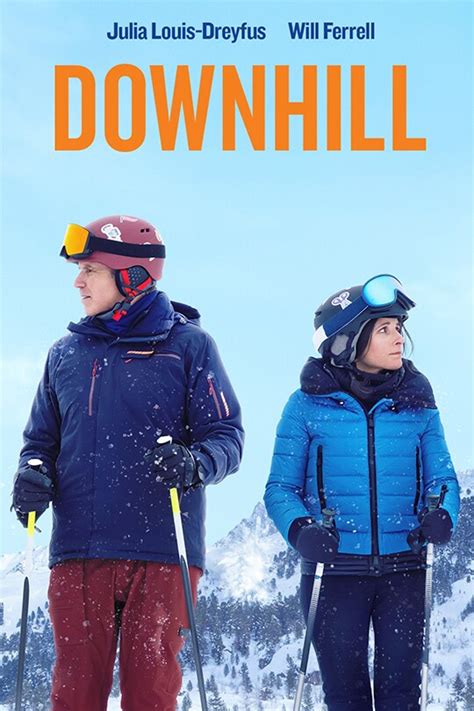
When I was given the assignment to review Downhill, an adaptation of the 2014 comedy Force Majeure, I felt like I had something to prove. I grew up in Florida with few personal reference points for winter outdoor activities, so I watched snow-sport movies (mostly Johnny Tsunami) with a very uncritical eye. Now that I live in out west and ski often, I hoped I’d finally be able to size up the moves in this ski movie. Alas, I left Downhill with even more questions than I went in with-it seems that knowing anything about skiing makes seeing Hollywood’s version of the sport a truly distressing experience.
Not that this project didn’t come together with some inspiration, starting with the first time that Will Ferrell and Julia Louis-Dreyfus have worked together. And then there’s the writing/directing duo-Jim Rash and Nat Faxon, who previously made a family summer comedy to remember with “The Way Way Back,” working with “Succession” writer Jesse Armstrong.
Downhill is about a family ski vacation in the Alps; it stars Will Ferrell and Julia Louis-Dreyfus as Pete and Billie, the husband and wife. On their second day, as they sit on a deck for lunch, a controlled avalanche sends a cloud of powder barreling down the mountain and towards the restaurant. Their trip quickly unravels after Pete runs away during what turns out to be a controlled avalanche, abandoning his children and Billie in what he believes is an actual life-or-death moment. As the cloud settles Pete returns to find his family unharmed but terribly shaken by the experience. He promptly orders lunch as if nothing happened, but his actions open a wound that slowly festers for the duration of the movie.
The avalanche incident hangs over Billie and Pete for the rest of the trip, and tension mounts as Pete shows more of his cowardly, selfish true self. When Pete invites visiting work friend Zach (Zach Woods) and his wife Rosie (Zoe Chao) to come over for drinks (without giving Billie proper notice), Pete continues to deny the event, and tries to use ski boots as proof that he didn’t run away.
Read also: "Miracle" Movie Quotes
Critical Reception
Downhill has all the makings of a flop: it only made $5.1 million on its opening weekend (Sonic the Hedgehog made $70 million that same weekend), and critics have already complained about the one-dimensional characters and incoherent plot points.
I wasn’t too sure about an English language remake of the superb 2014 Swedish domestic drama “Force Majeure”. I was even less convinced after seeing the trailer for “Downhill”, an Americanized version starring Will Ferrell and Julia Louis-Dreyfus. I loved the original (from director/co-writer Ruben Östlund) for its subtle dark wit and dramatic gut punch.
Helmsmen Nat Faxon and Jim Rash co-direct and co-write (with Jesse Armstrong) “Downhill”, a follow-up to their terrific 2013 gem “The Way, Way Back”. Prior to that, the pair penned the Oscar-winning script for Alexander Payne’s “The Descendants”. Here their mix of comedy and drama is far more jagged. It’s in the dramatic moments that we see shades of what made “Force Majeure” effective.
Östlund’s movie was essentially a existential tragedy about a seemingly sturdy marriage built on an emotional fault line. “Downhill” latches onto that idea but seems completely unsure of how far to go with it. Does it embrace the understated psychological bite of the original film or go with the more palatable studio approach? Faxon and Rash try to have it both ways and the results are frustratingly uneven. There are scenes where the tension between characters (either spoken or unspoken) is palpable and the emotions are raw and authentic. But then we’ll get a weird attempt at humor that lands with a tonal thud.
Casting and Performances
Much of it has to do with the casting. Louis-Dreyfus carries the movie and frankly we don’t get enough of her on the big screen. Her performance is always at the right temperature and she drives each the film’s most potent scenes. Most importantly she shrewdly manages the aforementioned balance between drama and humor.
A badly miscast Will Ferrell doesn’t fare as well and his years of playing halfwits actually hurts his character. Ferrell is hardly subtle when it comes to comedy, a truth that was etched in my subconscious from the start. So even when he’s playing it serious I found myself waiting for a visual or verbal punchline. He’s just not that convincing. I can see people going into “Downhill” expecting a straight comedy strictly because of the two leads. These viewers are sure to leave disappointed. The movie’s most striking scenes are its most serious and they are driven by a fantastic Julia Louis-Dreyfus (please do more movies). She literally keeps the picture afloat.
Dr. Will Ferrell acts like Will Ferrell, only less so; he’s not particularly funny, and his glum one-note portrayal goes well past the point of tedium. Those expecting a typical Will Ferrell comedy might want to recalibrate their expectations accordingly.
Rash and Faxon try to make these scenes from a marriage pop with broadly drawn side characters, and depending on how you wish this movie would play out, it’s going to be too much or not enough. The trend seems to be horny Europeans, starting with Miranda Otto and her comically-forward hotel employee Charlotte; later, Louis-Dreyfus has a lesson with a comically-forward ski instructor named Guglielmo (Giulo Berruti).
A major void in the comedy and the drama of the story is in how “Downhill” uses its cast. For Ferrell, this is where a movie that took more advantage of his talents could have excelled, and instead it casts him so that you always see his man-child characters of the past. We don’t get the sense that we’re watching one man’s maturity set-back-even with a detail about his father passing away eight months ago-so much as that he’s always been like this, and needs to learn one way or another that you can’t coast through the family roles you’ve signed up for. And the comedy goes even further in highlighting his goofy quality, as his few overtly funny scenes prefer to have him acting like the most immature of the three males of the family, or falling over at a bar drunk like it’s Frank the Tank from “Old School” acting out against domestication.
Thankfully, Louis-Dreyfus is given richer material, as she goes from visibly disturbed to quietly disgusted. She experiences her own understanding that she deserves better than Pete’s inaction, and has some cutting bits of dialogue whenever Pete tries to deflect or deny what happened. And in one of the story’s mildly amusing scenes, she asserts her autonomy during her time with tempting ski instructor Gugliemo. Her actions are surprising, and also make her character more interesting than her sourpuss husband.
“Downhill” watches Billie and Pete grow farther and farther apart, with Pete failing to admit a shame that Ferrell sometimes hints at with a boyish frown. Rash, Faxon, and Armstrong eventually bring their couple to a grand finale of sorts, and it’s not only stunningly abrupt but an undermining of its all-star talent’s emotional potential.
Skiing Inconsistencies
Am I to believe that Ferrell and Louis-Dreyfus have excellent form and can rip straight down bumps without ever turning their torsos? Or am I to believe that they are both so bad that they must wrench their entire bodies around to make a simple turn on the world’s biggest, emptiest blue runs? Downhill would have the audience hold both of these truths at once.
I’m certainly not one to judge-actors can’t fake everything, and my own form often resembles the latter. But is there any more effective way to keep audiences distracted from the dialogue than keeping our minds racing about which scenes involve body doubles?
I can’t fully explain how these particular skiing inconsistencies made their way into the film. (Nor can I explain how someone thought it was a good idea to have a character imply, in one scene, that your ski instructor is allowed to hit on you aggressively, without encouragement, as long as he’s a hot European man.) Surely someone on the set of Downhill was an experienced skier. Maybe its filmmakers just figured audiences don’t really care what it looks like because we’re all here for the funny famous actors anyway.
But I’m also going to chalk it up to the fact that filming in the Alps probably requires a very tight schedule or you’ll blow your budget. That makes my next observation additionally confusing: I’m convinced that some of the sweeping scenes of Pete and Billie shredding were computer generated.
That said, the filmmakers don’t get everything wrong. They seem to get the gear situation, at least. This is a well-to-do family that goes on regular ski vacations at resorts and, accordingly, everyone wears very nice, new-looking puffies (Ferrell conspicuously flashes a Salomon logo throughout most of the movie) and slightly tight snow pants, which seems accurate enough.
Should You Watch It?
Should you see this movie? That depends. If you’re looking for something light and you like Julia Louis-Dreyfus, you will probably have a good time. If you saw and loved Force Majeure, as a lot of people did, you may find yourself suffering from “the original is better” syndrome, and you will probably not have a very good time.
You may also have issues with Downhill if, like me, you are judgmental of fictional characters’ bad decisions (I’d never Force Majeure my significant other!) or if you still believe one’s significant other should communicate and acknowledge wrongs, especially if they abandon you in the middle of an apparent avalanche.
Details
All rights reserved.
- Original Audio: English, English (United Kingdom)
- Audio: English (United States) (AD, Dolby 5.1, AAC), French (Canada) (AAC), Spanish (Latin America) (AAC)
- Subtitles: English (United States) (CC, SDH), French (Canada), Spanish (Latin America)
- Accessibility: Closed captions (CC) refer to subtitles in the available language with the addition of relevant non-dialogue information. Audio descriptions (AD) refer to a narration track describing what is happening on screen, to provide context for those who are blind or have low vision.