Winter can be a drag for some, but for those who own a snowmobile, it's an opportunity for thrilling adventures. Over the past decade, snowmobiles have evolved into high-performance machines capable of conquering any terrain.
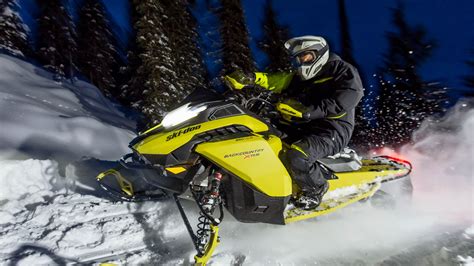
Yamaha has been a significant player in this evolution, offering a range of four-stroke snowmobiles that combine power, performance, and innovation. While Yamaha may be exiting the snowmobile market in 2025, they are set to release one final lineup of machines in North America. Let's take a closer look at some of Yamaha's offerings.
A Look Back at Yamaha's Four-Stroke Innovation
Back in 2003, the Yamaha RX-1 was named the Snow Goer Snowmobile Of The Year because of its game-changing innovation: it was the first legitimate four-stroke sled. Since then, Yamaha has continued to refine its four-stroke technology, with each new introduction claiming to be better than the last.
FX Nytro: Addressing Handling Concerns
The FX Nytro debuted with an engine that puts out an honest 135 hp at 8200 rpm. While the initial models had shortcomings with front-end handling, Yamaha addressed these concerns in later production models. The XTX package stood out with its superior suspension.
Key handling revisions included changes to the spindle, increasing trail for more front-end stability. The caster angle was also increased from 22 to 25.8 degrees. While these changes improved predictability, they also slightly reduced the quickness of steering engagement.
Read also: High-Speed Yamaha
RS Venture GT: Deluxe Touring Model
The new RS Venture GT deluxe touring model started with the engine: the Genesis 120 EFI. Yamaha claims that even though the engine is calibrated for improved power and fuel economy, engineers squeezed another 6 peak horsepower from the plant. The peak comes earlier and is less linear than the carbureted engine, but the peak comes at the midrange where it will be most appreciated.
Although there is good space in the cockpit for both driver and passenger, on sharp, full-lock turns, the elbows of the driver were obstructed by the knees of passengers. While a touring sled is not expected to rail through corners at reckless speeds, based on our past tests of other “GT” machines that were outfitted with the clicker shocks, we expected the Venture to corner flatter than it did.
The very last Yamaha Sidewinder SRX | No.998 Up for Auction
Yamaha's 2025 Snowmobile Lineup
Yamaha's journey into the snowmobile world began with the testing of its prototype design, the YX15, in 1965. It had plenty of flaws, but after redesigning the YX, Yamaha released its first snowmobile, the SL350, in 1968.
Here's a glimpse into Yamaha's final lineup of snowmobiles for North America:
Youth Models
- SRX120R: Designed for the youth market, this budget-friendly vehicle features a slide-rail torsion-spring rear suspension and double-wishbone coil-over shocks. Safety features include a high-visibility whip flag, a kill switch, and a removable key.
- SnoScoot ES: A step up from the SRX120R, the SnoScoot is an electric-start four-stroke with a 192 cc engine, CVT transmission, and Hayes Hydraulic Disc brake.
Trail Models
- SX Venom: A gateway to the world of snowmobiling, the Venom model is designed to hit the trails. It has a Camo Hacksaw 121-inch track and dual-shock rear suspension with 10.7 inches of play.
Utilitarian Models
- Transporter Line: These full-size snowmobiles come in three flavors and feature fuel-injection engines with electronic oil injection.
- Transporter 800: With its twin-cylinder 794 cc, two-stroke engine, it shares the same mission as the Lites but packs it in a more powerful package.
Mountain Models
- Mountain Max Line: Designed to conquer any mountain, these models feature a Yamaha Mountain ski setup, SRV-M Front suspension, and a powerful 794 cc, two-stroke, two-cylinder engine.
Performance Models
- SR Viper: Featuring a three-cylinder, 1,049 cc Genesis engine with four valves per cylinder and closed-loop fuel injection, this model is geared toward performance.
Sidewinder Series
Yamaha offers many selections in its top-of-the-line Sidewinder series, ranging in price from $18,099 to $21,499. All of the Sidewinders use a 998 cc Genesis engine with turbochargers. Here's a breakdown of some of the models:
Read also: Snowmobile Helmet Types
- L-TX SE: Employs the same state-of-the-art, 137-inch track as the Viper, plus a more advanced rear suspension and array of features designed to handle harsh bumps and cross-country terrain.
- S-TX GT EPS: A touring snowmobile.
- M-TX LE 153: A mountain-oriented machine, with a 3-inch lugs on a 153-inch track.
- X-TX SE and X-TX LE EPS: Crossovers that employ 146-inch rear tracks.
- Sidewinder SRX LE EPS: Incorporates a Fox Zero Intelligent Quick Shift shock system, with adjustable suspension and compression damping.
Yamaha Sidewinder S-TX GT 2020: A Detailed Look
The 2020 Yamaha Sidewinder S-TX GT is a new model at Yamaha for 2020. It’s actually an evolution of the Sidewinder S-TX DX 146 that was tested in 2018. Yamaha designed the Sidewinder S-TX GT 2020 for long, comfortable rides for two passengers.
Here are some of its key features:
- 16.3-litre auxiliary fuel tank located in the rear trunk and connected to the main tank, which gives an impressive total capacity of 50 liters.
- Push-button starter directly on the handlebar.
- Standard contact breaker cord for added safety.
- Goggle case located between the handlebars and the dashboard.
- High windshield that protects from the wind without affecting visibility.
- Heated seats and passenger handles.
- Heated visor outlets at the front and rear.
- LED headlights with accent lighting.
The SRV chassis has been tried and tested over the last few years and is well suited for long rides. It’s an extremely comfortable snowmobile for trail riding, and we don’t feel tired driving it, even after long days. The driving position is amazingly comfortable, and the seat height is ideal.
With more than 200 HP under the hood, we can talk about high performance. This 998cc turbocharged, fuel-injected, three-cylinder Genesis four-stroke engine was introduced in 2017 by Yamaha for its Sidewinder range. It’s still the most powerful production engine on the market today.
The Yamaha Sidewinder S-TX GT 2020 offers the possibility of transforming into a Solo snowmobile in a few seconds if the situation arises. By removing the heated passenger seat, the preload blades and even the rigid suitcases, you get a high-performance Solo snowmobile.
Read also: Comprehensive Review: Yamaha FX Limited SVHO
In short, this snowmobile is really designed for those who love long rides in pairs or solo. It really is the best of both worlds, without compromise. It’s comfortable, high performance and versatile.
Performance on the Trails
Riding a snowmobile is far more physical than newcomers expect. You don't just sit back and steer-you use your body to bully the rear track around as if you're on a big, stubborn motorcycle. The entire trail system is essentially one giant race circuit, linked together like a vast neurological network with two-way traffic. With a few exceptions, you more or less pick your own speed limit out here.
The performance of these things is plenty intoxicating. Their weight-to-power ratios are better than any contender's at this year's Lightning Lap. The average zero-to-60 time for our four machines was just 3.6 seconds, and the Yamaha Sidewinder clicked off a 12.2-second quarter-mile.
Trails throughout the state are managed by 68 grooming clubs whose members spend their nights out on them, driving tractors dragging specially designed sleds that smooth and condition the snowpack. Groomer operators are mostly volunteers, and their shifts last anywhere from eight to 14 hours. Most clubs groom six days a week.
There are also kamikaze deer, which use these paths to avoid being overworked in the deep snow. The deer look soft, but they're heavy. According to the Michigan Department of Natural Resources, 15 fatalities occurred on snowmobiles in the winter of 2017-2018 in our state, many of which involved solid-object impacts. And also alcohol.
But there is an upside to all this bartending, and it's that these establishments not only provide a place to bench-race and graze on deep-fried salad, they also serve as snowmobilers' quasi-cars-and-coffee meetings, with parking lots and snowbanks lined with machines from various years and manufacturers. And these riders know their stuff.
Final Thoughts
Yamaha's four-stroke snowmobiles have left a lasting impact on the snowmobiling world. From the innovative RX-1 to the powerful Sidewinder series, Yamaha has consistently pushed the boundaries of performance and technology. While the company may be exiting the market in 2025, its legacy will continue to be felt for years to come.
tags: #yamaha #four #stroke #snowmobiles