The Yamaha Exciter burst onto the scene during the evolution from snowmobiles as family utility machines that could play a little bit to pricey personal recreation devices. The 1992-93 snow season marked the 25th year for Yamaha snowmobiles.
Initially offered with a choice of 340 or 440 engines, both of which were stronger than average for their displacement, the Exciter was also well very equipped for the day. And the Exciter was also one of the first snowmobiles to be fitted with a shock absorber charged with compressed nitrogen over oil instead of the usual air over oil, resulting in better rear suspension performance.
Snow Goer evaluators were really pleased with the new model, saying that “all we had to write about (previously) was Yamaha’s durability and consistently strong engine.
According to an owner’s survey published the following season in Snow Sports magazine, first year Exciter buyers were generally happy with their new ride, praising its handling and stability, overall performance and oil injection. But on the other hand, many did not like the fuel economy or the grabby clutching that quickly wore belts and required frequent lubrication.
As one owner put it, “It has bugs.
Read also: High-Speed Yamaha
The Exciter really hit stride with the 1977 model. Revised porting provided a modest power increase. But the real improvement resulted from another race track technology transfer, the drive clutch from the SRX suitably retuned for the fanner’s power band.
The Exciter was continually improved in typical Yamaha fashion.
The 1978 model brought a new Keihin carb that improved fuel economy, new bearing materials in the drive clutch for better reliability, a more tapered tunnel, new seat and footrests, an 8-gallon gas tank and relocated larger instruments for better readability. And the 1979 version changed hood color to black with red trim. It was also the last year for the 340 version.
By the end of its initial six-year run, the original Exciter had been a huge asset for Yamaha in weathering the final stages of the great manufacturer shake-out.
My buddy Tony “Yammiegod” Bellucco sums up the Exciter as “One of the best Yammies of all time.
Read also: Comprehensive Yamaha Review
Engine: 433cc Yamaha reed valve 7-port “Torque-Induction” axial fan-cooled twin with one Keihin PW42-38 slide valve carb.
When I first started attending Minnesota’s Hay Days Grass Drags in the mid-nineties I was on the lookout for a Yamaha 440 Exciter.
I found several contenders, but their aluminum belly pans and bumpers were either twisted, bent, stretched or all three.
A few years back I found a 440 Exciter for sale in the vintage tent at Hay Days and it looked to be in above average condition. Unfortunately, I had no room in the trailer to bring it home and not enough cash with me so I had to walk away from that deal.
That winter I went to the Waconia Ride-In event in Waconia, Minnesota and there was that very same Exciter I walked away from at Hay Days. A few moments later I was the proud owner of a 1977 440 Exciter.
Read also: Snowmobile Helmet Types
As it turned out, the sled needed a piston and rings, a carb rebuild and a carb intake boot. It took three years, but the folks at Hudon’s Salvage in Barneveld, New York, tracked down an original OEM intake boot for that hateful Keihin carb. I put more time into this project than I intended, but it was a good runner and I may have put 150 miles on the sled.
The 1993 Exciter SX derives the direct benefits.
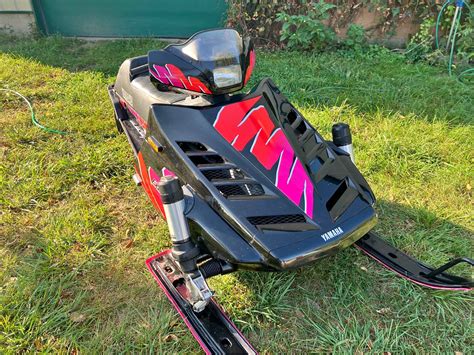
Based on our pre-season test riding, we feel that the SX's TSS suspension is the equal of any existing suspension in cornering and superior in straight ahead running. Every year the TSS has been steadily improved. Always good-to-excellent in straight line running, the newest TSS version corners flat, transfers weight exceptionally well and can match the best trailing arm suspensions in the business.
Like Polaris with the Indy chassis and IFS, Yamaha has steadily refined its suspensions. And, as with Polaris, if you look at the basic concept of TSS, you'd say it's "old" technology. But compare the SX version with the SR-V version and you'll be amazed at how much better the same concept is 13 years later.
Going into the 1992-93 season, Yamaha has lost the momentum it had a year ago when everyone was talking about the new Vmax-4. Yamaha certainly gained immediate attention from the 743cc quad engined sled.
The Vmax-4 returns in '93 but with substantially less press than a year ago. Too bad, because the latest version is a better machine. The clutching, which needed refinements during the season, is vastly improved. The liquid-cooled 743cc four cylinder engine is as smoothly powerful as ever.
Expect more performance as the quad has new port timing and a higher compression ratio for 1993. The front suspension is more serviceable with the adjustments moved to the top of the strut instead of at the bottom. With 20-plus adjustment positions for preload, the TSS can be truly fine-tuned. So can the rear suspension which gets new progressive spring rates and revised damping in the nitrogen charged shocks.
While the Vmax-4 may no longer be the top premium performer, it remains as one of the best overall premium performance sleds you can buy. It is extremely "trail-able" and makes an excellent high performance sports touring machine.
It comes with standard thumb and hand warmers, halogen headlight, aluminum skis with plastic bottoms, a wide 39 inch ski stance, easy-pull flat slide carbs and the uniqueness that only a four cylinder engine offers.
At $8,749, the Vmax-4 will command a premium price for its premium performance features. You can save nearly $3,000 and get one of the biggest performance surprises of the season in the Exciter SX. For its $6,099 base price, the SX gives you a Vmax-4 type front suspension with 38.6 inch ski stance, a pair of "TM" series easy pull flatslide carbs; plastic-bottomed skis; full block Vmax-4 type track with aggressive pattern; and a projected 10 percent power increase over the standard 569cc Exciter liquid-cooled twin.
The power increase puts the SX engine in the low 90 horsepower range. Getting it there required raising the compression ratio from 6.5:1 to 6.9:1, widening the intake ports, going to flat slide TM38 carbs; and shortening the "Y" of the two-into-one exhaust by 20 millimeters.
The other new Exciter model for 1993 is the extended track Exciter ST which comes with a 136 inch full block track. It joins the standard Exciter II and electric start outfitted Exciter II LE in the '93 model line.
All three share the 569cc Yamaha twin, use round slide VM38 carbs, have a wide belt variable ratio drive system, and a 36.2 inch side ski stance.
All Exciters have an eight gallon fuel capacity, Yamalube oil injection, pod-mounted instrumentation and carbide ski runners.
Yamaha's all time best selling snowmobile, the Phazer series, enters 1993 with minor updates. Introduced for the 1984 snow season, the Phazer is recognized as a sporty, lightweight sled.
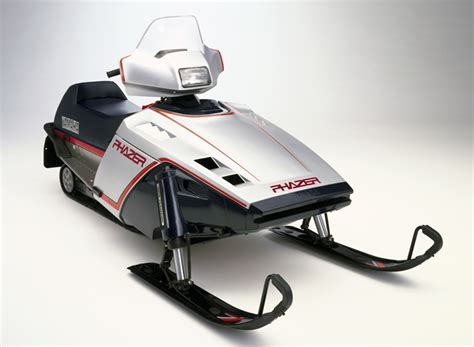
Of particular note on the Phazer is way in which the headlight is directly connected to the handlebars so that the headlight follows the direction of a turn. This feature was certainly new among Yamaha models when it was introduced in 1984, and Yamaha claims that it and other features 'began a new era in snowmobiling'.
The Phazer was always known for its sharp handling, free-revving 485cc fan-cooled engine, solid reliability (most notably on Phazer II), light weight, and most importantly, value.
Snowmobiles under the original Phazer name appeared until 1989; new models such as the Phazer II, Phazer Deluxe, Phazer SS etc., were sold until 1998, when it was revamped to the more traditional looking snowmobile and was known as the Phazer 500 (1999-2001). Yamaha released a bold new snowmobile under the Phazer name-plate for the 2007 model year.
The snowmobile featured a radical new design which is inspired from the YZ250F motocross bike. The new Phazer is powered by a new 80 hp 499cc fuel-injected liquid-cooled four-stroke twin which makes its peak power at 11,000RPM. The engine is based on Yamaha's highly successful and dependable YZ250F dirt bike engine.
It comes with the wide belt 'Xtra Ratio clutch system, a 36.2 inch ski stance, TSS front suspension, eight gallon fuel tank, and fairing mounted instrumentation. In addition to the base Phazer II and more deluxe, electric start-equipped Phazer II LE, there is an extended track version, the Phazer II ST. The ST has a 136 inch track while the shorter tracked versions rely on a 121 inch track.
Some of the lightest sleds in the "trail sports" category, the Phazer models range in weight from the base Phazer's 403 pounds to the 425 pounds of the stretch track Phazer II ST.
Power is supplied by a 485cc axial fan-cooled twin that uses a pair of Mikuni butterfly carbs for an extremely light throttle response.
Measuring 72mm by 59.6mm for bore and stroke, the Yamaha twin has been a stalwart performer over the years.
A couple of our favorite sleds are based on the Phazer II, but have totally different body work. The single passenger Venture GT and its two-passenger sibling, Venture XL, use essentially the same engine and clutch system as the Phazers. The key difference is the addition of reverse gear. Yamaha was the first to fit its reverse gear sleds with a warning "beeper."
This Yamaha pair is designed for touring and outfitted with all the bells and whistles. They come standard with TSS, Pro-Action link rear suspension, electric start, hand and thumb warmers, tall wind-deflecting windshield, and, on the two-up XL, king-queen seating. The XL version was the first to offer standard handwarmers for the rear passenger. Now Ski-Doo's new Grand Touring makes them standard fare as well. The Ventures have the same 8.2 gallon fuel capacity as the Phazers.
The 1993 Yamaha Ovation LE is a solid package for those wanting an inexpensive trail touring sled.
Despite the lethargy-invoking nomenclature, the Ovation is a solid value as you start with one of Yamaha's most proven fan-cooled twins. The 337cc power package is nearly bullet-proof, will propel this machine to trail speeds quickly, and will conservatively milk fuel from the Ovation's 8.1 gallon fuel tank.
Standard features include TSS, oil injection, adjustable handlebars and speedometer. This semi-deluxe trail sled offers convenient electric start, thumb and handlebar warmers, high windshield, built-in backrest and storage compartment.
Available in Yamaha Black, the '93 Ovation LE retails for $3,549.
With the new Bravo LT, Yamaha gives riders a value-packed, feature-loaded long-track. The new Bravo LT features a single cylinder 246cc fan-cooled engine, sure-firing CD ignition system and autolube oil injection. But, it also features an extra-long 136 inch track for extra traction and flotation in deep snow. The added length is large enough to accommodate a built-in cargo rack on the back.
A tow hitch designed to haul a tow sled is standard as are a speedometer, adjustable handlebars, parking brake, high-profile windshield and a large cushion seat.
Joining the new Bravo LT is the updated Bravo, Yamaha's original beginner's sled. For '93 there is a new rear bumper for improved reliability and a taller windshield for protection from wind and snow. Powered by a 246cc Yamaha single, the Bravo comes in Yamaha Black and has a retail price of $2,449.
In addition to the long-tracked Bravo, Yamaha offers a couple of serious work sleds that can make the transition to sports touring if necessary. The more serious work sled is the VK540, a sled built to take on heavy-duty workloads and tough conditions. The new VK540 comes with TSS, a new wide-belt clutch system, standard electric starting, and a new 156 inch long by 20 inch wide full-block pattern track.
Power comes from a 535cc fan-cooled engine and gets to the track via Yamaha's two-speed plus reverse gear transmission. For durability, there is a tough new belly pan and a newly designed front bumper. For riding - on or off trails - the VK540 includes a king-queen seat with backrest, a spacious rear luggage rack and large under-seat storage trunk. a tachometer, trip meter, adjustable handlebars, reverse-gear beeper and electric thumb and handlebar warmers are standard fare. If your workload doesn't require the toughness of the VK, you can opt for the Enticer II LT, which was introduced last year.
It's designed as a dual-purpose sled that works hard and plays hard. Yamaha's exclusive TSS and a wide 36 inch ski stance make this sled a consistent handler on trails and in deep snow. Its 408cc fan-cooled engine gives the Enticer II LT reliable power and the reverse gear system provides easy two-finger shifting. There is a long 136 inch track for superb traction and flotation. The Enticer II LT also features the modified Pro-Action rear suspension; a wrap-around aluminum bumper; high-mounted headlight; large luggage rack; tall windshield; plus an optional electric start kit.
While the excitement in Yamaha's line up for 1993 is less intense than last season's introduction of the Vmax-4, the Yamaha product line is solid. And, it contains this year's biggest - and most pleasant - surprise in the Exciter II SX.
tags: #yamaha #snowmobile #exciter