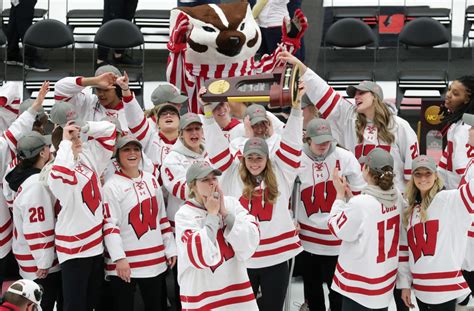
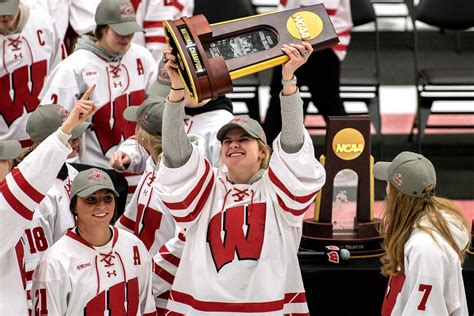
The University of Wisconsin-Madison women’s hockey team is synonymous with success. Winning is a tradition that UW women’s hockey has celebrated in every year of its existence and one that its alumnae continue well into their professional careers. On March 19, 2023, they shut out the Ohio State Buckeyes to secure the program’s seventh national championship, breaking the UW’s tie with the University of Minnesota to become the most decorated college women’s hockey program in the country.
On March 23, 2025, the Badgers defeated the Ohio State Buckeyes in the NCAA championship game at Ridder Arena in Minneapolis, Minnesota. Trailing 1-0 in the first period and 3-1 in the second, the badgers tied the game with 18.9 seconds in the third period thanks to a Kirstin Simms penalty shot. The penalty shot was awarded due to an Ohio State player closing her hand around the puck in the goal crease, and infraction uncovered after a video review that Laila Edwards advocated for to the Badger coaching staff.
But how did this legacy begin? Let's delve into the history of this remarkable program.
The Early Years: Laying the Foundation
In 1973, Marianne (Anderson) Larson, Jill Steinberg, and Karen Schwarz founded the UW Women’s Hockey Club as a haven for female students seeking ice time and a team to share it with. Badger Bob was also one of the earliest advocates for UW women’s hockey. He welcomed the athletes of the Women’s Hockey Club onto the ice after his team’s games in the Dane County Coliseum and secured interview spots for the women during radio broadcasts of the men’s games. When MacMillan arrived on campus in 1998, she practiced with the men’s team for a year while the women’s program laced up its skates.
The first UW women’s hockey team was established in 1999 and only three years old when Johnson took the reins, trying to build a program worth supporting. On October 8, 1999, the Minnesota Duluth Bulldogs played the Wisconsin Badgers in the first ever Women's WCHA conference game at the Kohl Center in Madison, Wisconsin. On July 9, 1998, Julie Sasner, then the head coach of the women’s hockey team at Cornell University, was announced as the first head coach of the Wisconsin women’s hockey program. Sasner left the UW after just one season and was succeeded by her assistant coach, Trina Bourget. Bourget led the Badgers to another third-place finish in 2000-01 and a tie for second in 2001-02 before also taking her leave. The young women’s hockey program needed stability in its leadership to match the strong performance from its players.
Read also: Perfect Red Snowboard Pants
“Our plan is to compete for a national championship within five years,” Sasner said at the outset of the first season.
The Wisconsin Women's Hockey Experience
The Mark Johnson Era: A Dynasty is Born
Mark Johnson ’94 didn’t need an introduction when he took over the role of head women’s hockey coach in 2002. He’d spent the previous six years as an assistant coach with the UW men’s hockey program, for which he’d played from 1976 to 1979. Prior to coaching, Johnson enjoyed a successful 11-year career with the National Hockey League (NHL). But before he, too, could be a great coach, the younger Johnson had to be a novice. His first head coaching gig marked his first experience coaching female athletes. The technical learning curve was minimal - “Hockey’s hockey,” he says - but he was quick to pick up on his new team’s desire to understand the purpose behind the directions he issued. Johnson became Wisconsin women’s hockey head coach in 2002, but NCAA hockey was nothing new to him even then.
Trust is a foundational pillar of Mark Johnson’s coaching strategy. “He’s a very hands-off coach,” says Abby Roque ’20, a Kazmaier Award finalist and WCHA Rookie of the Year and Player of the Year. She played for Johnson until her senior season was cut short by the pandemic in 2020. Hilary Knight ’12, who played in four NCAA championships with the Badgers and holds 12 program records, recalls a game during which she found herself shying away from shots after missing one in the previous period. “It was that simple,” Knight says. This instance is emblematic of one of the foundational pillars of Johnson’s coaching philosophy: trust. “He is always going to get the best out of players because of this mutual respect,” Knight says. “Once they have ownership of their team, then they’re going to play at a higher level,” Johnson says.
With Johnson at the helm, reaching this higher level didn’t take long. The Badgers first qualified for the NCAA tournament during the 2004-05 season. The following year, they claimed their first WCHA regular-season, playoff, and NCAA championship titles and defended all three in 2006-07. Johnson didn’t let up after that historic win. Johnson’s race to catch up to the likes of Minnesota-Duluth and Minnesota became clear, and a loss to Minnesota-Duluth in the 2008 championship final solidified it. Johnson stayed consistent in strong recruiting and built teams that wanted to win. Between 2008 and 2012, the team went on to compete in four NCAA championships under Johnson, winning two. The team missed the Frozen Four in 2003 and 2004, as they were still finding their footing and competing with teams that had already made names for themselves. Then, in 2005, Johnson took Wisconsin to the national quarterfinals. An incredible 36-4-1 record in the 2005-06 season brought the Badgers to the finish line. They beat Mercyhurst in the quarterfinals in double overtime and shut out St. Lawrence 1-0 in the semifinals. Johnson’s coaching style was built on years of collegiate, Olympic and professional hockey that has secured him 667 wins and eight national championship titles.
Read also: The Legacy of NESCAC Women's Hockey
Continued Success and Alumnae Achievements
The years since have brought five more first-place finishes in the WCHA and three more national titles. “Wins are fun, and it’s much better to win than lose, but when you see kids develop and then reach some of their goals that they set, that’s why we’re in the business,” Johnson says. “Are you learning life lessons as you go through your process? Only the legendary coach of one of the greatest hockey teams in NCAA history could ask such a question.
The University of Wisconsin Women’s Hockey team made history again. The team won its seventh national title on Sunday in a major upset, beating the Ohio State Buckeyes, the top ranked team of the season and the 2022 defending NCAA champions. The Badgers now lead Minnesota with the most national titles of all time in the Frozen Four. Notably, the game marked the first time all season Ohio State failed to score a goal. On Monday night, fans cheered on the team as they entered the LaBahn Arena in Madison to celebrate the historic win. More than 100 people came out decked in red and white to support the players. UW-Madison Chancellor Jennifer L. Mnookin made an appearance. Senior goalie Cami Kronish, recognized as the Frozen Four’s most outstanding player, received a standing ovation.“I can’t believe this is reality. I’m just the happiest person,” she told the crowd, thanking them for their support.
Many UW hockey alumnae were among the few girls - if not the only girl - on an all-boys team in their childhood hockey leagues. Roque spent her high school career getting ready in first-aid closets and public restrooms while her male teammates enjoyed the luxury of a locker room. The NHL may favor UW hockey alumnae in its administrative ranks, but not on their all-male rosters. This past August, just as collegiate athletes returned to campus and geared up for their seasons, the newly formed Professional Women’s Hockey League (PWHL) announced its six founding franchises in Boston, New York, Minneapolis/Saint Paul, Toronto, Montreal, and Ottawa (coached by UW hockey alumna Carla MacLeod ’06). On September 18, the first draft of the PWHL saw seven more Badgers enter the professional ranks. Kristen Campbell ’20, Jesse Compher MS’23, and Mellissa Channell ’17 joined Nurse and Turnbull in Toronto. Natalie Buchbinder ’23 and Sophia (Shaver) Kunin ’19 will play for Minneapolis/Saint Paul. “We [built] this for ourselves, but it’s going to be so much greater when this younger generation gets up to the pro level,” Roque says. “I’ve had so many little girls already say to me that they always wanted to be an Olympian, but now there’s a real pro league, too.
“Anyone who’s an alum [of the program] has pride in it,” says assistant coach and UW hockey alumna Jackie (Friesen) Crum ’06. With a legacy like this, who wouldn’t be?
Notable Alumnae Making a Difference
Knight is one of many UW hockey alumnae who continue to make history and forge new opportunities for pee-wee players and professionals alike. Anyone familiar with the 34-year-old hockey star’s résumé will understand just how much of a testament this is to her alma mater. She’s a four-time Olympian and a gold medalist who made her Olympic debut under Johnson in 2010. She’s competed in 13 International Ice Hockey Federation (IIHF) world championships with Team USA, taking home gold in nine. She led the Boston Blades of the now-defunct Canadian Women’s Hockey League to a Clarkson Cup victory in 2013 and later helped the Boston Pride of the National Women’s Hockey League (now the Premier Hockey Federation) win the first-ever Isobel Cup. But perhaps Knight’s proudest achievement is the work she’s put in off the ice to give back to the game she loves. In 2017, Knight and her teammates on Team USA, including captain and fellow Badger Meghan Duggan ’11, threatened to boycott the IIHF women’s world championship in response to stalled negotiations over equitable pay. She’s an executive committee member of the Professional Women’s Hockey Players Association, a nonprofit organization created in 2019 in response to dissatisfaction with compensation and operations in the Premier Hockey Federation. “You leave the UW wanting to change the world,” Knight says.
Read also: Is the Freedom Suit Worth It?
Duggan - a Kazmaier Award winner, three-time Olympian, two-time Team USA captain, and gold medalist - is the first director of player development for the NHL’s New Jersey Devils. She’s also the president of the Women’s Sports Foundation, an organization founded by tennis player Billie Jean King in 1974 to promote female involvement in sports. Sarah Nurse ’18, an Olympic gold medalist and two-time world champion with Team Canada, became the first woman to feature on the front of an EA Sports NHL video game when she donned her Canadian sweater on the cover of NHL 23. She’s also a vocal advocate for inclusivity in hockey. Abby Roque became the first Indigenous woman to compete in Olympic ice hockey for Team USA. And Roque, a world champion and member of the Wahnapitae First Nation, became the first Indigenous woman to compete in Olympic ice hockey for Team USA during the Beijing games in 2022.