The St. Louis Blues are a franchise in the National Hockey League’s (NHL) Western Conference. The Blues were founded in 1967 as part of the largest expansion effort in NHL history and made a significant impact on the league right out of the gate.
In 2019, led by a rookie goaltender, St. Louis made an improbable run to the playoffs that culminated in the team’s first championship in its history. Despite its early success on the ice, the team later faced financial difficulty and nearly relocated. St. Louis made the Stanley Cup Finals in its first three years of existence and made the playoffs nine times in its first decade. St. Louis did manage to regain its footing as a franchise, but went almost fifty years before returning to the Stanley Cup Finals.
St. Louis Blues | Road to the Stanley Cup 2019
The Early Years: Expansion and Stanley Cup Appearances
In 1966, the NHL consisted of six teams known as the Original Six. In 1967, the league began a period of expansion that saw its size double with the addition of six new teams. These franchises had made up the NHL since the league reorganized in 1942 and were located mainly in the northern and eastern United States. The new franchises included the California Seals, Los Angeles Kings, Minnesota North Stars, Philadelphia Flyers, Pittsburgh Penguins, and the St. Louis Blues.
The Blues were not one of the league’s original picks for admission. The owners of the Chicago Blackhawks, the Wirtz family, had insisted that St. Louis be given a franchise instead of Baltimore. The Wirtz family also owned the St. Louis Arena, the venue that would be used by the St. Louis franchise. Arthur Wirtz agreed to sponsor the new team in exchange for the purchase of the St. Louis Arena, and the NHL accepted the deal. They thought that St. Louis was an effective location for hosting a franchise, and that the influx of money brought in by a franchise would allow them to sell the arena for a profit. The team was named for the genre of music popular in the city, most specifically, a song by famous blues musician W. C. Handy called “St. Louis Blues.”
Read also: Deep Dive: Blues Jersey History
While hockey fans in St. Louis were at first slow to embrace the new team, the Blues’ initial success soon began attracting attention. The team advanced to the Stanley Cup Finals in its first year of existence-a rare feat in professional sports-before losing the series in four games. St. Louis also made the Stanley Cup Finals in 1969 and 1970, but lost both times.
From 1967 to 1971, the Blues were coached by future Hall-of-Famer Scotty Bowman, who would go on to win 1,244 career games-the most in NHL history-and nine Stanley Cups with several other franchises. By the 1970-1971 season, the Blues were regularly selling out home games and averaged the highest attendance of any NHL team.
Turbulent Times and Ownership Changes
Despite its initial success, the team’s fortunes began to change in the 1970s. While St. Louis continued to make playoff appearances-from 1967 to 1977, the team missed out only during the 1973-1974 season-many of those teams finished with a losing record and St. Louis began to lose fan support. A series of NHL realignments placed the Blues in a tougher division. In 1977, the Blues were sold to pet food giant Ralston Purina.
In 1980-1981, the Blues won a then-franchise record 45 games, but followed that up with three losing seasons. Ralston Purina announced in 1983 that it intended to sell the team to a Canadian company that planned to move it to Saskatoon, Saskatchewan. Still beset with financial difficulties. However, the NHL blocked the sale and instead sold the Blues to entrepreneur Harry Ornest, who kept the franchise in St. Louis.
For most of the remainder of the 1980s, the Blues were mired in mediocrity. They made the playoffs several times-albeit with average or losing records-but failed to make an impact in the postseason.
Read also: Understanding Blues Ticket Costs
Resurgence and the Gretzky Era
However, the team experienced a resurgence in the 1990s and early 2000s, finishing with a losing mark just once and making the Western Conference Finals in 2000-2001. During the 1995-1996 season, St. Louis briefly acquired superstar Wayne Gretzky, the greatest player in NHL history. Gretzky only played in eighteen games for St. Louis before leaving after the season.
The Road to the 2019 Stanley Cup
The Blues experienced a down period in the mid-2000s and early 2010s, making just one playoff appearance over that time. However, beginning in 2011-2012, the Blues embarked on the most successful era in the team’s history. From 2001 to 2018, the Blues won two division titles and advanced to the Western Conference Finals in 2016. The team also set a franchise record for wins with 52 in 2013-2014.
After missing the playoffs in the 2017-2018 season, the Blues looked like they were headed for another disappointing season in early 2019. On January 3, St. Louis had the worst record of any of the NHL’s thirty-one teams and had just fired their head coach. In December 2018, the team had brought up rookie goaltender Jordan Binnington, who was the fourth goalie on the Blues’s depth chart to begin the season.
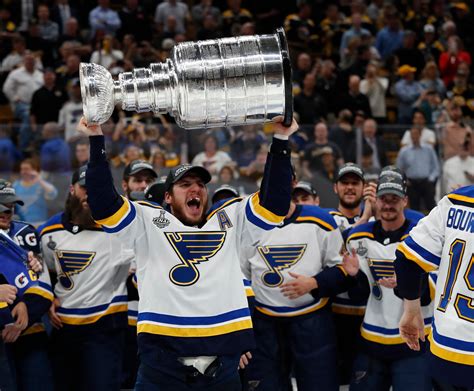
On January 5, Binnington shut out the Philadelphia Flyers and gave up just two goals in the next two games. Riding Binnington’s hot streak, the Blues finished out the season with a 30-10-5 record and earned a playoff berth. St. Louis dispatched Winnipeg, Dallas, and San Jose to move into the Stanley Cup Finals for the first time since 1970. Led by Binnington and playoff most valuable player Ryan O’Reilly, the Blues defeated the Boston Bruins to win the franchise’s first-ever Stanley Cup.
Team Identity and Ownership
Since the team’s founding, the Blues’s logo has remained relatively consistent. The logo is a blue musical note with a wing shape trailing away to the upper right. The original logo was outlined in yellow, while the modern version is outlined in yellow and white.
Read also: Gateway City Hockey
In 2012, St. Louis native Tom Stillman bought a controlling interest in the Blues for $180 million.
Notable Players
Several former Blues’s players have been inducted into the Hockey Hall of Fame, including some who only played a few seasons with the team during their careers. Hall of Fame goalie Grant Fuhr won four Stanley Cups with the Edmonton Oilers in the 1980s. Fuhr signed with the Blues before the 1995-1996 season, and spent four seasons with the team. Hall of Fame center Adam Oates played slightly more than two years of his nine-year career with St. Louis, but held the franchise record for averaging 1.47 points per game.
Defenseman Al MacInnis played for St. Louis from 1994-2004 and made two All-Star appearances with the team. In 1999, he won the Norris Trophy as the league’s best defenseman. His performance in St. Louis, combined with his thirteen years playing for Calgary, earned him a Hall of Fame induction in 2007.
Defenseman Chris Pronger played nine seasons with the Blues from 1995-2004. Pronger was a three-time All-Star and won the Norris Trophy in 2000. That same year, he also won the Hart Trophy, which is awarded to the NHL’s most valuable player. He entered the Hall of Fame in 2015.
Defenseman Alex Pietrangelo was drafted by the Blues in 2008 and was a part of the team’s 2019 championship squad. Pietrangelo has made two All-Star teams and, as of early 2020, was rising up the franchise leaderboard in assists and games played. Two-time All-Star goaltender Mike Liut, who played for the Blues from 1979-1985, holds the team mark for most wins in goal with 151. He also set the team record for most career goals saved with 9,165.
The argument for best all-time player in Blues’s history comes down to two players: Brett Hull and Bernie Federko. Hull, who played for St. Louis from 1988-1998, was a three-time All-Star and won the Hart Trophy in 1991. He holds the team record for most career goals with 527, and his career total of 741 stands fourth in NHL history. Hull is second on the Blues’s all-time assists list with 409 and in points scored with 936. A player earns a point for every goal scored or every assist made.
Federko played with St. Louis from 1976-1989. He holds the franchise mark for games played with 927, assists with 721, and points with 1,073. Hull was elected to the Hall of Fame in 2009 and Federko was enshrined in 2002.
Season Records
| Season | NHL | St. Louis Blues | Games Played | Wins | Losses | Overtime Losses | Points |
|---|---|---|---|---|---|---|---|
| 2024-25 | NHL | St. Louis Blues* | 82 | 44 | 30 | 8 | 96 |
| 2023-24 | NHL | St. Louis Blues | 82 | 43 | 33 | 6 | 92 |
| 2022-23 | NHL | St. Louis Blues | 82 | 37 | 38 | 7 | 81 |
| 2021-22 | NHL | St. Louis Blues* | 82 | 49 | 22 | 11 | 109 |
| 2020-21 | NHL | St. Louis Blues* | 56 | 27 | 20 | 9 | 63 |