This article delves into the history of two distinct ice hockey teams: the Cobourg Cougars Jr. and the Chicago Cougars, exploring their origins, achievements, challenges, and eventual fates.
The Cobourg Cougars Jr.
The evolution of the Cobourg Cougars Jr. began as members of the Eastern Ontario Junior ‘B’ Hockey League, rewarding their fans with an entertaining brand of hockey. However, with the passage of time and the graduation of key personnel, the Cougars’ organization experienced difficult times. In 1971, the Cougars joined the Central Ontario Junior ‘C’ Hockey League and were a force from the outset.
In fact, in 1974, the Cougars achieved what no other Cobourg OHA team had ever accomplished - winning the OHA provincial championship in its category. Following the ’78-79 season, Vern MacGregor (the most successful head coach in club history) vacated his post after eight years and handed over the head coach’s reins, as one decade ended and another began. Cougars experienced a down period for the next three seasons. Cougars responded with a first-place finish in the Central circuit with a 20-6-6 record.
They swept Beaverton Ice Hawks, erased Lindsay in five games and dethroned Bowmanville Eagles in seven games in the group final. However, in a bitterly contested provincial struggle, Cougars bowed to Gananoque G-Men, later found to have used over-age players. The OHA, in its infinite wisdom, ruled that Cobourg, Bowmanville, and Lindsay engage in a three-team, home-and-home round-robin. Of note, centre Gord Sharpe won the league scoring crown with 104 points, a Cougar record that still stands. Cougars placed third in the 1981-82 scheme of things with 25-10-1 long under the guidance of co-coaches Bryan Rose and Gus Bambridge.
Cobourg captain Dave Waldie was selected the league’s best player exemplifying leadership and sportsmanship. Up was the only direction Cougars could go in 1991-92 and that’s precisely what they did, climbing to the fourth spot with 20-13-1 credentials. They made a quick exit from playoffs though, lasting just five first-round games before capitulating to Bowmanville Eagles. While the Cougars endured slim pickings on the ice and at the box office during much of the second half of their Junior C days, there were still a plethora of players who shone during the club’s Junior C successes and struggles.
Read also: Features of Custom Hockey Gloves
Feeling that a change of scenery and a new challenge were necessary to restore interest and revive the franchise, the Cougars took a calculated gamble in 1992 and applied for entry into the Provincial Junior A (tier II) League. New president Rod Baker’s energy and leadership had a lot to do with Cobourg’s acceptance. The Cougars iced a vastly upgraded edition in 1993-94, improving to 17-20-3 for a sixth-place finish and a date with Markham Waxers in the first round of playoffs.
They dropped the first two games of the round but rebounded to take the next four, climaxed by a double-overtime win in game six, to win the series. That setback diminished though in the wake of the tragic death of 16-year-old defenceman B. J. Brian Drumm was hired as coach for the 1994-95 campaign and Cougars finished very strong after Christmas to wind up a solid fourth overall in the East Division. Two players, perhaps the most skilled ever to lace up the skates for the Cougars in the decade of Junior A, earned league accolades. Cougars hosted the Central Canadian Tier II Junior A championships for the Dudley Hewitt Cup spring of 1996, making it to the semi-finals.
The next two seasons proved to be trying ones, almost forgettable in fact, as they missed the playoffs both years. Things began to look up though with the return of Brian Drumm from the OHL to take on the job of head coach. Cougars finished eighth in 1999, fourth in the Eastern Conference in 2000 and fifth last season. As of mid-December of this season, Cougars appear headed for their highest finish ever in a decade of tier II Junior A competition thanks in large part to a 15-0-0 record at home and overall stats of 24-8-3, good for the second spot with 51 points. An additional bonus is a marked increase in local player content.
It is notable that the Cobourg Cougars are the only community-owned team in the East Conference that counts on several sponsors in order to remain fiscally viable in a small market. Notable players in Cougars’ 10-year existence as a Junior A entity include Andrew Clark, Simon Sherry, Doug Wright, Jason Colasante, Todd Aird, Tim Lacey, Barrie Pilgrim, Ryan Serra, Darryl Buttar, Dave Burroughs, Rob McLean, P.J. But enough of the past and present. The future awaits for the Cougars with new faces, new adventures, new challenges, new hopes.
In the Summer of 2010, the Cobourg Cougars merged hockey operations with the Bowmanville Eagles. This move eliminated their local competition for players and local fan base. The Cougars quickly disposed of the Kingston Voyageurs in seven games with four home-ice victories and were named the Central Ontario League Representatives. However, in the semi-finals of the provincial playoffs, the Cougars flirted with disaster Bradford Vasey’s 3-1 in games and behind by a goal in the waning moments of a do-or-die struggle at the Bradford bandbox.
Read also: The story of Craig Needham

Miraculously, they staged the mother of all comebacks inspired by the most famous goal in Cougar history. Terry Irwin triggered the life-saving goal with only three seconds left in regulation time to tie the score and send the game to OT, in which Cobourg prevailed. Although Simcoe proved to be a formidable opponent, the Cougars were not to easily overcome. They dropped the series opener but proceeded to churn out four straight wins, taking home the crown.
Captain Terry Lewis, the league’s scoring king with 88 points, added 71 points in group and provincial playoffs to cap a sensational year. Other heroes included Jim Flesch, Ron Fowler, Brian Connor, Paul Bevan, Terry Irwin, Randy Fife, Stu Watson, Bill Whitelaw, Pat Rutherford, Garth Beer, Alex Calder, Doug Choiniere, Bob Stevenson and John Pollock. Altogether, these classic Cougars regained the Central Ontario league title at the expense of arch-rival Lindsay Muskies. Then it was on to the provincial quarter-finals against Dunnville Terriers in what turned out to be an epic seven-game series.
The Chicago Cougars
The Chicago Cougars were a professional ice hockey team in Chicago. They competed in the World Hockey Association (WHA) from 1972 to 1975. The Cougars were a charter member of the WHA, owned by brothers Walter and Jordan Kaiser, owners of Lakeshore Health Spa. (The Kaisers would be briefly involved with World Team Tennis later.) The Kaisers owned the land in Rosemont and wanted to build a sports arena on it, following the example of Nassau Coliseum.
They saw getting a professional hockey team as a good way of getting that. The team's primary playing venue was the International Amphitheatre, located at 4220 South Halsted Street in Chicago's Stockyards district. Built in 1934 primarily for livestock exhibitions and political conventions, the arena had a seating capacity of approximately 9,000 for hockey games and was adapted with an ice surface for the Cougars' use. During the 1974 Avco Cup Finals against Gordie Howe and the Houston Aeros, the team's two home games were played at the Randhurst Twin Ice Arena in suburban Mount Prospect.
Just prior to their third season, the team was sold to Cougars players Ralph Backstrom and Dave Dryden, and player-coach Pat Stapleton after the original owners, Walter and Jordon Kaiser, were unable to secure funds to build a new arena. The land for the arena, originally named the O'Hare Sports Arena, was sold to the village of Rosemont and became the Rosemont Horizon (now the Allstate Arena). The Cougars were the first North American major professional hockey team to feature player numbers on the front of their jersey in the upper right corner.
Read also: Inside Aaron Ness's Career
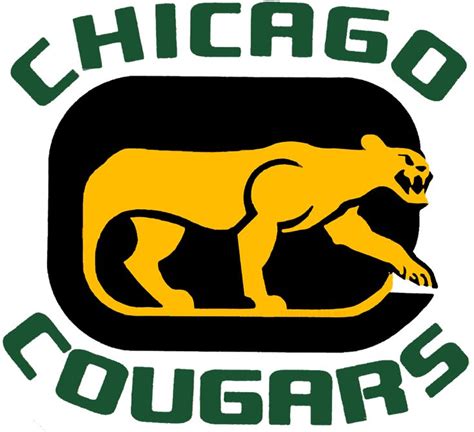
The next professional team to adopt this feature was the NHL's Buffalo Sabres in 2006, who continued to feature front numbers on their jerseys until 2020. The Chicago Cougars adopted a distinctive branding centered on a fierce cougar theme, reflecting the team's name and aggressive playing style in the World Hockey Association (WHA). The primary logo featured a yellow cougar in a prowling stance within a green rounded rectangle shaped like a "C," with the cougar's tail curving downward to form a hockey stick, symbolizing speed and power on the ice. Arched above and below the emblem in green lettering were the words "CHICAGO" and "COUGARS," rendered in a bold, italicized font to evoke motion and urban energy.
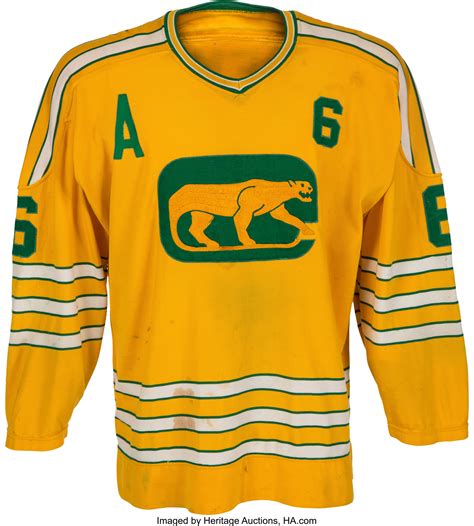
The team's official colors were gold (or yellow), green, and white, chosen to stand out under the arena lights and differentiate from the established Chicago Black Hawks' red, black, and white palette. A hallmark of the Cougars' uniform design was their pioneering placement of player numbers on the front of the jerseys in the upper right corner, making the team the first in North American major professional hockey to implement this feature for improved visibility from the stands and broadcast cameras. Home jerseys were white with green and gold trim, featuring the primary logo on the left chest in full color against a green "C" outline, sleeve stripes in alternating green and gold bands, and the innovative front number in green with white outlining.
Away jerseys reversed the scheme in a bright gold base, with white and green sleeve and waist bands, the logo in green and white on the left chest, and the front number in green. This bold, high-contrast look prioritized readability and flair, setting the Cougars apart from NHL contemporaries. The Cougars' adoption of front-placed numbers exemplified their embrace of WHA innovations aimed at modernizing the sport's presentation, influencing later uniform trends across professional hockey.
Seasons and Performance
The Cougars finished last in the WHA's Western Division during the season with 54 points. Team defense finished 8th overall with 295 goals against and dead last in team offense with 245 goals. The Cougars finished fourth in the Eastern Division with 81 points. They were seventh overall in goals for with 271 and sixth overall in goals against with 273. Pat Stapleton finished ninth in the league with 52 assists and Ralph Backstrom followed in tenth with 50. Larry Mavety finished tenth in the league with 157 penalty minutes. The Cougars would make their only postseason appearance that year.
In the Eastern Division semifinals, they upset the defending league champion New England Whalers, four games to three. In the divisional final, they defeated the Toronto Toros, four games to three, with the Cougars winning the decisive seventh game on Toronto ice, 5-2. Chicago would be hopelessly outmatched in the AVCO World Trophy Final against the Houston Aeros, though, who featured hockey legend Gordie Howe and his sons, Mark and Marty. The Cougars finished third in the Eastern Division and twelfth overall with 61 points.
They were tenth overall in goals for with 261 and twelfth overall in goals against with 261. Larry Mavety finished tenth in the league again with 150 penalty minutes but was traded to Toronto after playing 57 games with Chicago. The 1973-74 season represented a significant improvement for the Chicago Cougars, transforming them from league also-rans into playoff contenders in the World Hockey Association.
Guided by player-coach Pat Stapleton, a former NHL All-Star who joined from the Chicago Blackhawks, the team posted a 38-35-5 record, accumulating 81 points and securing fourth place in the tightly packed Eastern Division behind the New England Whalers (90 points), Toronto Toros (86 points), and Cleveland Crusaders (83 points). In the playoffs, the Cougars exceeded expectations with a pair of hard-fought upsets. As the fourth seed, they faced the top-seeded Whalers in the division semifinals and prevailed in seven games (4-3), showcasing defensive grit and timely scoring.
Advancing to the division finals against the second-seeded Toros-who had dispatched the Crusaders in six games-Chicago again pushed the series to its limit, winning 4-3 to earn their first-ever trip to the Avco World Trophy Finals. The Avco Cup Finals pitted the Cougars against the Western Division champion Houston Aeros, featuring Gordie Howe and his sons. Houston dominated the best-of-seven series with a 4-0 sweep, outscoring Chicago 22-9 across the games: 3-2 (Game 1), 6-1 (Game 2), 7-4 (Game 3), and 6-2 (Game 4). Despite the decisive defeat, the series highlighted Chicago's competitive edge, as they kept early contests close before Houston's offensive firepower prevailed.
Key to the Cougars' success were standout individual efforts, particularly from goaltender Dave Dryden and coach Pat Stapleton. Dryden anchored the net through all 18 playoff games, providing stability during the upsets with a goals-against average under 4.00 and key saves in high-pressure situations against New England and Toronto. Stapleton, serving as player-coach, led the defense with 58 points (6 goals, 52 assists) in the regular season and added 13 assists in the playoffs; his leadership earned him the Dennis A. Murphy Trophy as the WHA's top defenseman.
The 1974-75 season marked a sharp downturn for the Chicago Cougars in the World Hockey Association, as the team regressed from their Avco Cup finals appearance the previous year to finish with a record of 30 wins, 47 losses, and 1 tie, totaling 61 points. This performance placed them third in the Eastern Division, 31 points behind the playoff-qualifying Quebec Nordiques and well out of postseason contention. A pivotal midseason development occurred on December 28, 1974, when original owners Jordan and Walter Kaiser sold the franchise to players Ralph Backstrom, Dave Dryden, and Pat Stapleton amid escalating financial pressures.
This unprecedented player ownership arrangement, the first of its kind in major professional sports, aimed to stabilize operations but ultimately exacerbated fiscal challenges; the new owners were denied access to season ticket revenues held by the Kaisers and failed to secure external investment, straining team resources and limiting operational flexibility. The team retained core contributors such as Backstrom, who had 39 points in 70 games, and goaltender Dryden, who posted an 18-26-1 record with a 3.87 goals-against average, but overall depth suffered from the ownership transition and performance slump.
Attendance plummeted to an average of 3,168 per game across 39 home dates-down from 3,959 the prior season-reflecting waning fan interest and contributing to revenue declines that foreshadowed the franchise's imminent collapse.
Player Ownership and Financial Struggles
In late 1974, amid mounting financial losses exceeding $4 million over 2½ years, the Chicago Cougars' original owners, brothers Jordon and Walter Kaiser, sold the franchise just prior to the 1974-75 season. The buyers were a four-man group comprising player-coach Pat Stapleton, center Ralph Backstrom, goaltender Dave Dryden, and attorney Jeff Rosen, who served as the team's player agent and was appointed club president.
The sale, completed on December 27, 1974, was valued at approximately $2 million, following negotiations complicated by disputes over unpaid bills for arena rent, equipment, player salaries, and league dues. The deal's terms included significant involvement from the broader roster, with 14 players contributing to a collective investment of $350,000 ($25,000 each paid upfront)-with the balance financed through a bank loan, with players as co-signers-to support the purchase and ongoing costs. Backstrom emerged as a key leader in the investment effort, committing substantial personal funds alongside his teammates.
Control was structured through a player-formed corporation governed by a five-man board, including Backstrom and two other players, which oversaw business decisions while leaving day-to-day management intact. The transition provided short-term benefits, notably a surge in team morale as players felt a heightened sense of ownership and commitment, fostering unity amid the WHA's competitive pressures. However, challenges persisted, including strained funding from the initial investments and uncertainty over long-term financial stability, as the league itself grappled with instability.
Venue Disruptions and Playoff Atmosphere
In the 1974 World Hockey Association playoffs, the Chicago Cougars faced a significant venue disruption during their semifinal series against the Toronto Toros and the subsequent Avco Cup Finals against the Houston Aeros. The team's home arena, the International Amphitheatre with a capacity of approximately 9,000 for hockey, was booked for a production of Peter Pan starring Olympic gymnast Cathy Rigby, which melted the ice surface and rendered it unusable.
Beginning in 1974, the Cougars turned to Randhurst Twin Ice Arena in suburban Mount Prospect as a secondary or temporary facility to address logistical challenges at the Amphitheatre. This smaller rink, located adjacent to the Randhurst Shopping Center, accommodated around 2,000 spectators and hosted key games, including playoff matches during the 1973-74 season. This move drastically reduced attendance and altered the playoff atmosphere, with the intimate mall setting creating a stark contrast to the larger, more electric environment of the Amphitheatre.
Games at Randhurst drew crowds far below the Cougars' regular-season average of around 4,900, as the limited seating and unconventional location-complete with a catwalk-style public address system-dampened the spectacle for fans. Media coverage highlighted the absurdity of the situation, dubbing the Finals the "Supermarket Series" and emphasizing the surreal image of legendary player Gordie Howe competing in a mall rink. Local and national outlets, including The New York Times, portrayed the incident with a mix of humor and criticism, noting how the theatrical booking overshadowed the Cougars' on-ice efforts and symbolized the WHA's chaotic operations.
The Cougars adapted by leveraging the compact venue's intensity to upset Toronto in the semifinals, winning the series 4-2 despite the disadvantages, which briefly boosted momentum through fervent home support. However, in the Finals, the small arena failed to propel them further; an early controversial elbow by Howe on Cougars defenseman Larry "Moose" Mavety in Game 1 set a physical tone, and Houston swept the series 4-0, effectively ending Chicago's playoff run amid the venue's constraints.
Dissolution and Legacy
The Chicago Cougars were dissolved after the conclusion of the 1974-75 WHA season amid severe financial difficulties and the league's broader contraction, which saw several franchises fold due to unsustainable funding. Following the dissolution, the Cougars' roster was dispersed via a WHA dispersal draft in June 1975, allowing players to sign with remaining WHA teams or transition to the NHL. Numerous former Cougars, including defensemen like Pat Stapleton and forwards such as Rich Broadhead, joined NHL clubs, where they contributed during the league's expansion era in the late 1970s.
The last active player from the Cougars in major professional hockey was left winger Curt Brackenbury, who appeared in 141 NHL games across multiple teams and retired after the 1982-83 season with the St. The Cougars' collapse highlighted the perils of operating in NHL-saturated markets like Chicago, where competition from the established Blackhawks limited fan support and revenue, contributing to the WHA's overall instability.
The Cougars saw television on all three seasons on WSNS-TV. Brad Palmer was sole announcer the first season (of 7 away games), and was replaced by Red Rush afterwards (for 25 and 26 regular season away games, plus 4 away playoff games in 1974.) For the away games of the series vs Toronto Toros, the first two were on WFLD and the other two on WCIU. Radio was strictly home matches only all three seasons. Howard Balson and Lorn Brown or Bud Kelly provided the announcing. The Cougars made the playoffs only once, in 1974.
The Victoria Cougars
This article is about the professional Victoria Cougars ice hockey team that existed from 1911 to 1926. The Victoria Cougars were a major league professional ice hockey team that played in the Pacific Coast Hockey Association (PCHA) from 1911 to 1924 under various names, and (after the PCHA's merger with the Western Canada Hockey League) in the Western Hockey League (WHL) from 1924 to 1926. The original Victoria franchise of the PCHA, the Victoria Senators, were formed in 1911, and became the Victoria Aristocrats in 1915.
The Aristocrats challenged the Toronto Blueshirts for the Stanley Cup the following year, but lost. In 1916 the team was forced to move to Spokane, Washington, after having their arena (Patrick Arena) commandeered by the Canadian military. A new team was formed in 1918 and again were dubbed the Victoria Aristocrats, with players from the folded Portland Rosebuds. In 1922 they changed their name to the Victoria Cougars. Led by coach Lester Patrick, the Cougars won the Stanley Cup in 1925 against the Montreal Canadiens of the National Hockey League (NHL).
The Cougars were the last non-NHL team to hoist the Stanley Cup as well as the last west coast team to win it until the Anaheim Ducks did so in 2007. They attempted to repeat as champions in 1926 but they lost the final series to the NHL's Montreal Maroons. The WHL dissolved after the season. That spring, a group of businessmen from Detroit won an NHL expansion franchise and bought the rights to many of the players from the Stanley Cup finalist Cougars. The new NHL franchise adopted the nickname "Cougars" in tribute. After the series win, a new angled ring with the words "Won/By/'Cougars' Victoria, B.C. 1925" was added between the original bowl of the Cup and the original first ring of the base.
Here's a table summarizing key details about the Chicago Cougars' seasons in the WHA:
| Season | League | Record | Points | Division | Playoffs |
|---|---|---|---|---|---|
| 1972-73 | WHA | 26-50-2 | 54 | 5th, Western | Did not qualify |
| 1973-74 | WHA | 38-35-5 | 81 | 4th, Eastern | Lost in Avco World Trophy Final |
| 1974-75 | WHA | 30-47-1 | 61 | 3rd, Eastern | Did not qualify |